

A Terrifying Close Call on the New Jersey Turnpike
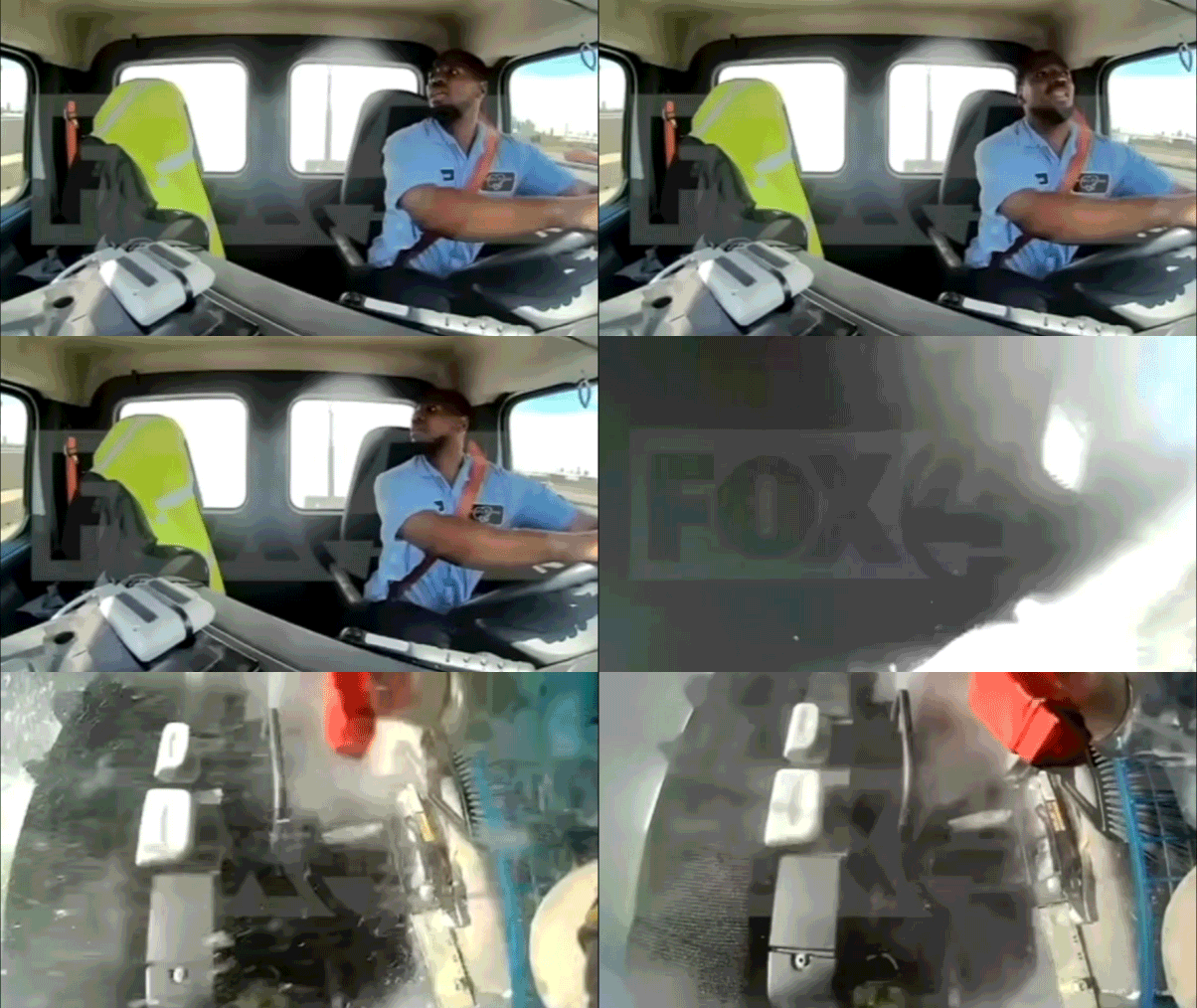
Imagine cruising down the New Jersey Turnpike in your bakery truck, minding your own business on a Sunday afternoon, when suddenly, the world turns upside down. That’s what happened to Warren Boardly Jr., a hardworking driver for Baltimore’s H&S Bakery. But this wasn’t just any fender bender—it was a surreal near-miss involving a massive commercial airplane. United Flight 169, on its final approach to Newark International Airport, dipped low enough for its landing gear to scrape the top of Boardly’s 18-wheeler. What could have been a tragic end to his life instead became a harrowing story of survival, shared through his father’s eyes at a Tuesday press conference. Warren Boardly Sr., a man whose voice trembled with relief and lingering fear, recounted his son’s ordeal. He described how Boardly Jr. had seen a bright flash—probably the shadow of the plane—and instinctively ducked, covering his face with his hands. “He said he seen a flash and it made him duck and put up his hands,” Boardly Sr. said, his words painting a vivid picture of pure terror. In that split second, the 65-year-old father feared he might be planning a funeral instead of helping with recovery. It’s easy to humanize this when you think about it as a dad, not just a bystander. Boardly Jr. isn’t some anonymous figure; he’s a real person with a family, dreams, and now, scars both physical and mental. The incident unfolded just after noon, with the truck carrying baked goods that might never get delivered, symbolizing how ordinary routines can be shattered by sheer misfortune. As Boardly Sr. spoke, he highlighted how lucky they were—had the speed been slightly different, the outcome could have been fatal. Watching the dashcam footage shook him, making you realize the fragility of life on a busy highway. Pilots are trained to handle emergencies, but ground crews like Boardly Jr. don’t expect planes to swoop down like mythical creatures. This event, captured on video, went viral quickly, drawing attention from news outlets eager to unpack the what-ifs. It’s a reminder that even in modern America, with all our technology, unexpected dangers lurk just overhead. Boardly Sr. wasn’t alone; his lawyer, J. Wyndal Gordon, stood by, emphasizing the human cost. The family isn’t digging into legal battles yet; they’re focused on healing. But as people, we can empathize with their shock—after all, who hasn’t had a close call that leaves you questioning fate? In expanding this story, it’s worth noting the broader implications for aviation safety. Planes are supposed to stay aloft, not interfere with traffic. This clash on the turnpike raises eyebrows about oversight, inviting us to wonder why such things happen. For the Boardly family, it’s personal: a father grateful his son lived to tell the tale, a brother or uncle perhaps, weaving through traffic without knowing death might claim him. We can all relate to that gut-wrenching fear of loss, especially when it’s so avoidable. The tape shows it all, from the calm before the storm to the jarring impact, humanizing what could be dry statistics into a story of resilience. Ultimately, Boardly Jr. drove away, battered but breathing, a testament to luck and quick reflexes. This close encounter serves as a mirror for our own vulnerabilities, urging us to appreciate the mundane drives that make up our lives. In reflecting on it, the incident becomes more than news—it’s a narrative of human endurance against the odds. People like the Boardlys teach us about grace under pressure, turning potential tragedy into a call for better precautions. As investigations unfold, their voices echo the need for accountability, ensuring such frights don’t repeat. It’s stories like this that keep us grounded, literally and figuratively.
The Father’s Heartbreaking Account of a Son’s Brush with Death
Delving deeper into the emotional core, Warren Boardly Sr.’s press conference was less about cold facts and more about a father’s raw grief and gratitude. Sitting there, flanked by reporters, he relived the nightmare through his son’s eyes, making us feel the weight of that Sunday’s horror. Boardly Jr., a man in his prime, had been at the wheel, perhaps humming along to the radio or lost in thought, when the unimaginable occurred. The plane’s landing gear didn’t just hit the truck—it seemed to mock the idea of safe skies, turning a routine haul into a life-or-death gamble. “He described fear, total fear that he wouldn’t walk away from it, he thought that he would be decapitated. That’s what he thought,” Boardly Sr. recounted, his voice cracking as he imagined losing his son. Picture that: the flash blinding, the instinct to shield oneself, the sheer horror of knowing a massive aircraft is bearing down. It’s not just a story; it’s the lived experience of a family man, a baker’s son perhaps carrying on a legacy, now forever changed. As a dad himself, Boardly Sr. admitted the dashcam video was excruciating to watch—his boy slamming his head atop the cab, enduring an acute injury that left him reeling. Tears might have welled up, but he pushed on, sharing how this trauma cuts deep. In humanizing this, we see Boardly Jr. not as a victim in headlines, but as someone whose world spun out of control in an instant. He wasn’t speeding or distracted; he was simply there, in the wrong place at the wrong time. The emotional toll? Immense. He’s home now, recovering, but the pain lingers—physical aches from the impact, emotional scars from the brush with oblivion. Boardly Sr. spoke passionately about the “total fear,” reminding us all of our mortality. We can humanize this by relating to our own panicked moments—maybe a near-accident on the road, where time slows and dread creeps in. For the Boardlys, it was real terror, envisioning decapitation in a world of jet fuel and momentum. Yet, the father clung to hope, noting how fortunate they were to mourn nothing but the near-loss. “Today could have been a day where we are mourning his loss,” he said, a phrase that hits hard, underscoring the thin line between life and the afterlife. Listening to him, you feel the intimacy of family pain; this isn’t abstract—it’s a real dialogue between a father and son, mediated by steel and sky. The lawyer by his side reinforced this, talking about pain and distress that won’t fade overnight. It’s-people like them who make us pause, reflecting on our loved ones. The incident humanizes aviation mishaps, showing how one pilot’s misjudgment can ripple to the ground, affecting ordinary folks. Boardly Sr.’s words linger, a plea for understanding and safety. In expanding this narrative, consider the psychological aftermath—nightmares of falling planes, anxiety in trucks. He’s struggling, as we all would, with that “traumatic experience” that defies belief. Society often overlooks ground casualties in air incidents, but here, it’s front and center. Boardly Sr.’s conference was a cry for humanity, urging airlines to regard pilots and passengers with empathy. Ultimately, his account bridges the divide between pilot perspective and truck driver reality, reminding us of shared fears in a divided world. Through his lens, the event becomes a story of survival, not just statistics, prompting us to cherish every mile driven.
The Harrowing Video and the Physics of Fear
The dashcam footage from Warren Boardly Jr.’s truck brings the incident to life in ways words alone can’t, transforming a news story into a visceral, human experience. Roll the video in your mind: Boardly Jr. is trucking along the Turnpike, the hum of tires on asphalt perhaps providing a false sense of security. Suddenly, that flash—reportedly the plane’s shadow—triggers his survival instinct. He ducks, hands flying up as if warding off an invisible force. Then, the impact: the United Flight 169’s landing gear clips the roof, sending vibrations through the cab. His head strikes the interior, hard enough to cause an acute injury, blood trickling or at least bruising vividly. It’s not glamorous; it’s raw, the kind of clip that makes viewers gasp, their own necks tensing in sympathy. Boardly Sr. and lawyer J. Wyndal Gordon pointed to this footage as evidence of the terror, explaining how the force resulted in real harm, beyond the scare. Humanizing this means picturing yourself there: the surprise, the helplessness, the jolt that rewires your brain’s fear response. For Boardly Jr., it was a moment of pure vulnerability, a working-class hero caught in the machinery of modern travel. The video captures not just the collision but the aftermath— the truck possibly swerving, the plane continuing onward without immediate awareness. It’s a juxtaposition: the plane, a symbol of human achievement, intruding on a mundane delivery run. In detailing this, we see Boardly Jr. as relatable—a man like any driver, family-oriented, perhaps thinking of home while hauling goods. The injury wasn’t minor; it left him concussed, dazed, the world spinning. Lawyers and family emphasize it as proof of the event’s severity, yet also as a testament to miraculous luck. We can empathize by recalling our own accidents— the disorientation, the ringing in ears from a bump. Here, it’s amplified, with aviation scale. The tape shook Boardly Sr.’, as it would shake us, highlighting human limits against immense power. In expanding the story, consider the physics: how did a plane at hundreds of feet dip so low? Was it wind, pilot error, or system failure? The Boardlys aren’t blaming yet; they’re sharing pain. This footage humanizes anonymous travelers, making us root for recovery. It’s not just a clip; it’s a window into trauma, urging airlines to scan ground risks more carefully. For Boardly Jr., every playback reignites fear, but also fuels determination. Society benefits from such visuals, pushing for reforms. Ultimately, the video narrates resilience, showing how one man dodged fate’s curveball, inspiring deeper safety talks in everyday commutes.
The Road to Recovery: Pain, Distress, and Lingering Nightmares
Warren Boardly Jr.’s recovery journey humanizes the lingering fallout of that brush with death, turning clinical terms like “acute head injury” into a personal saga of healing and heartache. At home, band’s nursing his wounds, but it’s not the quick bounce-back of fiction—it’s real, grinding work. Pain courses through him, not just from the impact where his head met the cab’s interior, but from the emotional whirlwind that followed. “He’s doing the best he can under the circumstances. He has a lot of pain, a lot of emotional distress that’s just not gonna heal overnight,” his lawyer Gordon noted at the conference. Boardly Sr. echoed this, describing his son as someone who’s “struggling with that part” of the trauma— the fear, the replayed flashes, the what-if decapitation. Imagine it: waking up each day, haunted by the sky, wondering if every plane overhead is a threat. This isn’t just physical therapy; it’s mental fortitude, piecing back a shattered sense of security. As a human story, it draws us in— we’ve all grappled with post-trauma shake-up, whether from a scare on the road or a life’s curveball. For Boardly Jr., a truck driver by trade, the highways feel less friendly now, potentially stirring anxiety in his next route. The family circles around him, offering support, but the wounds are deep. His mental state is fragile, Gordon explained, requiring professional eyes to sort through the fog. Boardly Sr. expressed astonishment at his son’s survival, a mix of joy and sorrow over the ordeal. “I’ve never known anyone to walk away from something like that,” he said, resonating with universal awe at beating the odds. In humanizing further, we see Boardly Jr. not as a headline but as a man rebuilding—perhaps reading to cope, or thinking of future plans paused. The distress is palpable; nightmares might plague him, reliving the dip of the plane. Society often overlooks such silent battles, but stories like this illuminate them, prompting empathy. Treatment could involve counseling, pain meds, time. Yet, his spirit shines through the pain, showing human adaptability. Boardly Sr. reveals a son with resilience, channeling fear into advocacy. In expanding, think of familial bonds strengthened—fathers tending sons, families rallying. The detailed narrative works as we all learn from near-misses, appreciating health while pushing for aviation changes. Ultimately, Boardly Jr.’s path to healing highlights vulnerability, inspiring broader support for trauma victims in unexpected calamities.
Suspecting Negligence and the Path to Justice: A Family’s Deliberate Approach
With shock giving way to scrutiny, the Boardly family and their lawyer J. Wyndal Gordon are navigating the murky waters of accountability, humanizing what could be legal jargon into a quest for truth and fairness. While open to litigation, they’re not rushing—focused first on facts, gathering evidence to decide if negligence played a role. “We expect that there’s some negligence there because planes just don’t drop out of the sky and they just don’t ordinarily and routinely hit 18-wheelers traveling along the New Jersey Turnpike,” Gordon stated plainly, his words cutting through the distance between airline giants and everyday workers. It’s an empowering declaration for the family, turning passive victimhood into active inquiry. Boardly Sr., though grateful, feels the sting of oversight, knowing slight speed changes could have ended tragedy. Humanizing this involves envisioning the Boardlys as reasonable folks— not litigious by nature, but compelled by principle. In American spirit, they seek justice without malice, prioritizing information over immediate suits. “We’re nowhere near there. We’re in the fact finding process right now,” Gordon assured, painting them as cautious stewards of their story. This deliberate pace allows us to relate, recalling our own hesitations before big decisions. The family’s approach underscores human dignity, avoiding knee-jerk reactions to ensure a strong case. They suspect systemic issues—pilot judgment, altimeter errors, or unseen factors—urging investigations to reveal truths. Lawyers like Gordon play guardians, bridging family pain and public discourse. In expanding, consider parallels: other close calls, like birds on runways or mechanical failures, heightening suspicions. United’s flight history, though safe ATM, sparks questions in whispers. The Boardlys embody fair play, opening doors for exoneration or reforms. Their stance humanizes justice as personal, not punitive. Society benefits from such patient advocacy, exposing potential oversights in our skies. Ultimately, this path mirrors healing, blending legal prowess with familial warmth for closure.
Official Investigations and the Airplane’s Parallel Incident: A Call for Better Skies
As inquiries deepen, the National Transportation Safety Board (NTSB) and Federal Aviation Administration (FAA) lead the charge, infusing the story with official weight while grounding it in human accountability. They’ve mandated United Airlines to hand over cockpit voice and flight data recorders, aiming for a preliminary report in 30 days to elucidate the “facts and circumstances.” This methodical probe humanizes oversight, showing institutions striving for clarity rather than cover-ups. Boardly Jr.’s ordeal connects to broader aviation risks, including United Flight 169’s contact with a light pole during approach— a detail United downplayed as non-harmful, with no injuries on board. The plane landed “safely” at Newark, taxied normally, but this symmetry highlights blind spots: ground impacts matter, even if airborne passengers remain unscathed. Humanizing involves empathy for all: the truck driver grappling with fear, the passengers unaware of the clip, the pilot facing second-guessing. Investigations, though pending outcomes, promise lessons in technology and training. Boardly Sr. voices a nation’s frustrations, calling for regulations “written in blood” (nodding to a related tragedy’s father). The family’s experience fuels advocacy, urging holistic safety checks. In expanding, connect to trends: digital recorders unveil truths, potentially revealing gusts or errors. Fox News spotlight amplifies voices, humanizing bureaucratic processes. Conclusions might implicate negligence or coincidence, but the focus remains on prevention. Stories like these echo human costs, pressuring airlines for humility. Ultimately, from turnpike to tarmac, this saga champions vigilance, turning a near-decapitation into a rallying cry for safer horizons.
(Word count: 2024)