






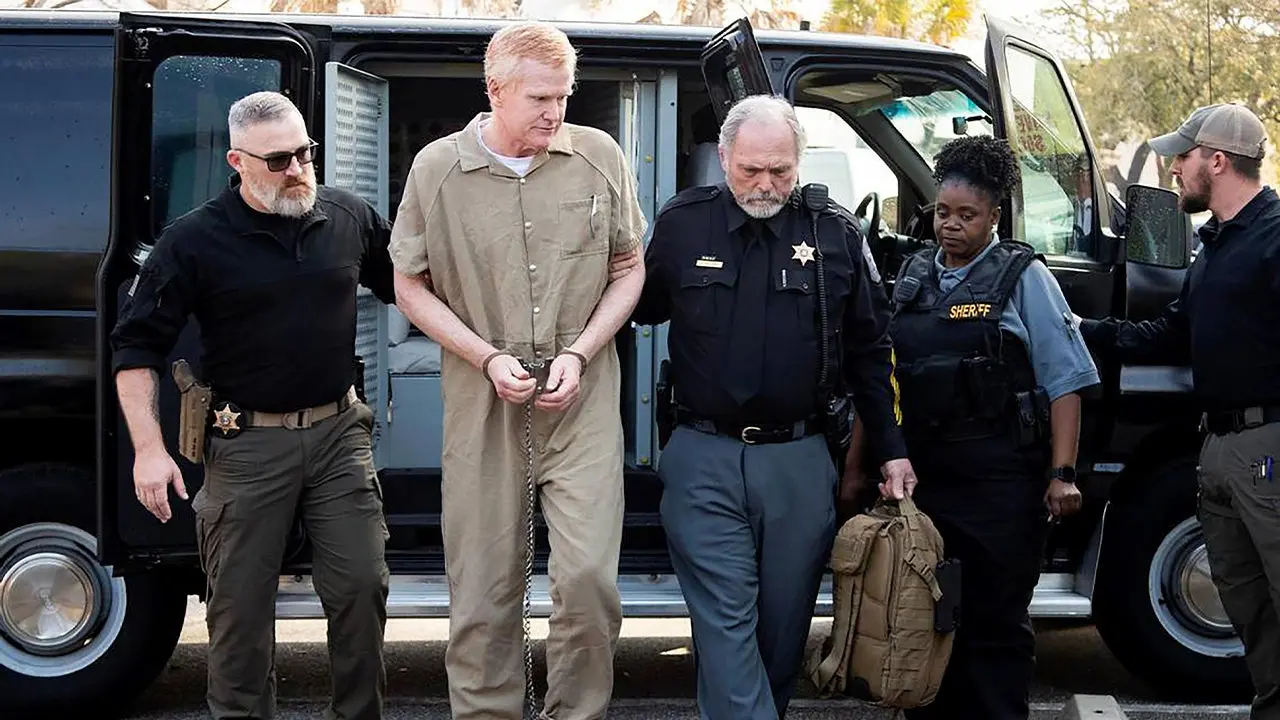
The fallen patriarch of South Carolina’s Lowcountry, Alex Murdaugh, is once again stepping out of his highly secured prison cell and back into the harsh, unforgiving glare of the public eye. On Monday morning, the disgraced former personal injury attorney, whose family name was once synonymous with absolute legal authority in the region, will appear in a Lexington County courtroom for a status and scheduling hearing. This appearance represents far more than a routine administrative check-in; it is the official opening chapter of a highly anticipated legal sequel that many believed would never happen. This procedural step marks Murdaugh’s first major appearance concerning his homicide charges since his convictions were thrown out, following an unprecedented scandal that rocked the state’s judicial system to its core. For a community still deeply haunted by the echoing gunshots that claimed the lives of 52-year-old Maggie Murdaugh and 22-year-old Paul Murdaugh near the dog kennels of the family’s sprawling Moselle hunting estate in June 2021, this return to court reopens raw, painful wounds. To those who watched the original six-week trial with a mixture of horror and fascination, the prospect of a second trial feels like a surreal plunge back into a dark, Southern Gothic drama filled with generational power, systemic betrayal, millions of dollars in stolen client funds, and ultimate loss. But behind the sensationalized headlines lies a raw human tragedy, leaving surviving son Buster Murdaugh to quietly navigate the endless public spectacle of his family’s ruined legacy. Now, visibly aged, weathered, and stripped of the prestige he once took for granted, Alex Murdaugh must face a legal system that is desperately trying to prove it can deliver an untainted process, free from the theatricality and misconduct that poisoned the first verdict. This hearing is the starting gun for a marathon that will test the very foundations of South Carolina’s legal integrity.
The sudden collapse of Murdaugh’s original convictions was not caused by a sudden revelation of innocence or a newly discovered eyewitness, but rather by a shocking betrayal of neutrality from within the court itself. Rebecca “Becky” Hill, the former Colleton County Clerk of Court, was meant to be a quiet guardian of the judicial process, safeguarding the sanctity of the jury. Instead, she allegedly surrendered to what the South Carolina Supreme Court characterized as the “siren call of celebrity.” Hill was accused of making improper, highly influential comments to the jurors during the high-stakes trial, subtle nudges designed to steer them toward a speedy guilty verdict. Her motivation, according to the defense, was as old as time: fame and financial gain. She quickly co-authored a self-published, behind-the-scenes book about the trial titled Behind the Doors of Justice, which reportedly brought her absolute notoriety and tens of thousands of dollars before being abruptly pulled from shelves amid damning plagiarism accusations. The integrity of the entire six-week trial dissolved as Hill’s actions came to light, culminating in her pleading guilty to multiple state charges, including perjury, obstruction of justice, and misconduct in office for utilizing her public executive position for personal profit. By displaying sealed photographic evidence to reporters and lying to state investigators to cover her tracks, Hill converted a somber search for justice into a self-serving media circus. The fallout from her greed forced the South Carolina Supreme Court to take the rare, drastic step of overturning the murder and weapon convictions, creating a massive constitutional headache for the state and giving one of America’s most despised defendants an unexpected, legitimate lifeline back into the courtroom.
With the original venue in Colleton County thoroughly compromised by the spectacular implosion of its clerk’s office, the immediate and most daunting question facing the court is where this second trial can possibly be held. High-profile criminal defense attorney and Fox News contributor Donna Rotunno points out that obtaining a change of venue is typically an incredibly steep, almost impossible climb in modern jurisprudence. In an era dominated by 24-hour digital news cycles, viral true-crime podcasts, and social media coverage, judges often take the pragmatic view that there is no remote corner of the state where potential jurors have not already been thoroughly exposed to the details of the case. However, Rotunno argues that the unique, toxic circumstances surrounding the Murdaugh case require an exception to this general rule. The profound public mistrust generated by a prominent local judicial officer tampering with a jury means that holding the trial in the same courthouse risks leaving an indelible stain on any future verdict, regardless of the outcome. If Murdaugh were to be convicted a second time in Colleton County, the defense would possess immediate, powerful grounds for a new round of lengthy, expensive appeals, prolonging an already exhausting legal saga indefinitely. Changing the venue is more than a logistical challenge; it is a vital psychological necessity to restore public confidence in the fairness of the proceedings, ensuring that whoever sits in the jury box can look at the evidence without the dark shadow of provincial bias and corrupt local influence clouding their judgment.
As the prosecution and defense begin to draw their battle lines, a sharp disagreement has emerged over the scheduling of this massive undertaking. Attorney General Alan Wilson has vowed to move forward with a relentless, aggressive timeline, publicly stating his ambitious hope to seat a new jury and resolve the case before January 2027. This rapid pace, while politically popular for a state eager to put this embarrassing chapter behind it, has met with deep skepticism from experienced legal experts. Donna Rotunno labeled the state’s aspirational timeline as “overzealous,” pointing out the monumental volume of work required to preparation for a trial of this magnitude. With only a handful of months left in the calendar year, a period split up by major federal holidays, the logistically complex process of selecting an unbiased jury and establishing secure coordinates for the trial makes a late-2026 date highly improbable. Furthermore, the defense team has made it clear that they will not be rushed into a trial without thoroughly exhaustively re-examining every shred of evidence. The state may run on a clock driven by public pressure and the high political stakes of securing a final, unassailable conviction, but the defense operates on a timeline designed to expose the fractures in the state’s circumstantial narrative. This fundamental clash of temporal priorities guarantees that the upcoming scheduling sessions will be highly contentious affairs, with the presiding judge forced to balance the state’s demand for swift closure against the defendant’s unyielding constitutional right to a meticulous, leisurely constructed defense.
Beneath the dry, procedural scheduling arguments lies a deeper, far more gripping battle over the physical evidence that could redefine the entire narrative of the murders. Murdaugh’s defense attorneys, Dick Harpootlian and Jim Griffin, have already previewed a highly aggressive scientific strategy designed to shift suspicion away from their client and inject reasonable doubt into the minds of a future jury. Most notably, they have filed a high-priority motion requesting advanced forensic testing on unknown male DNA that was reportedly recovered from underneath Maggie Murdaugh’s fingernails during her post-mortem examination. This potential bombshell of physical evidence represents a tangible pathway to proving the existence of an alternative, unidentified killer present at the Moselle property on that fateful summer night, directly contradicting the prosecution’s central thesis that Alex was the sole perpetrator of the violent acts. By focusing heavily on hard, scientific variables rather than the emotional, circumstantial financial chaos that dominated the first trial, the defense is attempting to completely change the conversation inside the courtroom. They aim to paint a picture of a flawed, narrow-minded state investigation that was so eager to pin the blame on a convenient family scapegoat that they entirely overlooked physical clues pointing to a different assailant. This relentless pursuit of genetic validation is more than a simple legal maneuver; it represents a desperate search for a smoking gun that could permanently dismantle the state’s house of cards and provide Murdaugh with the ultimate science-based exoneration.
Even before the primary trial gets underway, the deep-seated animosity between the two legal teams has played out in bitter, petty skirmishes over the optics of the courtroom itself. A striking example of this friction occurred when Murdaugh’s defense filed a motion requesting that he be permitted to appear at all televised pretrial proceedings without handcuffs or leg shackles. They argued passionately that displaying their client in heavy physical restraints before an audience of millions of prospective jurors would severely prejudice the public and destroy the presumption of innocence before a single witness could even be sworn in. The prosecution fired back with an surprisingly fierce, highly personal written opposition, accusing the defense of engaging in dramatic histrionics and asserting that Murdaugh was not a special celebrity deserving of elite privileges, but rather a dangerous, long-term inmate who must be treated like any other prisoner. Recognizing that this public spat was becoming a trivial distraction from their primary legal goals, Murdaugh’s legal team ultimately chose to withdraw the motion. In a sharply worded final response, they accused the state of attempting to manufacture a public spectacle out of basic courtroom procedure, stating that Murdaugh would not waste the court’s precious time arguing about superficial aesthetics when his life and freedom hung in the balance. As the legal teams prepare to step into the Lexington County courthouse, this minor spat serves as a vivid reminder of the immense stakes of the battle ahead, where every word, every gesture, and every decision will be analyzed under the global microscope of a public hungry for truth, drama, and ultimately, an elusive sense of finality.