



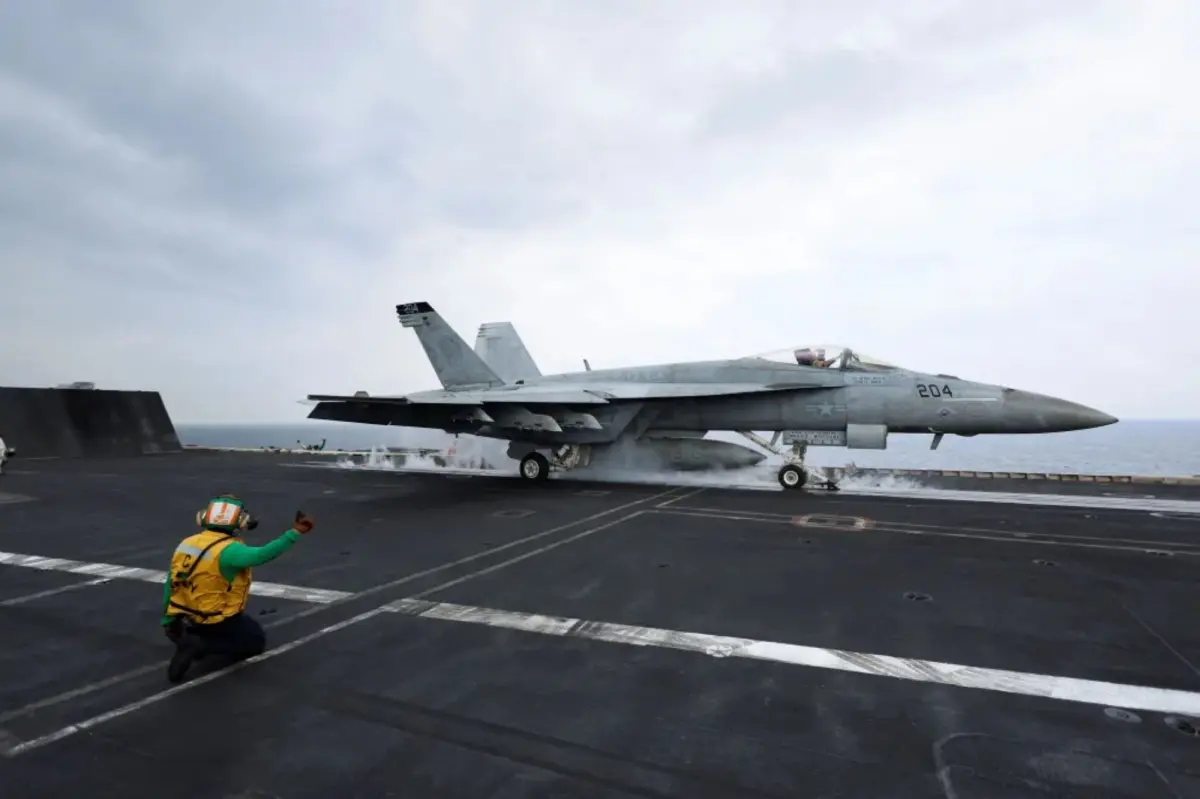
On the morning of what should have been just another routine landing, the sky over the Atlantic off the Virginia coast held a scene of controlled chaos. The USS Dwight D. Eisenhower, a massive nuclear-powered aircraft carrier, was moving steadily through the waves, its flight deck a humming, roaring city of metal and motion. Aircraft returning from missions lined up in the sky, each waiting for its turn to touch down on a runway that was never truly still. For the two U.S. Navy aviators in the cockpit of their two-seater aircraft, the approach must have felt familiar—a practiced sequence of checks, radio calls, and adjustments that they had performed countless times before. But then, in the space of a heartbeat, the familiar turned terrifying. As they were landing, something went wrong. The plane was not going to make it safely onto the deck, and the aviators made the split-second decision that every pilot hopes never to face. They ejected. The seats fired, the canopy shattered or detached, and the two men were hurled upward and away from their stricken aircraft, their parachutes opening over the cold, gray water below. On the ship, sailors who had been watching the recovery operation suddenly found themselves in the middle of an emergency. The sound of alarms and urgent shouts replaced the normal rhythm of landing operations. Four of those sailors were injured in the chaos that followed. It was a moment of violence and fear, a stark reminder that even the most routine carrier landing carries enormous risk.
The Navy described the event with the understated language that military organizations often use for such moments: a “mishap occurred during aircraft recovery operations.” In a short, careful statement, officials confirmed that the two aviators, assigned to Carrier Air Wing 3, successfully ejected and were rescued by search and rescue personnel. These are the men and women who train for exactly this scenario—the rescue swimmers, the helicopter crews, the lookouts who scan the water for a splash and a parachute. Within moments of the aviators hitting the water, the rescue machinery of the Navy swung into action. Both pilots were plucked from the sea and brought back aboard the Eisenhower, where they were handed over to medical personnel for evaluation. They were alive, breathing, and in the care of their shipmates, but the ordeal was far from over. Aboard the ship, the four injured sailors were also receiving medical care. One of them was serious enough to require transport to a hospital in the Norfolk, Virginia, area, though the Navy was quick to note that the injuries were not life-threatening. The statement left many questions unanswered. The Navy did not disclose which type of two-seater aircraft was involved, nor what happened to the plane after the ejection, nor what might have caused the accident. Requests for additional details were met with silence, at least for now. In the fog of an ongoing incident, the priority was clear: take care of the people, recover the facts, and only then tell the full story.
To understand the weight of what happened that Monday, it helps to understand the vessel at the center of it. The USS Dwight D. Eisenhower is a Nimitz-class nuclear-powered aircraft carrier, a floating city of nearly 100,000 tons and more than 5,000 personnel. It was commissioned in 1977, and over the decades it has become one of the most recognizable symbols of American naval power. Named after the Supreme Allied Commander in Europe during World War II and later the 34th President of the United States, the ship carries with it a legacy of service, sacrifice, and strength. On its flight deck, aircraft launch and recover around the clock during operations, and every launch and recovery is a choreographed dance between pilots, flight deck crews, air traffic controllers, and dozens of other specialists. The sailors who work on the flight deck wear colored jerseys that mark their roles—some handle munitions, some fuel, some maintenance. They work within inches of jet engines and propellers, in all weather, day and night. For them, a landing is not just a pilot’s achievement; it is a team effort where everyone has a job, and every job matters. The four sailors injured in this mishap were part of that team. Their injuries may have been physical, but the experience of watching an aircraft crash or abort in front of you, of feeling the ship shudder and hearing the alarms, leaves its own mark. They are not just anonymous names in a report; they are sons and daughters, husbands and wives, friends and mentors. They are people who chose to serve, who stand on a moving runway in the middle of the ocean, who do their duty even when fear is present. The aviators, too, are more than just pilots. They are part of Carrier Air Wing 3, a community of aviators and support personnel who train together, deploy together, and rely on one another with a trust that is almost impossible to describe. When they ejected, they were not just saving themselves; they were acting on the training and instincts that the Navy has spent years instilling in them.
The human dimension of this story extends far beyond the flight deck. Somewhere in Virginia, or perhaps elsewhere in the country, there are families waiting for news. Spouses, parents, children, and friends know that their loved ones are at sea, and they know that the work is dangerous. They have learned to live with the tension of being proud and worried at the same time. When a mishap occurs, that tension turns into a specific, chilling anxiety. A phone call that comes at an unusual hour, a message from the command, a news alert that mentions a carrier and an accident—these are the moments that make military families feel the weight of their loved one’s service. The Navy’s statement, short and factual, is also a lifeline for those families. It tells them that the aviators are alive, that they have been rescued, and that the injured sailors are receiving care. It does not tell them everything, but it tells them enough to breathe. In the hours and days that follow, the emotional aftermath will unfold quietly, away from the cameras. The aviators will sit with medical staff and flight surgeons, their bodies checked for the trauma of ejection, their minds replaying the sequence of events. The sailors will be treated for their injuries, and their shipmates will check on them, bring them meals, and sit by their beds. The broader crew of the Eisenhower will do what military communities have always done in the wake of a mishap: they will process the fear, support one another, and prepare to go back to work. There will be laughter in the mess decks again, and the normal rhythms of shipboard life will slowly resume. But no one aboard that ship will forget the moment when the sky turned violent and the ocean reached up to claim what it was owed.
The Navy’s response to this mishap will now follow a well-established path. First and foremost is the care of the people involved. The aviators are being evaluated, the injured sailors are being treated, and everyone affected will have access to the medical and psychological support they need. This is not just a matter of protocol; it is a recognition that the human cost of a mishap can outlast any physical injury. After the immediate response comes the investigation. The Navy will convene a thorough review to determine exactly what happened, why it happened, and what can be done to prevent it from happening again. The term “mishap” is deliberately broad, used by the Navy to describe an unplanned event that may involve equipment failure, human error, environmental factors, or some combination of these. At this stage, no one knows which of those factors played a role. Investigators will examine the aircraft, if it can be recovered, along with maintenance records, flight data, training histories, and the testimony of the aviators and witnesses. They will look at the weather, the condition of the ship, the timing of the landing, and a hundred other details. The process can take weeks or months, and it is designed not to assign blame, but to learn. In the unforgiving environment of naval aviation, every mishap is a lesson waiting to be understood. The Navy has a long and proud history of using accidents to make flying safer, of taking a tragic event and extracting from it the knowledge that saves lives decades later. This incident, though frightening, may ultimately contribute to that ongoing effort. But in the immediate aftermath, the focus is simpler and more human: a crew recovering from a shock, a ship pressing forward, and a Navy counting its blessings that the outcome was not worse.
As the sun set over the Atlantic on the evening of the mishap, the USS Dwight D. Eisenhower continued on its mission. The flight deck, once again calm, bore the scars of the day’s events, but the ship itself remained steady, a reminder of the resilience that defines the naval service. The two aviators, safe in their bunks or in the infirmary, had been given a second chance. The four injured sailors were on the road to recovery. And the thousands of other men and women aboard the carrier were left with the quiet understanding that they had come face to face with the danger that is always present, even on the most ordinary days. They know that the sea is indifferent, that the machines they depend on are imperfect, and that the margin between success and catastrophe can be measured in seconds and inches. They know this, and yet they choose to serve. They choose to fly, to launch, to recover, to stand on the flight deck with the wind in their faces and the roar of engines in their ears. They do it because they believe in something larger than themselves, because they are part of a team, because they have made a commitment to protect their country and one another. The mishap off the coast of Virginia was a reminder of the price that commitment can demand. It was also a reminder of the extraordinary courage that so often goes unnoticed in the daily operations of the Navy. In the days ahead, the investigation will continue, the questions will be answered, and the Navy will learn what it can from this moment. But for now, the story is one of survival, of skill, of the bond between aviators and sailors, and of the fragile, precious nature of life. They were lucky. They know that. And so do we.