







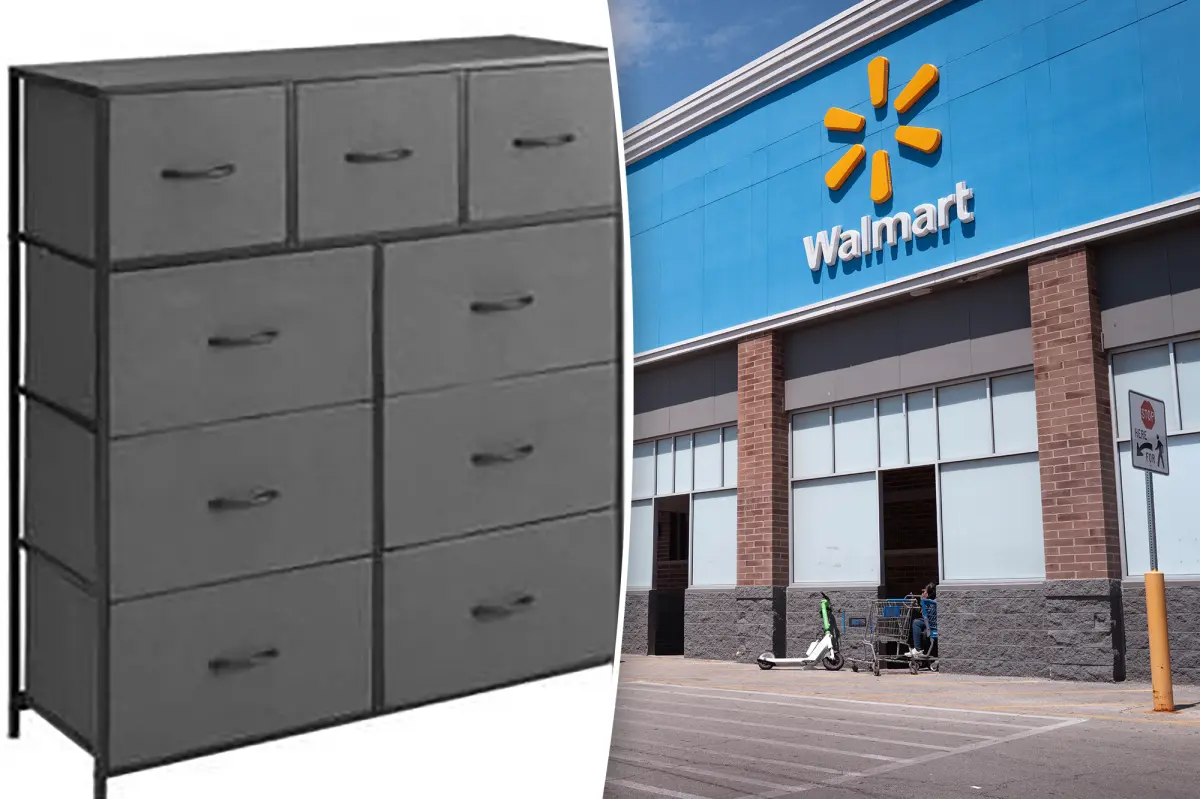
For any parent or caregiver, the home is envisioned as a sanctuary—a safe, nurturing space where children can explore, play, and grow without facing the unpredictable dangers of the outside world. We carefully select the items that fill our living spaces, constantly balancing our tight household budgets with the desire to create an aesthetic, comfortable, and functional environment for our families. However, this hard-won sense of domestic peace has been deeply unsettled by the recent news that retail giant Walmart is recalling a highly popular, budget-friendly piece of furniture: the Mainstays 9-Drawer Fabric Dresser. In an announcement that has quickly reverberated through thousands of households across the nation, federal safety regulators revealed that approximately 165,000 units of this widespread storage piece are currently being recalled due to a severe tip-over hazard that threatens the lives and physical safety of young children. When we purchase everyday furniture items, we do so with an implicit, built-in trust that these heavy structures are fundamentally stable, thoughtfully engineered, and manufactured to withstand the energetic and curious nature of toddlers. Yet, the Consumer Product Safety Commission has made it painfully clear that these specific fabric dressers pose an unacceptable risk of tipping over and trapping young children underneath their combined weight if they are not securely anchored to a wall. This sudden revelation transforms a routine, helpful home organizer into a silent, looming threat, sparking a natural wave of anxiety among parents who bought the product to simply organize their children’s clothing, toys, and blankets. The recall serves as a sobering reminder of the invisible hazards that can lurk within our living spaces, urging us to look more closely at the objects we surround ourselves with and reevaluate the fragile balance between affordable home styling and the uncompromising demands of child safety.
The formal, clinical vocabulary used in official government safety warnings—words like “unstable,” “entrapment,” and “hazard”—often sanitizes the terrifying, visceral reality of a furniture tip-over incident. To truly understand why this recall is so incredibly critical, we must look at how young children organically interact with their physical environments. To an eager toddler, a chest of drawers is not just a storage unit; it is a highly inviting ladder, a mountain to climb, or a curiosity cabinet waiting to be scaled so they can reach a favorite toy resting on top. When a child opens multiple drawers to peer inside or steps onto a lower drawer to pull themselves up, the center of gravity of the entire unit shifts dramatically forward, often with devastating speed. Over the course of many years, these seemingly innocent moments of play have resulted in horrific domestic tragedies, causing dozens of preventable fatalities and thousands of severe injuries that have left families permanently shattered by grief. It was the tireless, deeply personal advocacy of parent groups who lost their precious children to these accidents that finally forced significant legislative change, leading to the enactment of the Stop Tip-overs of Unstable, Risky Dressers on Youth (STURDY) Act in late 2022. This monumentally important federal law radically raised the bar for furniture manufacturing in the United States, mandating that clothing storage units pass rigorous stability tests designed to simulate real-world conditions, such as multiple drawers being open simultaneously or children climbing on the frame. Because the Mainstays 9-Drawer Fabric Dresser fails to meet these modern, mandatory safety benchmarks, its continued presence in our homes directly undermines the vital protections that the STURDY Act was designed to guarantee, proving that engineering compromises can have life-or-death consequences for the most vulnerable members of our families.
To identify whether your own home is currently housing this specific hazard, it helps to walk through the exact physical details and specifications of the recalled item. Manufactured from September 2023 through December 2025, the Mainstays 9-Drawer Fabric Dresser is a highly common piece of furniture that was sold both online at Walmart.com and in physical department stores nationwide for an extremely accessible price point of around $80. Designed under Walmart’s widely recognizable private-label brand, Mainstays, which is famous for catering to budget-conscious college students, young renters, and growing families, this particular unit stands nearly four feet tall and features a lightweight black metal frame designed to hold nine removable fabric drawers in either brown or black. While the dresser’s lightweight design—weighing in at a mere 32 pounds—makes it incredibly easy to assemble, disassemble, and transport, this light weight is precisely what makes it so dangerously prone to tipping forward when subjected to the pulling forces of a small child. Fortunately, as of the time of the official recall announcement, there have been no documented reports of injuries or deaths directly associated with this specific Mainstays model. However, safety advocates warn that waiting for an actual tragedy to occur before taking action is a gamble no household should ever take. The clear, immediate directive for anyone who currently owns this dresser is to stop using it immediately if it is not securely anchored to the structural studs of the wall, and to move it to a completely isolated area where children cannot touch, climb, or pull on it while disposal or return plans are finalized.
In the wake of such a massive recall, the logistical and emotional burden inevitably falls back onto the consumer, who must now navigate the sheer inconvenience of dismantling, transporting, and disposing of a product they bought in good faith. Walmart has sought to mitigate this natural customer frustration by offering a clear path toward financial restitution, pledging a full refund to any customer affected by the recall. To receive this financial reimbursement, purchasers do not need to struggle with hauling the entire, bulky metal frame back to their local department store; instead, Walmart is asking customers to simply slide out and remove all nine fabric drawers and bring only those drawers to any physical Walmart location across the country. As for the structural black metal frame, consumers are instructed to discard it permanently and responsibly in accordance with their specific local and state municipal waste regulations to ensure that the hazardous frame does not find its way into a secondhand market or landfill where it could be salvaged and reused by someone else unaware of the safety hazard. This split method of return—bringing in only the fabric drawers while discarding the metal frame—is a practical strategy designed to simplify the physical process for busy families, allowing them to claim their $80 refund without the hassle of fitting a fully constructed four-foot dresser into the back of a standard passenger vehicle. It represents a vital effort to make the recovery process as human-centered and painless as possible, acknowledging that while money can easily be refunded, a family’s internal peace of mind is invaluable and must be restored with care, respect, and prompt action.
For modern mothers, fathers, and guardians, this latest furniture recall occupies a frustratingly familiar place in a seemingly endless cycle of product warnings, safety alerts, and supermarket pullbacks. In recent months, Walmart shelves and digital storefronts have witnessed a series of safety scares across various child-focused product categories, leaving parents feeling increasingly exhausted, overwhelmed, and hyper-vigilant about the everyday items they bring into their homes. Just weeks before this furniture recall, Walmart had to pull nearly 10,000 units of the Wiifo Children’s Tower Stools—which were sold online between mid-2022 and early 2026—after more than twenty distinct reports emerged of the stools suddenly collapsing, resulting in several painful pediatric injuries. Similarly, toward the end of April, the mega-retailer was forced to issue an urgent recall for the BlissfulDestiny Magnetic Stick Figure Toy Sets due to severe choking and ingestion hazards that directly violated mandatory federal toy safety standards designed to protect curious toddlers who naturally explore their physical worlds by putting small objects in their mouths. Each of these successive product safety incidents steadily chips away at the hard-earned trust that consumers place in major retail corporations, transforming the simple, joyful act of shopping for child-rearing essentials into an anxiety-inducing minefield of constant risk assessment. When even basic, foundational tools like step stools, educational magnetic toys, and bedroom dressers are found to possess fundamental design flaws, parents are forced to shoulder the exhausting mental load of acting as amateur safety inspectors within their own homes, meticulously researching batch numbers and analyzing manufacturing dates just to keep their children safe.
Ultimately, the recall of the Mainstays dresser highlights a complex, ongoing societal tension: the delicate balance between economic affordability and physical safety. In an era where inflation has driven the cost of everyday living to historic heights, budget-friendly home options like Walmart’s Mainstays line are a financial lifeline for millions of families trying to furnish comfortable homes on limited streams of income. However, this sudden safety scare serves as a powerful, haunting reminder that an affordable price tag must never come at the cost of structural integrity or human life. While Walmart has reiterated its corporate commitment to customer health and safety, emphasizing their pledge to act swiftly to block hazardous items from sale and pull non-compliant goods from store shelves, the frequency of these recalls proves that consumer vigilance remains our most vital line of defense. As citizens, neighbors, and parents, we must continue to advocate for rigorous manufacturing standards, support comprehensive safety legislation like the STURDY Act, and actively hold massive corporations accountable for the safety of the products they mass-produce and distribute. By treating this recall not merely as a minor logistical inconvenience but as an active opportunity to audit our living spaces, inspect our existing furniture anchors, and share life-saving safety information with our local communities, we can actively cultivate safer environments. The true, lasting measure of a home’s beauty lies not in how affordably it is decorated, but in how safely, deeply, and unconditionally its inhabitants are loved, protected, and cherished within its walls.