





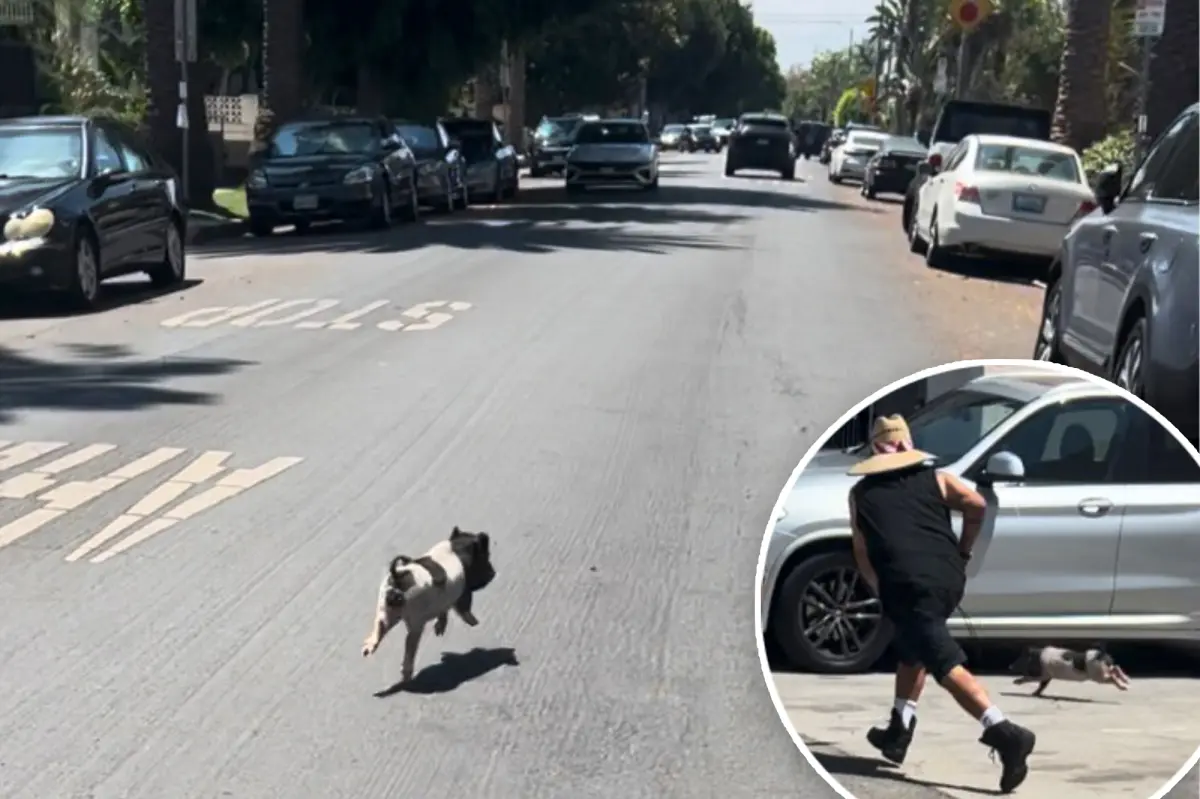
In a city renowned for manufactured drama, celebrity sightings, and carefully curated chaos, the universe occasionally delivers a dose of genuine, unscripted absurdity that captures the collective imagination like nothing else. Such was the case on a seemingly ordinary weekend in West Hollywood, where the predictable rhythm of brunch crowds, boutique shopping, and gridlocked traffic was abruptly disrupted by a most unexpected protagonist: a small, black-and-white pig with an inexplicable need for speed. This was no scripted movie trailer, no viral stunt cooked up by a marketing team; this was the real, live, hooved equivalent of a bucket of cold water thrown onto the sun-drenched sidewalks of Los Angeles. Passersby, initially in a state of confused disbelief, found their mundane errands derailed by the sight of a portly porker darting through crosswalks and weaving between the legs of startled pedestrians, instantly transforming their daily commute into a surreal theater of the unexpecteduster.
The genesis of this wild escapade can be traced to a moment of innocent misidentification. Jamaal Harrison, an ordinary Angeleno enjoying a casual ride on his e-bike, spotted a blur of movement out of the corner of his eye. His brain, wired for the urban landscape, immediately categorized the silhouette as a lost dog—perhaps a stray puppy that had wandered too far from home. However, as the creature turned its head, revealing a flat snout, floppy ears, and a curly tail, the truth hit Harrison with a jolt of pure, comedic bewilderment. This was no canine; this was Wilbur, a fearless swine in a city of glamour, trotting down the asphalt with the determination of a marathon runner. What followed was a slapstick urban safari that Harrison, armed with nothing but his e-bike and a heroic sense of civic duty, would find himself leading. The initial confusion quickly gave way to a profound realization that the city’s traffic laws had no provision for a galloping pig, and that the only way to handle the situation was to join the chase, hoping to outmaneuver this surprisingly swift creature.
The pursuit itself unfolded as a beautifully chaotic performance of man versus nature, albeit a nature that was living rent-free in a hipster neighborhood. Harrison, who later recounted the tale to local media, described spotting what he assumed was a canine companion before the anatomy became unmistakably porcine. With the e-bike humming beneath him, Harrison attempted to herd Wilbur through the winding streets and claustrophobic alleyways of West Hollywoodaine. It was a comedic absurdity of epic proportions: a modern, battery-powered vehicle struggling to keep pace with a farm animal who had clearly taken a crash course in urban evasion. Wilbur dodged, ducked, and juked with the agility of a professional athlete, leaving his pursuer breathless and the assembled crowd of onlookers in stitches. Cars slowed to a crawl, not out of caution, but out of sheer entertainment, as the pig seemingly ignored the carefully designed infrastructure of the city, treating it as his own personal playground. The chase was not just about catching the pig; it became a communal spectacle, a shared narrative of a four-legged rebel resisting the confines of conventionality in a town that thrives on breaking the rules itself.
As Wilbur finally slipped away into the labyrinth of alleys and backyards, vanishing into the urban jungle, one might have assumed the story would end with a shrug and a “what just happened?” Instead, Wilbur’s legacy was catapulted into the digital stratosphere when Harrison uploaded his footage to TikTok. The video, a raw and unpolished document of the absurd chase, struck a chord that resonated far beyond the city limits of Los Angeles. The internet, that vast and often cynical ecosystem, found in Wilbur a unifying source of wholesome pandemonium. The comments section became a virtual dragnet, with residents flooding the thread with unsolicited intel and gleeful speculation. “I know exactly where that pig lives!” one user claimed. “That’s the pig from the backyard on Kings Road!” quipped another. The digital community transformed into a neighborhood watch group, working collectively to unravel the mystery of the nomadic swine. It was a beautiful, humorous spectacle of humanity collaborating towards a common goal, proving that in an age of fractured social discourse, a runaway pig could still unite people more effectively than any hashtag campaign.
Diving deeper into the emotional resonance of this story, it becomes clear that Wilbur had inadvertently tapped into a primal human need for connection and levity. In a sprawling metropolis where anonymity is often the default and interaction is typically transactional, the sight of a pig asserting its freedom on the pavement became a shared, unifying experience. The comments section of Harrison’s viral post became a digital town square, where strangers swapped observations like seasoned detectives. “I’ve seen that pig before!” they claimed, offering up potential neighborhoods, backyards, and even rumors of Wilbur’s favorite foraging spots. This collective brainstorming was not merely an exercise in mundane curiosity; it was a manifestation of communal care. The brief pursuit had morphed into a city-wide scavenger hunt, showcasing a deeply human instinct to protect what is lost and return it to safety. The laughter at Wilbur’s antics was not mocking; it was joyful, rooted in the shared understanding that life is often more bizarre and delightful than any work of fiction a screenwriter could pen. The pig was no longer just a pet; he was a symbol of spontaneous adventure, a four-legged muse inspiring an entire city to look up from their phones and look out for one another.
Yet, beneath the viral comedy and the affectionate chasing, there lay a poignant tale about freedom versus safety. Wilbur, whether by accident or an inexplicable act of pig rebellion, chose to escape the confines of his known world for a taste of the wild urban unknown. In that act, he became an inadvertent ambassador for the thrill of stepping off the beaten path Greek. The story peeled back the veneer of urban sophistication to reveal a raw, earnest emotional core: empathy. The fact that an entire city, renowned for its cynical coolness, collectively held its breath and rooted for a small pig’s safe capture speaks volumes about the latent kindness that thrives beneath the surface of congested freeways and crowded sidewalks. Harrison’s simple reflection—that “there’s a lot of people out there who love this pig”—serves as a profound social commentary. In loving this pig, we saw a reflection of our own desire for freedom, a rebellion against the mundane, and a shared vulnerability that unites all living creatures in a sprawling, often disconnected world.
The climax of Wilbur’s adventure was less a heroic, slow-motion capture and more a quiet reclamation by municipal order. Eventually, the animal control officers succeeded where the recreational pursuers failed, and Wilbur was transported to the Los Angeles Animal Shelter. Here, the narrative shifted from high-octane adventure to a somber waiting game. The shelter announced that Wilbur would be held for a statutory period until August 20th, a quiet deadline allowing his rightful owner to step forward and redeem him. There is an inherent melancholy in this bureaucratic limbo; the pig who tasted wild freedom was now confined to a sterile kennel, his fate hanging in the balance between a familiar home and a transfer to a facility better equipped to handle his species. The prospect of a sanctuary, however, offers a silver lining. Animal sanctuaries, with their open pastures, mud wallows, and dedicated caretakers, represent a far gentler landing zone than a backyard, which perhaps was ill-equipped to contain such an intelligent and restless spirit. As the clock ticks down to the decision date, the city watches with bated breath, hoping that this story concludes not with a sigh, but with a happy ending for the unsung hero of the pavement.
The fondness that erupted around Wilbur speaks volumes about the human capacity for emotional investment in the strange and the unexpected. It is remarkably easy to feel a deep, resonant affection for an animal we have never met, particularly one whose primary character traits involve a lack of concern for human traffic signals and a steadfast refusal to be contained. Wilbur became a placeholder for our own suppressed desires to abandon routine and dash wildly into the unknown. He represented, in his small, chubby frame, a spirit of anarchic joy that stands in stark contrast to the calculated lives we lead. The viral attention he received was not just about the novelty of a pig on the loose, but about the relief from the constant onslaught of negative news cycles and political squabbles. Wilbur offered a rare, uncomplicated dose of serotonin. As one commenter beautifully yet simplistically put it, “There’s a lot of people out there who love this pig.” That love is a testament to our empathy, proving that even in a sprawling city of millions, we will collectively stop to care for a single, small creature who dares to live boldly.
Wilbur’s legacy, however, transcends the temporary memory of a viral video. He became a catalyst for a city to remember its capacity for collective affection tune. For a brief moment, the rigid boundaries of class, neighborhood, and lifestyle melted away in the shared pursuit of catching a pig. Mr. Harrison, the accidental hero, embodied this new role with grace, his lighthearted commentary and genuine concern capturing the hearts of viewers. His statement, “There’s a lot of people out there who love this pig,” serves as the emotional core of the entire saga. It is a testament to the profound, inexplicable connection humans forge with animals, especially when those animals disrupt our expectations and force us to look up from our own lives. We love Wilbur not because he is significant in the grand scheme of the cosmos, but because he is, in his own way, a hero of the common man. He represents the unexpected detour, the breaking of routine, the audacious rejection of a predetermined path. In his brief sprint for freedom, he reminded a city of concrete and algorithms that there is still room for primal whimsy.
Reflecting upon the entire episode, the story of Wilbur the pig transcends its simple news headline. It becomes a parable about the intersection of urban life and natural instinct, and the absurd grace that occurs when they collide. For those fourteen days, a humble pig held the gaze of millions, humanizing a sprawling, impersonal city. He reminded us that joy can be found in the most unexpected places, even trotting through the exhaust fumes of Sunset Boulevard. The strangers who flooded the comments, the cyclist who abandoned his errands, and the shelter workers who now provide temporary refuge all participated in a unscripted tale of compassion. We rooted for Wilbur because, in a way, we saw ourselves in him—yearning for something beyond the fences we are given, sprinting toward freedom despite not knowing exactly where the path leads. As the deadline approachesais, the entire city of Los Angeles, and the digital world watching, waits for the epilogue. Whether Wilbur returns to a known home with a pig-proof fence or is taken in by a sanctuary where he can root, dig, and wallow to his heart’s content, his legacy is secured. He reminded us all, if only for a fleeting moment, that even in the most jaded corners of the world, we will always stop what we are doing to chase a little bit of joy, to cheer on an unlikely hero, and to fall in love with a pig who dared to sprint through the glittering streets of Hollywood. His story wasn’t just about an escaped animal; it was about a city rediscovering its heart, one hilarious, hoof-pounding step at a time.