






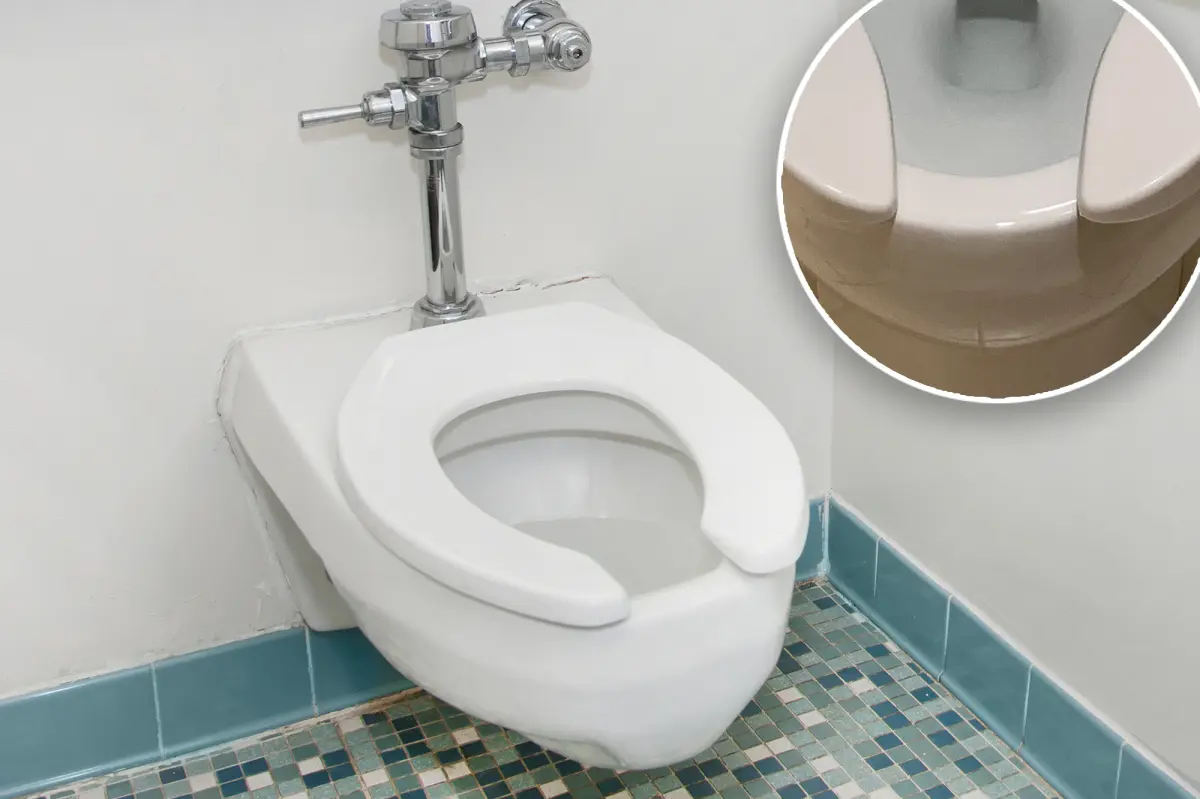
We have all experienced that sudden, sinking feeling of visceral dread when nature calls while we are away from the cozy, predictable sanctuary of our own private bathrooms. Entering a public restroom often feels like stepping onto a high-stakes sanitation battlefield, requiring a series of rapid mental calculations and awkward physical maneuvers before we can even think about relaxing. For the germ-conscious among us—which, let’s be honest, is almost everyone when confronted with a communal stall—this experience prompts an intricate, silent choreography of avoidance. We might meticulously construct a fragile protective barrier out of carefully layered toilet paper, or perhaps test our athletic endurance by executing a perfect, gravity-defying hover squat to avoid letting our bare skin touch a plastic surface that has played host to hundreds of nameless strangers. Beneath this universal daily struggle, however, lies an intriguing mystery hiding in plain sight: why do public toilet seats look so radically different from the smooth, unbroken porcelain rings we comfortably sit on at home? While our domestic bathrooms feature comforting, completely enclosed, oval seats, public restrooms are almost universally outfitted with stark, plastic U-shaped rings that possess a gaping, empty void right at the front. For decades, many of us quietly assumed this horseshoe design was merely a cheap manufacturing error, a cost-cutting shortcut, or some bizarre aesthetic choice meant to make commercial restrooms look distinct from residential ones. But as plumbing history and sanitation science reveal, this gap is actually a highly deliberate, scientifically backed, and legally protected design engineered specifically to protect us from invisible biological dangers.
To truly understand how this distinct little gap became a ubiquitous feature of our national landscape, we have to travel back nearly seven decades to an era of massive post-World War II infrastructure development and urbanization. In 1955, the American Standard National Plumbing Code officially stepped in to standardize public health measures across the rapidly expanding country, decreeing that all water closets created for public use must be equipped with seats made of smooth, entirely non-absorbent materials and must utilize an “open-front” design. This legal framework did not just suggest a preference for this layout; it laid down a strict plumbing mandate that was quickly adopted by state legislatures across the United States, including California’s famously rigorous state plumbing code. Suddenly, what had once been a minor architectural variation became a fundamental standard of public health law, forcing business owners, school administrators, and city planners to phase out traditional, closed-circle seats in favor of the now-iconic U-shape. This regulatory push was born out of a progressive era in civil engineering, where health experts recognized that rapidly growing metropolitan areas needed systematic, built-in defenses against the transmission of infectious diseases in high-traffic facilities. Far from being a random styling whim, the open-front toilet seat is a historic monument to national sanitation planning, demonstrating how a simple piece of mid-century legislation continues to silently police our collective hygiene in every corner of the country today.
This fascinating piece of hidden plumbing history recently captured the internet’s imagination when popular social media commentator Aakash Gupta published a highly detailed, viral thread on X (formerly Twitter) explaining the four-fold genius of the open-front seat design, eventually drawing in over 5.2 million views and a flood of bewildered reactions. At the absolute center of this design’s brilliance is a biological concept known as “contact elimination,” which tackles the psychological and physical nightmare of bacterial cross-contamination head-on. When an individual sits down on a standard, fully closed oval toilet seat, their thighs and lower abdominal area naturally press against the solid plastic surface, leaving an invisible residue of body heat, skin oils, perspiration, and microscopic dermal bacteria. When the next person enters the stall and sits in that exact same spot, their own skin directly interacts with that damp zone of biological leftovers, providing a seamless highway for opportunistic bacterial transfer. As Gupta eloquently explained in his viral post, removing the front-most curve of the plastic seat entirely eradicates this primary point of physical contact, thereby eliminating the shared real estate between subsequent users. By reducing the overall surface area of the seat, this gap provides fewer shared square inches and fewer bacterial transfer zones, allowing us to sit down with a much lower risk of picking up unwanted microbes from the strangers who preceded us.
Beyond the microscopic shield against bacteria, the open-front toilet seat offers a deeply thoughtful, highly functional ergonomic benefit that is especially vital for female hygiene and physical comfort. When women use public restrooms, the anatomical mechanics of wiping clean after using the toilet can be a surprisingly clumsy and sanitarily risky endeavor, particularly when forced to navigate the cramped, enclosed space of a standard residential toilet seat. On a traditional closed-ring toilet seat, a user is often forced to squeeze their hands and wrists into tight spaces, which dramatically increases the likelihood of accidentally brushing their clean skin or the pristine wiping paper against the dirty surface of the toilet seat itself. The U-shaped gap completely resolves this structural obstacle by acting as a built-in clearance corridor, perfectly proportioned to allow a human hand to pass through smoothly and cleanly without any risk of making contact with the underlying plastic or porcelain. This simple structural opening preserves personal dignity and physical cleanliness, transforming a high-risk maneuvering act into a quick, contact-free routine. By ensuring that sensitive bodily regions remain insulated from the shared fixtures of a public stall, this understated plumbing design serves as a silent, everyday guardian for human wellness, keeping our most vulnerable areas safe from accidental contact.
In addition to these human-centric hygiene protections, the open-front seat resolves a highly frustrating, mess-inducing reality of public restroom maintenance: the age-old problem of poor athletic aim and dripping, and the unpleasant consequences that follow. In any highly trafficked communal restroom, it is an unfortunate truth that some individuals—particularly male users who neglect to lift the toilet seat before relieving themselves—frequently leave messy traces of their presence behind. On a standard, closed-oval toilet seat, any stray drops or misdirected streams of urine inevitably gather right at the very front of the seat, pooling into an unsightly, stale puddle that lies in wait for the next unsuspecting guest. By removing that exact front arc of plastic, the U-shaped seat eliminates the physical target zone where urine typically collects, allowing any stray droplets to fall harmlessly through the empty air directly into the deep bowl below. As a result, the next patron to walk into the stall is spared the unpleasant, stomach-churning surprise of sitting on a wet surface, discovering instead a completely dry, clean, and inviting piece of plastic. This clever bypass not only elevates the baseline dignity of the public restroom experience but also significantly reduces the heavy cleaning burden placed on hard-working janitorial and maintenance staff, who would otherwise spend their shifts wiping up endless puddles of stray fluids.
Naturally, when these hidden plumbing design secrets were laid bare on social media, the internet reacted with its trademark mixture of humor, disbelief, and deep philosophical reflection on our built environment. While some practical skeptics pointed out that they do not typically sit on the very front section of a toilet seat anyway, others poked fun at the situation, joking that they had always simply assumed the gap was created for men who lacked the home-training required to lift the seat up before using it. Yet, the viral revelation also sparked a wave of profound gratitude among American travelers currently navigating foreign countries, with one user on vacation in Italy expressing a deep, nostalgic longing for the reliably clean and spacious design of American public toilets. Ultimately, the simple split-front toilet seat is a beautiful intersection of mid-century plumbing law, micro-biological defense strategy, physical ergonomics, and practical maintenance engineering. It serves as a gentle, reassuring reminder that the small, often invisible choices within our public infrastructure are not random accidents, but are instead carefully thought-out systems designed to protect our health, preserve our comfort, and make our shared public lives just a little bit cleaner.