


The holidays are supposed to be about warmth, hearth, and family, but for millions of Americans they’re also about the quiet dread that begins long before the turkey is carved: the airport. A traveler can do everything right—book early, arrive three hours ahead, triple-check the carry-on bag rules—and still find themselves staring at a departures board full of red letters as a winter storm gathers overhead. A stunning new analysis from Upgraded Points, based on Bureau of Transportation Statistics data, shows just how much of that chaos is tied to the weather. Over the last several holiday travel seasons, severe winter weather triggered one out of every five flight delays at major U.S. hubs. The study tracked 60 of the country’s busiest airports and nine major carriers from November through January, a period when family reunions, corporate year-end escapes, and ski vacations all collide. Nationwide, weather accounted for 21.9% of all disruptions during those months. That’s not just a statistic; it’s the sound of a thousand phone calls to airline customer service, the sight of exhausted children sleeping on terminal floors, and the sinking feeling that the long-awaited hug from Grandma might have to wait until tomorrow—or day after tomorrow. Holiday travel has always been a test of patience, but the numbers suggest that the deck is increasingly stacked against anyone who wants to get home for the holidays.
Some airports, however, are far worse than others when it comes to turning a festive journey into a weather-induced marathon. San Francisco International Airport stands in a category of its own: weather was blamed for a staggering 40.3% of its delays, making it the absolute worst winter offender in the country. That might come as a surprise to travelers who picture California’s golden coast as a winter paradise, but the Bay Area’s infamous fog, winter rain, and low ceilings can wreak havoc on tightly packed flight schedules. LaGuardia Airport in New York isn’t far behind, with winter weather responsible for 38.9% of its delays, and Seattle-Tacoma International Airport rounds out the top three at 32.8%. Newark Liberty, Anchorage, Houston’s George Bush Intercontinental, Boston Logan, Minneapolis-Saint Paul, Chicago O’Hare, and John F. Kennedy also make the list of the ten most weather-delayed airports during the holiday months. The full ranking reads like a warning shot for anyone planning a connecting flight through these hubs: SFO at 40.32%, LGA at 38.91%, SEA at 32.79%, EWR at 31.56%, ANC at 29.64%, IAH at 29.41%, BOS at 28.35%, MSP at 27.96%, ORD at 27.43%, and JFK at 25.80%. On the flip side, some airports offer far better odds. Bad weather only triggered 10.2% of delays at Los Angeles International Airport, and Honolulu, Kahului, and Miami also ranked among the safest bets for clearer skies and smoother takeoffs. For travelers in a position to choose their routing, a layover in sunny LAX or Miami could be the difference between arriving with time to spare and spending Christmas Eve stranded in a terminal food court.
The calendar and the airline you choose also matter more than most people realize. December, unsurprisingly, takes the crown for the worst delays, with bad weather grounding or stalling nearly 24% of flights during the holiday month. January isn’t much better, with 22.6% of delays attributed to winter conditions. The difference between the two months may sound small, but for anyone who has experienced the unique misery of a rebooked flight on New Year’s Day, every percentage point feels personal. When it comes to specific carriers, the data reveals a clear split between airlines that seem to absorb winter weather gracefully and those that struggle. Alaska Airlines had the highest share of winter-related delays among the nine carriers included in the study, at 27.8%. That means more than one in four Alaska flight delays during the holiday period could be traced directly back to meteorology. United Airlines followed closely at 25.4%. On the other end of the spectrum, Hawaiian Airlines showed the fewest weather-related delays, at just 7.9%, while Southwest Airlines also performed relatively well at 17.2%. For frequent flyers, this kind of information can shape booking decisions. For everyone else, it’s a reminder that the airline you choose is not just about price and seat comfort—it’s about how much weather-related pain you might be willing to endure when winter decides to flex its muscles.
But delays are only half the battle; the financial sting of holiday travel this year is enough to make anyone question their devotion to tradition. According to the same research, 2026 holiday airfares are expected to be the most expensive in ten years. Thanksgiving flights are averaging $402 for a domestic round-trip ticket, a massive 31% jump from last year—roughly $95 more for the same route. Christmas flights are averaging $452 per round trip, marking a 23% increase over last year. That means a family of four could easily spend over $1,600 just to sit on an airplane for a few hours, before factoring in baggage fees, parking, and the overpriced airport sandwich that costs more than a proper meal at a restaurant. The most painful part comes on the return side: Sunday, November 29 and Sunday, December 27 are expected to be peak return days, with massive surcharges attached to tickets landing on those dates. Airlines know that everyone wants to get home before Monday morning, and they price that desperation accordingly. For many travelers, the decision to fly home for the holidays is no longer just about time constraints—it’s a financial calculation involving credit card points, budget windows, and a deep breath before hitting the “purchase” button. Even those who manage to find a decent fare still have to face the possibility of a delay, which means the true cost of holiday travel is often paid twice: once in dollars, and once in hours lost to uncertainty.
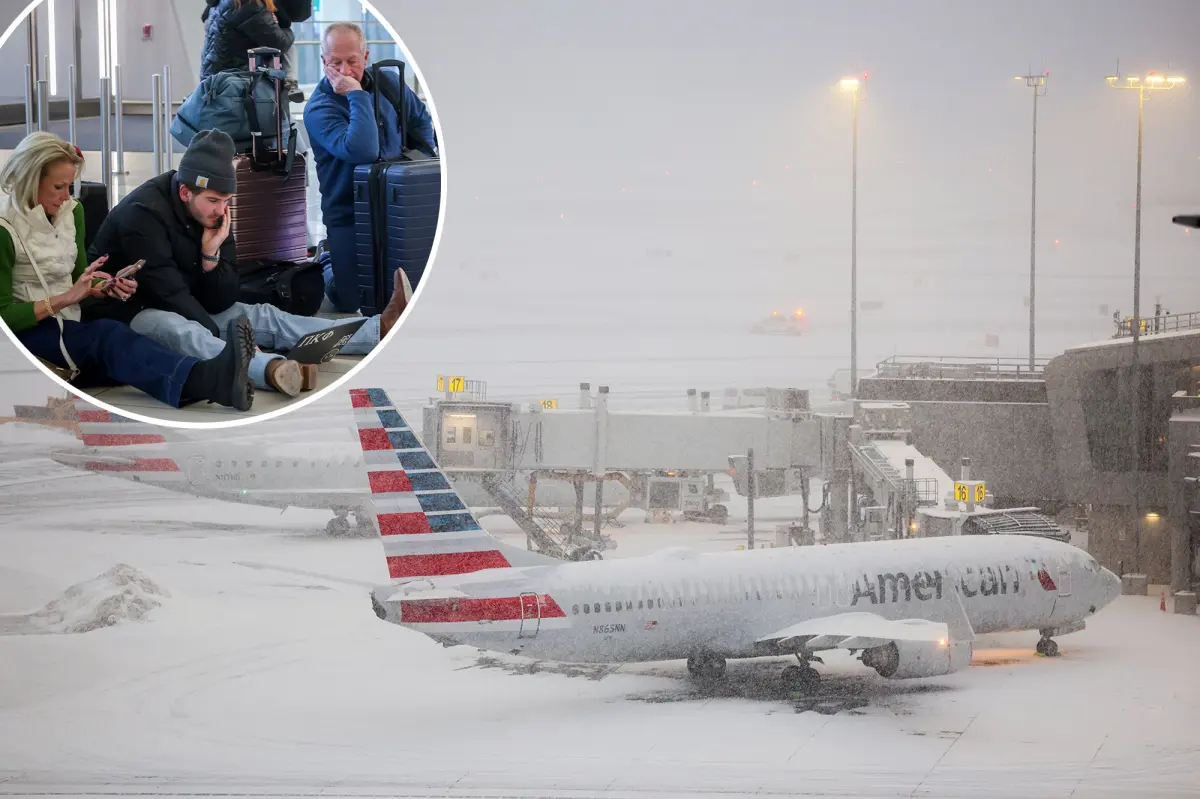
Last December, the harsh reality of that uncertainty was on full display at New York City’s airports, where a snowstorm brought holiday travel to a shuddering halt. Hundreds of flights were canceled as the storm slammed the tri-state area, leaving weary passengers stranded at John F. Kennedy International Airport on a Friday night that was supposed to be the start of a joyful weekend. The totals were staggering: 158 flight cancellations and 204 delays out of JFK, the highest of any airport in the country that day. Newark Liberty International Airport recorded another 107 cancellations, and LaGuardia wasn’t far behind with 90 scrapped flights. Together, the three major New York hubs reported a combined 335 delayed flights. Behind each canceled departure there were real people: college students hoping to make it home for winter break, parents holding toddlers and diaper bags, grandparents rerouted through unfamiliar cities. They stood in snaking customer-service lines, refreshed weather apps endlessly, and listened to announcements that kept pushing departure times further and further into the night. Some made it home. Many didn’t. The memory of that night lingers as a reminder that, for all our technological sophistication, a snowstorm can still bring the most connected country in the world to its knees.
So what is a determined holiday traveler supposed to do? First, understand that historical trends don’t guarantee the forecast for next month. A snowy December in San Francisco is about as unlikely as a thunderstorm in Honolulu; the data is about probabilities, not certainties. But probabilities are a good thing to know when you’re booking a nonrefundable ticket through a notoriously weather-prone hub. For those who want to stay one step ahead, the FAA’s National Airspace System Status dashboard offers real-time information about conditions across the country, which can help travelers adjust plans before they land in the middle of a ground stop. It’s also wise to book the earliest flight of the day, when delays tend to ripple less from previous disruptions, and to avoid peak return days if the budget can tolerate a little flexibility. At the very least, travelers can choose their airports and airlines wisely. Booking a December layover at SFO or LGA carries far more risk than catching a connection through sunny LAX or Miami, and choosing Hawaiian Airlines over Alaska Airlines—when possible—might mean the difference between a smooth journey and a holiday nightmare. Above all, the holidays are worth preserving. The long lines, expensive tickets, and weather delays are all part of the price we pay for the chance to sit around the table with the people we love. The trick is to plan for the worst, hope for the best, and remember that even a delayed flight eventually lands—and family, as it turns out, has a way of waiting up.