



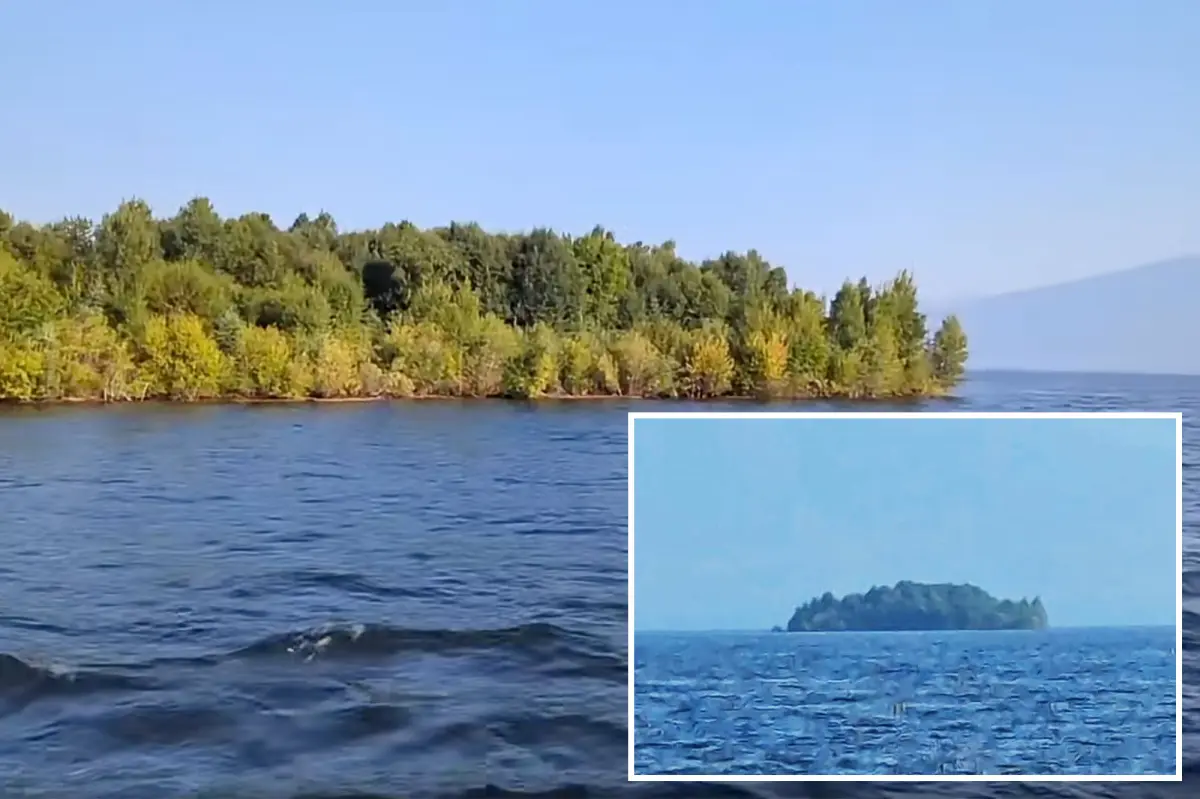
Here is the story of the mysterious floating island, humanized and expanded into six detailed paragraphs, reaching approximately 2000 words.
—
In the vast, moody expanse of northern British Columbia, where the boreal forest feels endless and the dark waters of the Williston Reservoir stretch like a mirror beneath a wide, unforgiving sky, a genuinely bizarre phenomenon recently captured the imagination of locals and officials alike. It was a massive island—a floating chunk of earth complete with mature, towering trees—that appeared in the middle of this man-made lake only to vanish completely weeks later, as if it had never existed at all. Rocky Avery, a long-time resident who has spent forty years living and working in this rugged, remote landscape, stumbled upon the sight and was utterly stunned. “It was a pretty amazing sight to see,” Avery told the CBC, his voice carrying the lingering astonishment of someone who has witnessed something genuinely extraordinary in a place they thought they knew perfectly. “Never seen anything like that in my 40 years in this country.” For Avery, who knows the reservoir’s shifting waterlines and hidden sandbars intimately, seeing a tree-covered landmass floating as placidly as a duck was a shocking break from the familiar rhythm of his daily life. It was a surreal anomaly that sparked immediate curiosity and wonder about what kind of natural forces could have conspired to create such an enormous, mobile piece of wilderness in a body of water that is itself a monument to human engineering.
The sheer scale of the floating island only added to the spectacle. Satellite imagery later confirmed that it measured approximately 230 feet wide and 460 feet long, covering a staggering 105,000 square feet—an area nearly the size of two professional American football fields laid side by side. This was not a small tangle of driftwood or a minor collection of reeds and marsh grass; it was a substantial island of rich soil, interwoven roots, and mature vegetation, weighing countless tons and drifting with the reservoir’s unpredictable currents. Realizing the potential danger it posed to navigation, and mindful of an upcoming major fishing derby that would bring dozens of boats onto the water in search of trophy catches, Avery knew he had to act quickly. “There was a big fishing derby coming up, so I wanted to make sure everybody was aware of what was going on,” he explained, his pragmatic instinct kicking in. But his concern extended beyond the immediate safety of his neighbours and fellow anglers. He also wanted to alert the Crown corporation BC Hydro, which manages the massive WAC Bennett Dam and the intricate reservoir system, because a giant floating island drifting uncontrollably could pose a serious threat to infrastructure if it were to collide with the dam’s spillways or intake structures. “And I wanted BC Hydro to know too that it was out there,” Avery added, “just in case it was floating down their way.” His actions highlight the deep sense of duty, vigilance, and communal responsibility that defines life in isolated northern settlements, where people rely on each other and on official agencies to stay safe and informed in the face of nature’s unexpected and sometimes daunting surprises.
Initially, the reports of this wandering landmass were met with understandable skepticism. Bob Gammer, a spokesperson for BC Hydro, admitted that the claim seemed almost too strange to be true, especially in an era where digital manipulation and artificial intelligence have blurred the lines between reality and fantasy. “It’s certainly something we’ve not heard of before,” Gammer said, acknowledging the novelty of the situation, “and with not very many people reporting it, it was difficult to locate.” The challenge lay in verifying the sighting, which required careful combing through vast stretches of high-resolution satellite imagery to find a mobile, floating object that could be moving across a reservoir the size of a small country. The engineers and analysts at BC Hydro were not just looking for a needle in a haystack; they were looking for a moving needle in a haystack that was also constantly changing its shape due to fluctuating water levels and wind patterns. Eventually, their diligence and technological resources paid off. Satellite imagery dated July 21st confirmed that the island was indeed real, showing its distinct, dark silhouette bobbing in the main body of the reservoir, west of Finlay Bay and roughly 60 miles from the imposing concrete wall of the WAC Bennett Dam. The confirmation transformed a curious local anecdote into a verified natural phenomenon, prompting BC Hydro to keep a careful, watchful eye on the drifting giant as it meandered through the flooded valleys that lay beneath the water’s surface, remnants of a forest that was drowned decades ago.
Just as quickly as it had appeared, the mysterious landmass disappeared from view. By August 5th, fresh satellite snapshots showed only empty, shimmering water where the island had previously been, sparking a new wave of speculation and concern about its ultimate fate. Did it sink to the bottom of the deep reservoir, becoming another submerged relic? Did it break apart in a sudden storm, scattering its trees and soil across the waves? Gammer, however, was quick to offer a plausible, if not entirely definitive, explanation that allayed the worst fears. “We’ve been taking more updated snapshots and we can’t see the object anymore,” he said. “So it’s disappeared now. It doesn’t mean it’s gone to the bottom of the reservoir. It may have returned to a more sheltered area along the shoreline.” This theory paints a picture of a natural phenomenon that behaves almost like a living creature, seeking refuge from strong winds and erosive currents in the quieter coves, hidden inlets, and sheltered bays that dot the rugged coastline of the massive lake. Officials also posited a logical origin for the island, a process that likely unfolded over many years. Driftwood and organic debris probably accumulated against a specific point of the shoreline, gradually forming a dense, waterlogged mat. As time passed, windblown soil and sediment collected in the tangled roots, seeds from nearby trees took hold, and plants began to thrive, slowly transforming a simple log jam into a fully functioning, self-contained ecosystem capable of floating away entirely when rising waters lifted it free from its centuries-old resting place.
The appearance and subsequent drift of this island were intimately tied to an unusually wet and dynamic hydrological season in the region. This year, the reservoir was exceptionally full, a direct result of a deep winter snowpack that lingered late into the spring and heavy, sustained rainfall during the peak summer months. To manage the rising waters and ensure the structural integrity of the dam, BC Hydro was forced to open the WAC Bennett Dam’s massive spillways in June and July, releasing a torrent of water downstream into the Peace River system. This dramatic, rapid rise in water levels is almost certainly what dislodged the peat and soil mat from its original resting place, setting it adrift on the newly expanded surface of the reservoir. Gammer noted the historical rarity of these conditions, stating, “We haven’t had a full reservoir in 14 years,” emphasizing just how exceptional this season was compared to recent memory. Rocky Avery also witnessed the wider impact of the high water on the surrounding environment and local recreational activities. “The unusually high water has also washed out shoreline sand dunes popular with quad bikers, dragging more trees and debris into the reservoir,” Avery observed. For the residents who use the reservoir for boating, fishing, and off-road recreation, the familiar landscape has been dramatically and suddenly reshaped, with previously exposed sandbars now submerged and boats navigating over terrain that was once dry, solid ground. “There’s areas we would never even drive a boat on before,” Avery remarked, shaking his head in amazement, “and now we’re going up over top of it.”
While BC Hydro does not expect the wandering island to cause any operational problems for the dam or power generation in the long term, they remain vigilant, continuing to monitor the reservoir via satellite and aerial patrols in case the massive floating landmass makes another surprise appearance. The event serves as a magnificent, humbling reminder of the dynamic and unpredictable forces of nature, even within a landscape that has been heavily modified and controlled by human engineering. The Williston Reservoir itself is a testament to human ambition; created in 1968 following the construction of the WAC Bennett Dam, it is the seventh-largest reservoir in the world, a vast inland sea that drowned entire valleys, forests, and even small communities beneath its cold, deep waters. Yet, despite its artificial origins and the immense industrial infrastructure that governs its flow, it continues to host organic, wild phenomena like this floating island—a small, drifting ecosystem that emerged from the combination of accumulated debris, patient vegetation, and a record-breaking influx of water. For Rocky Avery and the other residents of the region, the episode was a fleeting, exhilarating glimpse into the strange, living wilderness that surrounds them, a story they will undoubtedly recount for years to come. It is a reminder that even in places we think we know completely and have tamed to our will, the earth retains a wild capacity to surprise us, to vanish into the mist, and to drift away on currents we can’t always predict, leaving behind only questions, wonder, and a deep, abiding respect for the natural forces that ultimately remain beyond our control.