



In the vast, alkali-flat expanse of Nevada’s Black Rock Desert, where the horizon bleeds into a shimmering mirage and the wind howls with a lonely, ancient voice, lies a temporary metropolis unlike any other. This is Black Rock City, the ephemeral home of Burning Man, a gathering that has evolved from a small beach bonfire in San Francisco into a global phenomenon of radical self-expression. But if you are seeking a low-key, peaceful cruise through this surreal landscape, you have come to the wrong place. The playa—the dried-up lake bed that serves as the festival’s foundation—is not a place for quiet contemplation, but rather a roaring, hissing, and glowing theater of the absurd. The primary actors in this dusty drama are the art cars, immense, impossible machines that lumber across the desert like creatures from a fever dream. Whether they take the form of fire-breathing octopuses, pirate ships with billowing sails, or chrome-plated dragons, these “mutant vehicles” are the beating heart of the event. David Best, a veteran artist and the creative genius behind a rocket-shaped art car that looks like a 1950s sci-fi prop, dryly notes the festival’s own acronym, the DMV, which stands not for the Department of Motor Vehicles, but for the Department of Mutant Vehicles. It is a bureaucratic hurdle specifically designed to ensure that nothing on the playa looks like a standard, everyday automobile, forcing creators to transform their machines into pure, unadulterated fantasy or risk being relegated to the mundane world of bicycles and walking.
However, the path to transforming a humble truck chassis into a dazzling, fire-spitting dragon is paved with not just artistic vision and engineering grit, but staggering sums of money. The reality of Burning Man’s art-car scene is a stark paradox; it is a bastion of anti-commercialism and radical self-reliance that is simultaneously dominated by seven-figure budgets and tech-bro extravagance. Kevin Clark, the driving force behind the fierce and intimidating Rhino Redemption, offers a sobering piece of advice to aspiring builders: “Whatever you think you want to spend on a car, you can at least double it.” Clark’s own creation, a hulking, armored beast of welded steel and mechanical fury, cost him upwards of a couple hundred thousand dollars. Yet, his expenditure pales in comparison to some of the multi-million-dollar masterpieces that roll onto the playa each year, funded by the very Silicon Valley elite who seem to be colonizing the festival’s countercultural roots. The pressure to stand out in this dusty gallery of wonders has fostered a healthy, if expensive, rivalry among the ultra-wealthy. “There are definitely some rivalries, though they’re healthy,” Clark admits. “I appreciate the competition, and it’s produced some really wonderful things.” This competition, however, has irrevocably shifted the economic dynamics of an event that prides itself on anti-commercialism and communal effort.
The financial disparities are staggering. Consider the Mayan Warrior, a $3 million mobile disco on wheels, bankrolled by e-payment mogul Pablo Gonzalez Vargasaine. This magnificent, technicolor beast, adorned with intricate geometric patterns and thrumming with a massive sound system, requires a reported $300,000 just to transport to the remote desert each year. It is the ultimate status symbol for the tech elite who fly in on private jetsqb and camp in luxurious “plug-and-play” encampments. This is a stark contrast to the festival’s foundational ethos of “radical self-reliance,” where participants are expected to build their realities from scratch. Yet, despite the cost, the creation of these vehicles is governed by a strict aesthetic code: they must be completely unrecognizable as the automobiles they once were. A car is merely a chassis; a mutilated husk that serves as the skeleton for a sea monster, a Victorian steam engine, or a floating galleon. Possessing this quality in spades is ‘Monaco’, a full-rigged sailing ship on wheels with working sails that glide across the playa as if navigating the open ocean. Greg Barron, a diver and island dweller who conceived the ship, explains that it is fully functional, catching actual wind to reach speeds of up to 23 miles per hour while packed with delighted passengers. It is a testament to the extraordinary engineering and artistic vision that such projects demand, transforming the harsh, flat desert into an ocean of imagination.
The atmosphere in which these incredible machines operate is as unique as the vehicles themselves. Each year, up to 79,000 people descend upon Black Rock City for the nine days leading up to Labor Day. The environment is brutally austere: there is no cell phone signal, commerce is strictly forbidden, and all participants must bring every necessity—food, water, shelter, and art—with them. All logos and sponsorships must be covered, reinforcing the principle of gifting. Inside the city, money is worthless; the economy runs on barter, favors, and goodwill. Most people navigate the vast desert on bicycles, weaving between the towering art installations and the slow-moving mutant vehicles. The festival adheres to a strict “leave no trace” policy, meaning every single scrap of glitter and every discarded feather must be packed out by the person who brought it in. It is within this strange, decommodified, and utterly self-reliant context that these magnificent machines exist. They are not modes of transport so much as they are moving stages, carrying laughing, costumed revelers into the heart of the desert, their sound systems blasting music across the vast emptiness. They are gifts to the community, functioning as social hubs, dance floors, and mobile art galleries that weave through the crowds of cyclists and pedestrians.
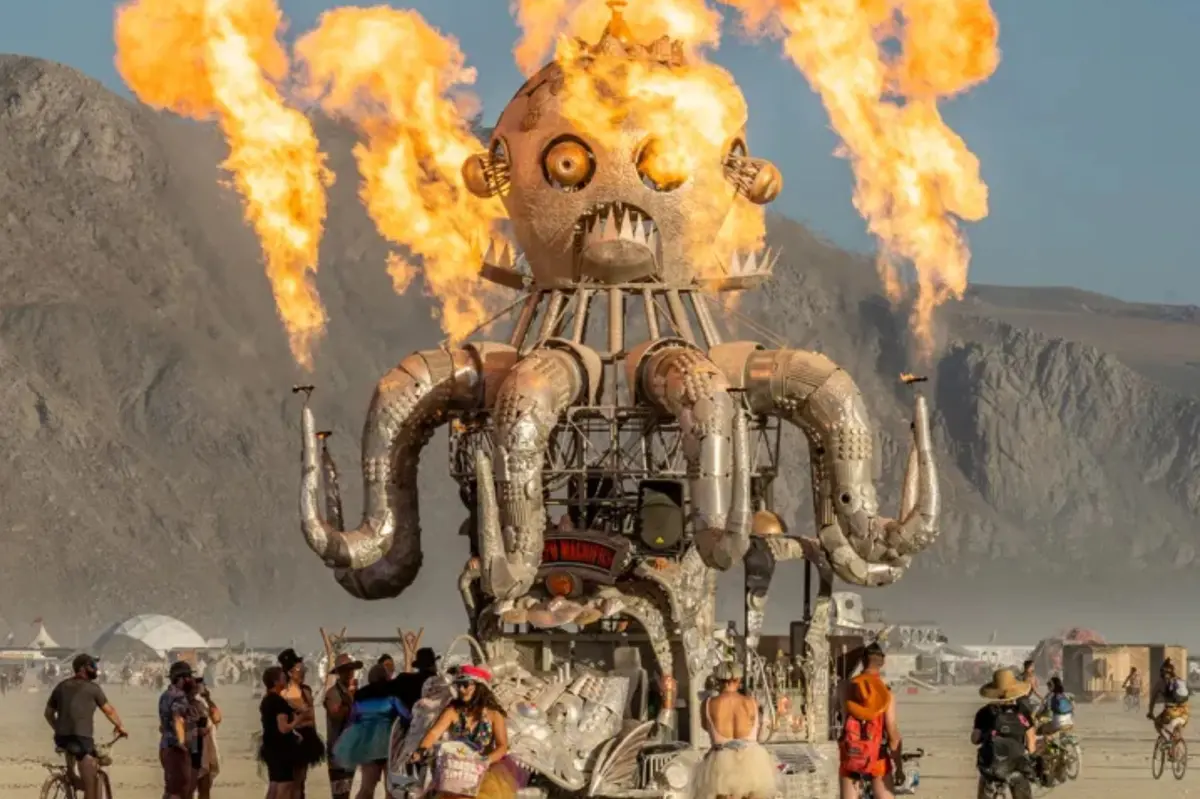
Amidst the millions of dollars and hired fabrication teams, there remains a powerful, earthy counterculture of homegrown artists who build their mechanical marvels in dusty garages with salvaged steel and sheer willpower. These are the true soul of the movement, individuals like Duane Flatmo, the creator of the legendary El Pulpo Magnifico, a magnificent, fire-breathing octopus constructed entirely from what most would consider junk. The creature, with its towering, articulated legs made from scrap metal, aluminum pie tins, and discarded industrial detritus, lumbers across the desert, sending eight-foot flames shooting from its tentacles. Flatmo describes the process of building such a beast as less about financial expenditure and more about “sweat equity.” The construction is a raw, visceral labor of love, fueled by camaraderie, welding torches, and, as he bluntly puts it, “scars, a lot of marijuana, and piles of aluminum pie tins.” The magic of these DIY builds lies in the collaborative urgency of their creation. When people wander by his garage to see the mess, the sparks, and the madness, they invariably ask to join in. “You’ve got your wire feed welders, gas, spray paint and piles of aluminum pie tins… plus smart, knowledgeable people who know how to work with tools,” Flatmo says of the chaotic workshop. For him, the finished product—a gorgeous, mechanical octopus that shoots flames from its tentacles—is merely the byproduct of a summer spent bonding with friends, collecting scars, and getting high.
The sheer scale of fantasy realized on the playa is breathtaking, pushing the boundaries of engineering and maritime law. Greg Barron, the visionary behind Monaco, has created a fully rigged, fully functional frigate that glides across the dust as if it were ocean water. “I’ve dived all over the world and live on an island,” Barron explained. “It’s a fully rigged, fully functional frigate. We catch the wind and have gone as fast as 23 miles per hour,” all while packed with delighted passengers. The ship, which looks like it sailed straight out of the Age of Sail, catches the desert wind and surges across the playa, a surreal sight of rigging, canvas, and polished wood amidst a sea of dust. These creations are not just transportation; they are moving sculptures, communal taverns, and stages for impromptu dance parties. With up to 79,000 people descending upon the playa for the nine-day event, the atmosphere is charged with a unique code of conduct. Black Rock City is a cashless, commerce-free zone; everything one needs must be brought in, and all phone signals are absentque. Generators hum, bikes are the primary mode of transport, and a strict “leave no trace” policy ensures that the desert is returned to its pristine state, with every last moop (matter out of place) meticulously picked up by hand before the gates close again.
The monetary value of these machines, however, often overshadows the genuine DIY grit and communal spirit that birthed the art-car movement. Duane Flatmo, the brilliant mind behind the legendary El Pulpo Magnifico, is a testament to the fact that creativity often thrives not on a million-dollar budget, but on ingenuity and sheer stubbornness. This magnificent octopus, which breathes fire from its tentacles, is built almost entirely from “junk”—scraps of metal, salvaged parts, and an endless supply of aluminum pie tins. Flatmo shrugs off the astronomical costs associated with the tech moguls’ builds. For him, the currency of creation is not dollars, but “scars, scabs and a lot of marijuana.” The process is a communal, organic effort. “People see this being built and they want to be part of it,” he says, describing the collaborative chaos that erupts in his garage. With a motley crew of friends, they weld, solder, and assemble the beast, fueled by camaraderie and pizza, working late into the night. Once out on the playa, the machine comes alive, shooting bursts of propane fire into the star-filled sky while a curated soundtrack, featuring tracks like Black Sabbath’s “Paranoid,” blasts from its custom sound system. For Flatmo, the value isn’t in the final polished product, but in the scars, scabs, and late-night arguments that went into it—the community forged in sparks and sweat.
This dichotomy between the “buy-it” and “build-it” philosophies is a defining tension of modern Burning Man. Old-school “Burners,” as the festival’s devotees are known, often view the influx of billionaires with a mixture of awe and skepticism. Jon Sarriugarte, a legendary car builder known for his fire-spitting snails and rocket cars, recalls a Silicon Valley billionaire who hired a ten-man crew to strip a brand-new Tesla to its bare frame, a process that took weeks and cost a fortune, simply to let an artist wrap it in a decorative metal skin. Sarriugarte himself was once approached by a wealthy investor to build a mutant vehicle, but the deal fell through when the investor presented him with a Non-Disclosure Agreement (NDA). For Sarriugarte, the very request felt antithetical to the spirit of the playa, where radical openness and communal gifting are paramount. His own process is intensely personal, a collaboration with his wife, who creates the incredible soundscapes that accompany his fire-breathing snails, often using her professional skills as a sound designer for Hollywood blockbusters. The act of building is a sacred ritual for him, a form of self-expression that cannot be outsourced. David Best echoes this sentiment, suggesting that these high-rolling tech bros, in hiring a ten-person fabrication crew to do the dirty work, are missing the entire point. They may get a beautiful, polished object to drive around for a week, but they miss the blood, the triumph, the frustration, and the sheer joy of creating. “They might have a good time,” Best says with a shrug, a hint of pity in his voice, “but they miss the best part.”
Ultimately, the world of Burning Man’s mutant vehicles is a mirror held up to the human condition—a reflection of our obsession with status, our capacity for genius, and our fundamental need for connection. On the one hand, a $3 million art car is a monument to ego and wealth, a glittering bauble for a billionaire to show off to less affluent burners. But on the other, on the playa, that same vehicle becomes a gift to the communityhola. It offers free rides, a pulsing dance floor, and a moment of wonder for any dusty traveler who crosses its path. The money is laundered through the desert, stripped of its corporate taint and repurposed into pure, unadulterated spectacle. Whether it’s the gleaming precision of a professional build or the patchwork charm of a home-built monster, the destination is the same: to inspire awe, create connection, and offer a ride to whoever needs one. Alexandra Lier, who documented these incredible machines in her book “Mutant Vehicles,” captures this spirit perfectly. “The creators are driven by art and community,” she says. “They are a mix of craftsmen and technological geniuses who make things that are gifts to the community, whether you’re getting a ride or just looking at their amazing cars.” The vehicles, she notes, are not trophies for their owners; they are offerings shared with the 70,000 strangers wandering the desert.
In the end, the art cars of Burning Man represent a profound paradox. They are the ultimate expression of radical self-expression, funded by extreme wealth or extreme thrift, yet they exist solely to bring joy to others. As David Best observes, there is a certain sadness in the billionaires who simply write a check and have a custom masterpiece delivered, skipping the months of grinding labor, the late-night welding sessions, the frustrating rebuilds, and the triumphant first start of the engine. “It’s too bad,” he muses, “they might have a good time.” His comment cuts to the very core of the event. Burning Man has never been about the destination or the finished object; it is about the process of creation. The true gift to the community is not the vehicle itself, but the hours of sweat, the shared problem-solving, and the defiant act of making something impossible with your own two hands. The smile of a passenger on a tricked-out pirate ship is fleeting, but the memory of dancing on the deck with the wind in your hair as the sun sets over the desert is eternal. In this harsh, beautiful, absurd landscape, the mutant vehicles are more than just transportation—they are the physical manifestation of the human spirit, a testament to our need to create, to connect, and to burn brightly, if only for a moment, against the vastness of the void. The price tag, whether it is $20,000 or $2 million, is ultimately irrelevant; what matters is the fire in the belly and the heat of the engine that carries you into the dust.