


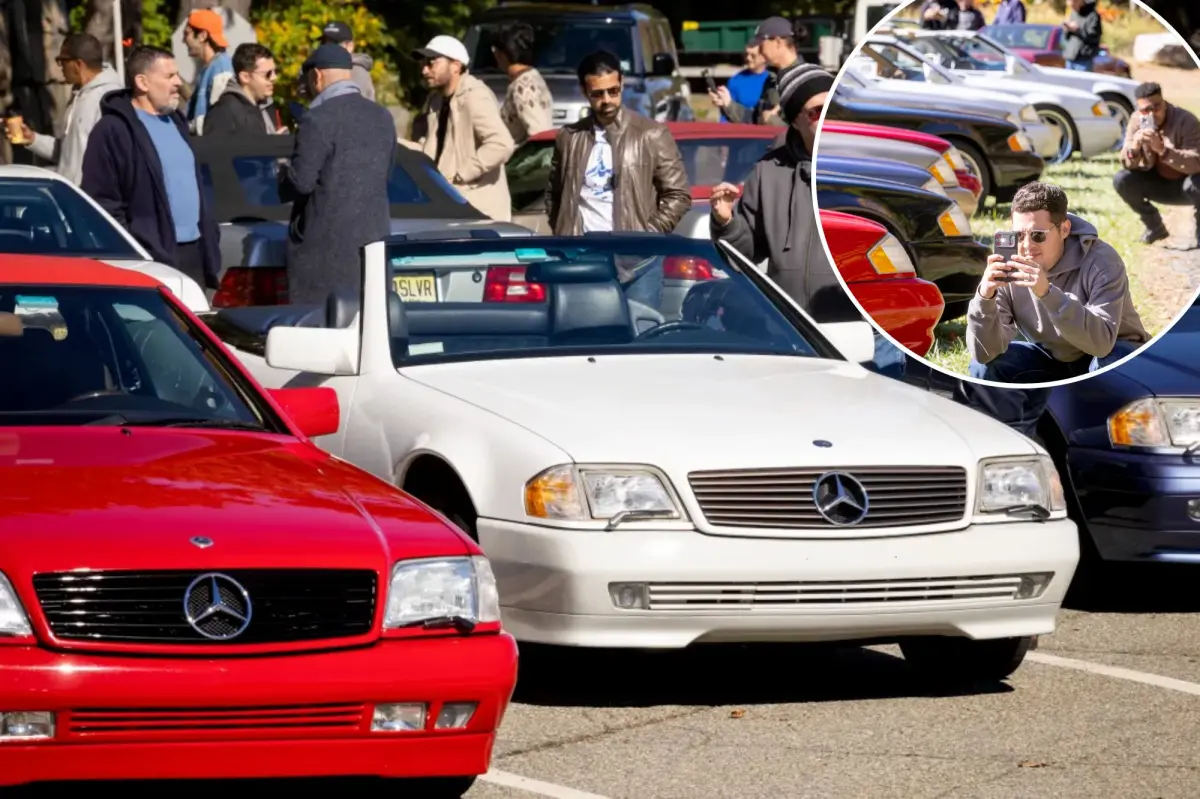
On a crisp early Sunday morning, while most of the world was still nursing coffee and easing into the weekend, a different kind of congregation was forming along the waterfront in Alpine, New Jersey. The boat basin, usually quiet at that hour, had transformed into a gleaming automotive gallery. Nearly seventy Mercedes-Benz SL convertibles sat in patient rows against the dramatic backdrop of the Hudson River, their polished curves catching the low golden light. There were classic black models, rare hunter-green editions, soft tops and hard tops, some restored to museum perfection, others clearly loved and driven. The R129 SL, a luxury convertible produced between 1990 and 2002, is a machine that speaks to a particular kind of longing, and the people who had gathered around it were not just casual onlookers. They were owners, enthusiasts, dreamers, men and women who had spent years waiting for the moment they could finally call one of these cars their own. They walked between the vehicles, peering through windows, comparing price tags, running fingers along chrome trim, and swapping stories as if they had known each other for decades. “I’m the black 600 over there,” one attendee announced, pointing to his refurbished two-seater. “Oh, no shit,” another replied, grinning. It felt less like a car show and more like a family reunion for people who shared the same secret obsession.
But this was not just any car meetup. Admission was free, but getting in required more than showing up. Attendees had to apply in advance, submitting photographs of their prized rides to event host Andrew Glaser, a New Jersey dealer and restorer who has become something of a gatekeeper for the R129 community. Only the most interesting, best-preserved, or most character-filled examples earned a spot. Once selected, owners were invited to join an exclusive gathering devoted entirely to the Mercedes-Benz R129 SL, followed by a scenic group drive through the winding roads toward Harriman State Park. The exclusivity was part of the appeal. For many of the selected enthusiasts, most of them in their thirties and forties, this was the culmination of a childhood dream. They belonged to a growing wave of collectors who are turning early obsessions into grown-up indulgences, fueling a modern-classic car boom in the process. Auctions and online sales of collectible cars surged ten percent to $4.8 billion in 2025, according to classic-car insurer Hagerty. A 2024 survey by the company found that sixty percent of Gen Z respondents were interested in owning a classic car, nearly twice the share of baby boomers. The numbers tell a story of a generation that grew up watching these cars in music videos, on movie screens, and in school parking lots, and who are now, finally, able to afford the objects of their youthful desire.
For Nev Schulman, a 42-year-old New Yorker who co-hosted Sunday’s event alongside Glaser and fellow enthusiast Aum Bhatt, the appeal is deeply personal. Schulman is currently three cars deep into his Mercedes modern-classic obsession, and he describes the R129 as the adult toy he can actually afford now. Earlier this year, he stumbled across a blue hardtop Mercedes on Facebook Marketplace while shopping for a friend’s fortieth birthday present. When the friend’s wife passed on the offer, Schulman could not resist the pull of fulfilling a dream he had carried since childhood. “I’ve always wanted this car,” he told the Post. “These are the cars I grew up with, and they were so expensive, but now I can afford it.” He bought the car for six thousand dollars, with seventy-two thousand miles on the odometer. It was not just a purchase; it was a reunion with a version of himself who used to stare at these cars from afar, wondering if he would ever have the chance to sit behind the wheel. Now he does, and he wants to share that feeling with others. Standing among the rows of gleaming R129s, Schulman looked less like a collector showing off and more like a kid who had finally been allowed into the candy store, except the candy store was a parking lot full of ninety-nineties nostalgia and the candy was made of German steel.
Tony Dinkins knows that feeling all too well. The 38-year-old drove down from Stamford, Connecticut, to show off his hunter-green R129 hardtop, a rare color that drew admiring glances from nearly everyone who passed. Dinkins bought the 1997 model two years ago for twelve thousand dollars after what he describes as a lifelong search for the car he had coveted since childhood. “I used to watch MTV; this car was in Tupac’s ‘Picture Me Rollin” music video,” he gushed, and the reference immediately transported many of the other owners back to the mid-nineties, when the SL was the ultimate symbol of success, style, and rebellion. With 114,000 miles on it, Dinkins has painstakingly restored the car himself, learning everything from YouTube videos, spending weekends in his garage with wrenches, polish, and patience. The car, which represented peak status when he was a kid, is now his summer, warm-weather flex. His daily driver is a Jaguar, but the Mercedes is something else entirely. It is a time machine, a trophy, a piece of his personal history that he can touch and drive and show off. Standing beside his freshly wiped hood, Dinkins spoke about the restoration process with the quiet pride of someone who had not just bought a car but had rescued a piece of his own past and brought it back to life with his own hands.
Andrew Glaser, the 40-year-old organizer of the gathering, has turned that nostalgia into big business. He is the founder of Vantage Auto, a New Jersey dealership specializing in modern classics, and he also owns Wolfgang’s, a Mercedes repair shop in Tenafly. In recent years, he has watched demand for the R129 surge as millennials and Gen Xers with disposable income seek out the cars they grew up admiring. “It’s relatable to people, and that’s why they’re going after them,” Glaser said. “Their grandparents had one, and their parents had one, and they’re also incredibly built cars, superbly engineered, amazing cars.” Standing in front of his own black hardtop with a red leather interior, Glaser explained the economics of the boom. He estimated that he has sold dozens of these models recently, and he noted that some examples that were once scooped up for around ten thousand dollars can now fetch sixty to seventy thousand dollars in excellent condition. “Let me sell you nostalgia and really cool stuff,” he said, summing up the appeal of the burgeoning market. But the obsession is no longer confined to the traditional boys’ club of car collecting. The Wall Street Journal recently chronicled the rise of the so-called “hot girl car,” with fashionable young women embracing beat-up vintage Broncos and other old-school SUVs as unlikely status symbols. Glaser has noticed the shift firsthand. At a recent car event in Newport, Rhode Island, he estimated that at least half the people approaching his business were women. The trend mirrors a broader nostalgia craze, from the revival of early-2000s designer handbags to Gen Z’s fascination with film cameras, flip phones, and other analog relics. Even New York City, hardly known as a car lover’s paradise, is now ripe with modern-classic enthusiasts. “In New York, people are meeting at six, 7 a.m. downtown in Soho and parking their cars on the streets to meet up,” Glaser said. “It’s thriving.”
For many, the appeal goes far beyond aesthetics. As new cars become increasingly dominated by touchscreens, lane-keeping assist, and computerized controls that often feel more like smartphones than vehicles, older models offer a more analog, more human driving experience. There is something about the weight of the steering wheel, the sound of the engine, the simplicity of physical buttons and gauges that cannot be replicated by a digital display. “Everything was about new, new, new, and now people are like, wait a second, hold on, maybe we want what used to be,” Glaser said. That sentiment was echoed by the owners as they prepared for the drive. Back at the boat basin, a fleet of R129s followed one another in their prized rides, forming a nearly seventy-car procession that snaked along winding roads toward Harriman State Park. The tops were down, the morning air was cool, and the sound of engines filled the countryside. “This is my last day to drive it with the top off,” one owner remarked, knowing that winter was approaching and the season for open-air driving was almost over. But judging by the lengths these collectors go to celebrate their vehicles, a little cold weather is unlikely to put the brakes on their obsession. If anything, the change of season only adds to the urgency, the preciousness, the knowledge that these moments are fleeting. And so they drive, a long line of gleaming Mercedes convertibles, carrying their owners not just along the roads of New York’s Hudson Valley, but backward through time, to an era when these cars meant everything, and forward into a future where the joy of owning them still feels brand new.