



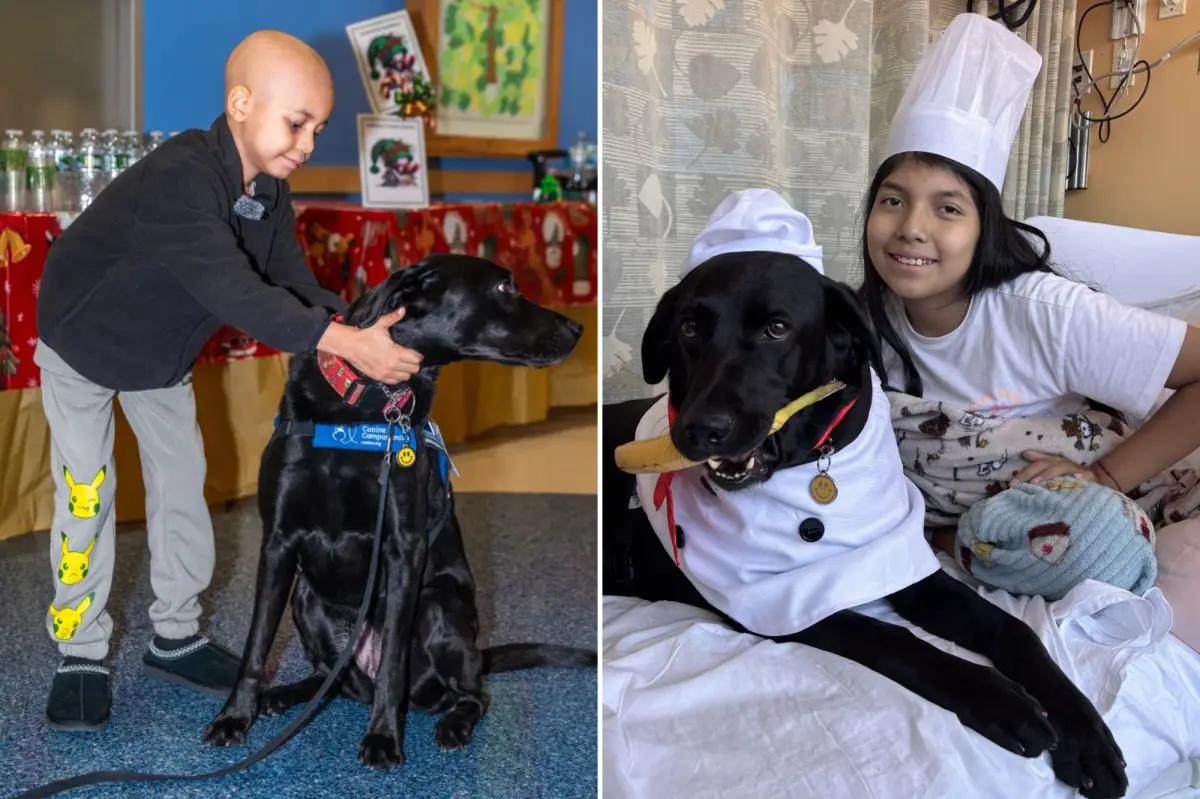
Polly doesn’t wear a white coat, and she will never write a prescription, but she has excellent bedside manner. On a recent afternoon at the Children’s Hospital at Montefiore Einstein in the Bronx, the 4-year-old Labrador Retriever walked quietly into a room where an 8-year-old cancer patient was struggling. The child had just come through a particularly difficult stretch of treatment; doctors had removed their breathing tube and were slowly reducing the sedative medications that had kept them comfortable. As the drugs wore off, the child’s body began to tremble, a frightening development for the patient and for the parents standing nearby. It was one of those moments in pediatric medicine that no training fully prepares a family for, a moment of helplessness in the face of a small body shaking with a force it cannot control. The room felt tight with worry, the monitors ticking, the adults exchanging glances over the child’s bed. Then Polly was lifted onto the bed. She settled in beside the child, warm and steady, her head resting near the child’s arm. The change was not subtle. The child’s breathing began to slow, the tremors became less frequent, and the tension in the room eased. “When Polly was present in the bed with this patient, they calmed significantly and their tremors were noticeably less frequent,” said Katy Dessick, Polly’s handler and a certified child life specialist at CHAM. Dessick described the moment as “an extremely difficult and emotional experience” for the child and their parents, who could see the difference the dog made. Here was no machine, no drug, no procedure; just a dog who seemed to understand what was needed. For the parents, the scene was a reminder that not all healing comes in syringes or scans. Sometimes it comes in the warm weight of a dog on the bed and the quiet reassurance that their child is still here, still fighting, still able to feel comfort. The moment was small, but it captured something essential about the role of facility dogs in modern pediatric care.
Facility dogs are not the same as therapy dogs who make occasional volunteer visits. They are specially trained canines who work alongside health care professionals as part of a care team, often paired with a handler such as a child life specialist, a nurse, or another clinician. Their job is not simply to provide a welcome distraction, though they certainly excel at that. Experts say these dogs can help children manage anxiety, navigate frightening medical procedures, and find the emotional breathing room to cope with serious illness. They can also, in the process, help doctors and nurses do their jobs more effectively. The research backs this up. A 2023 study surveyed medical staff at a Japanese children’s hospital and found that 73% of respondents who had observed facility dogs reported that the animals “Always” or “Very often” helped them gain patients’ cooperation with treatment, procedures, and end-of-life care. That is a striking number, because it comes not from dog lovers, but from clinicians who depend on cooperation to heal. In New York City, those benefits take shape through two Labradors: Polly, who works at CHAM in the Bronx, and Lev, a 7-year-old Labrador Retriever who works in the pediatric unit at Maimonides Medical Center in Brooklyn. Both dogs are trained to remain calm in a hospital environment full of beeping monitors, sudden alarms, rolling machines, and the occasional crash of a tray. They know how to sit still when a child is asleep, how to be gentle around IV lines, and how to meet a frightened patient exactly where they are. Many facility dogs are selected for temperament and go through months or years of training before they are placed in a hospital. They learn to ignore the smells of antiseptic and the sound of crying, and they learn to stay focused on their human partners. But their real skill is emotional. A child in the hospital often feels powerless, and a facility dog can restore some small sense of control. The dog is not going to give a shot, not going to ask uncomfortable questions, not going to leave. For a child, that can make all the difference.
Serious illness upends a child’s sense of normalcy. The familiar world of school, playgrounds, and sleepovers disappears, replaced by hospital rooms, invasive procedures, and a constant low hum of anxiety. Young patients are separated from family and friends, their bodies handled by strangers, their days ruled by schedules they never chose. At CHAM, Dr. Adit L. Tal, a pediatric hematologist-oncologist, sees this daily. Children receiving care for blood disorders and cancer often struggle to express their feelings to doctors, nurses, and other members of their medical teams. They may be scared of what the next scan will show, or embarrassed by their illness, or simply exhausted by the effort of staying brave. But the dogs can help break through that barrier. “A facility dog gives them the comfort to open up more,” said Tal. “In the presence of the dog, I see our patients become more calm and speak more freely to me and the medical team.” That effect is not limited to younger children. Dessick sees teenagers open up around Polly too, sometimes during therapeutic art projects that give patients a way to explore and express emotions they cannot yet put into words. The dog sits nearby, a quiet companion, asking nothing, offering acceptance. Polly has worked with Dessick for nearly three years, visiting children across CHAM’s inpatient and outpatient pediatric specialties. Her calm temperament helps Dessick navigate emotionally challenging situations, while her adaptability allows patients with different physical abilities to interact with her comfortably. Some children can only reach out a hand; others want to hug her and bury their faces in her fur. Polly meets each one where they are. “Polly has a way of making each person she interacts with feel special,” Dessick said. At Maimonides, Lev offers a similar source of comfort. His handler, Gabriel, has worked with him since the dog was only a few weeks old. “Lev gives them a chance to focus on something completely different,” Gabriel said. “For a few minutes, it can be less about being a patient and more about petting a dog, giving him a treat, laughing and just being a kid again.”
The dogs’ value is not limited to conversation or comfort. They are also what Tal calls four-legged motivation. When patients grow reluctant to participate in physical therapy, get out of bed for a walk, or follow a treatment plan, a dog’s company can give them a reason to try again. A child who will not move for a therapist may take a lap around the unit to show a Labrador. A child who dreads a needle may be able to focus on the rise and fall of a dog’s chest instead of the doctor’s hands. Tal explained that dogs can help children manage fears surrounding medication, central line insertions, and upcoming procedures. She also noted that the effect can be clinical: patients sometimes require less pain medication when the presence of a dog helps them relax through painful or frightening moments. This makes sense. Anxiety and pain are braided together, and when one decreases, the other often follows. A child who feels safe is less likely to tense up, less likely to fight the treatment, less likely to carry the trauma of an experience into the next round. The dogs’ influence extends beyond the children they visit. Caring for seriously ill patients and supporting distressed families takes an emotional toll on medical professionals, too. Doctors and nurses are only human. They carry the weight of every difficult diagnosis, every conversation that ends in tears, every child who does not get better. Facility dogs can offer staff a moment of calm amid the intensity of hospital work. “Our jobs can be emotionally taxing, and having the dog there to keep calm has been imperative to our well being,” Tal said. In that sense, Polly and Lev are part of the whole community of the hospital: they support patients, families, and caregivers alike. It is not unusual to see a nurse kneel down and scratch Lev behind the ears after a difficult shift. It is not unusual to see a doctor smile when Polly appears in the doorway. They turn a room from a place of clinical focus into a place that feels a little less sterile, a little more human.
The research supports what doctors and child life specialists observe in real time. A 2022 study of pediatric hospital personnel found that staff associated facility dogs with improved workplace morale and well-being, as well as stronger rapport with patients and families. A 2023 study in Japan found that a majority of staff who watched facility dogs in action believed the dogs helped them gain patients’ cooperation in treatment and procedures, including end-of-life care. These findings point to a broader truth: a facility dog is not a nice extra. It is a therapeutic tool that benefits the entire ecosystem of a hospital. At CHAM and Maimonides, the facility dog programs operate with support from EnCourage Kids Foundation, a New York City-based nonprofit that works with hospitals to improve the pediatric experience through initiatives such as pet therapy and music therapy. The foundation’s support allows hospitals to bring specially trained dogs into settings where they can do the most good, rather than relying on occasional volunteer visits. The dogs are not a replacement for medical treatment, of course. They do not take blood pressures or interpret scans. But they change the atmosphere in which medicine happens. A child who enters the hospital anxious about an infusion may meet Polly in the hallway and forget, for a moment, where they are. A parent who has been holding their breath through a round of bad news can kneel down and bury their hands in Lev’s fur. A nurse whose shift has been filled with heartbreak can sit on the floor for a minute and receive a gentle, nonjudgmental lick. For families, too, the dogs can be a lifeline. A parent watching their child suffer is often searching for something to hold onto. In hospitals, there are few places for that grief to go. A dog can absorb some of it without judgment, sitting quietly while a mother cries or leaning against a father’s leg as he makes a difficult phone call. If a child sees a doctor interacting warmly with a dog, trust can grow. The dog becomes a bridge between a young patient and the medical team. These moments do not show up on a chart, but they matter. They are part of what makes care more compassionate. And they are why programs like these keep growing.
For all the serious work Polly and Lev do, their hospital shifts also include plenty of play. There are treats to be earned and given, games to be played, and belly rubs to be delivered. “One of Lev’s favorite things is getting treats from the patients,” Gabriel said. “And the kids absolutely love being the ones who get to give them to him.” The dogs stretch out on the floor, tails sweeping, eyes soft, inviting small hands to pet them. They are, after all, still very good boys and girls. Those unscripted moments are not an interruption of the work; they are the point. A child who has been quiet, nervous, or having a difficult day can suddenly be smiling, petting Lev, interacting with him. “That is really what these visits are about,” Gabriel said. “Giving the children a little comfort, happiness and normalcy, and helping them forget about the hospital experience, even if it is only for a little while.” There is something deeply healing about that kind of play. It is not a strategy or a treatment plan; it is simply a child and a dog being together, sharing a small pocket of joy in the middle of a hard journey. The dogs make the hospital feel a little less like a hospital and a little more like childhood. That shift is not small. It can change how a child experiences treatment, how a family remembers a dark time, and how a medical team finds the strength to keep going. In the end, that is what facility dogs offer: not just distraction, but a doorway back to childhood. They allow a sick child to feel like a kid again. They let a teenager feel heard without having to explain themselves. They give a frightened parent a reason to take a full breath. In a world of white coats, IV poles, beeping monitors, and difficult conversations, Polly and Lev are warm, furry reminders that healing is about more than medicine. It is about connection, compassion, and the quiet presence of someone—or something—that simply stays by your side. And no white coat is needed for that.