


It is one of the most extraordinary artifacts ever created, a 230-foot-long embroidered epic that has somehow survived the better part of a millennium. And now, for the first time in nearly a thousand years, the Bayeux Tapestry has returned to the British Isles, a visit that feels less like a museum loan and more like a reunion with a long-lost, deeply complicated ancestor. On the surface, the tapestry is a grand medieval history lesson, chronicling the events leading up to the Battle of Hastings and the Norman Conquest of England in 1066. It tells the story of Harold’s fall, William’s victory, and the violent reshaping of a nation. But tucked into its intricate seams is something far more salacious: a sex scandal that could have threatened the very foundation of the new English throne. This is not just a story with a needle and thread; it is a medieval tabloid, filled with ambition, betrayal, and alleged bedroom secrets, all sewn painstakingly by hands that lived through the chaos themselves.
The tapestry is famously a work of staggering historical importance, depicting fifty-eight scenes that led to one of the most pivotal moments in English history. In the autumn of 1066, William of Normandy marched into England and defeated Harold Godwinson at Hastings, changing the course of the British Isles forever. The conquest replaced the English ruling class with Norman aristocrats, shifted the language of the court from English to French, and bound the two nations in a bitter, tangled alliance that would echo for centuries. But the tapestry has always had a mischievous side. It is famously well-endowed with phalluses—93, sometimes 94, depending on who is counting—and historians have spent decades trying to decipher what they mean. Are they crude jokes? Insults deliberately woven in to mock the powerful? Or perhaps some form of medieval graffiti, a decoy for the eyes of common folk scanning the borders? The phalluses are interesting, but they are not the real scandal. No, the truly explosive image is far more subtle, and yet it threatens to pull an entire kingdom’s foundational myth apart at the seams.
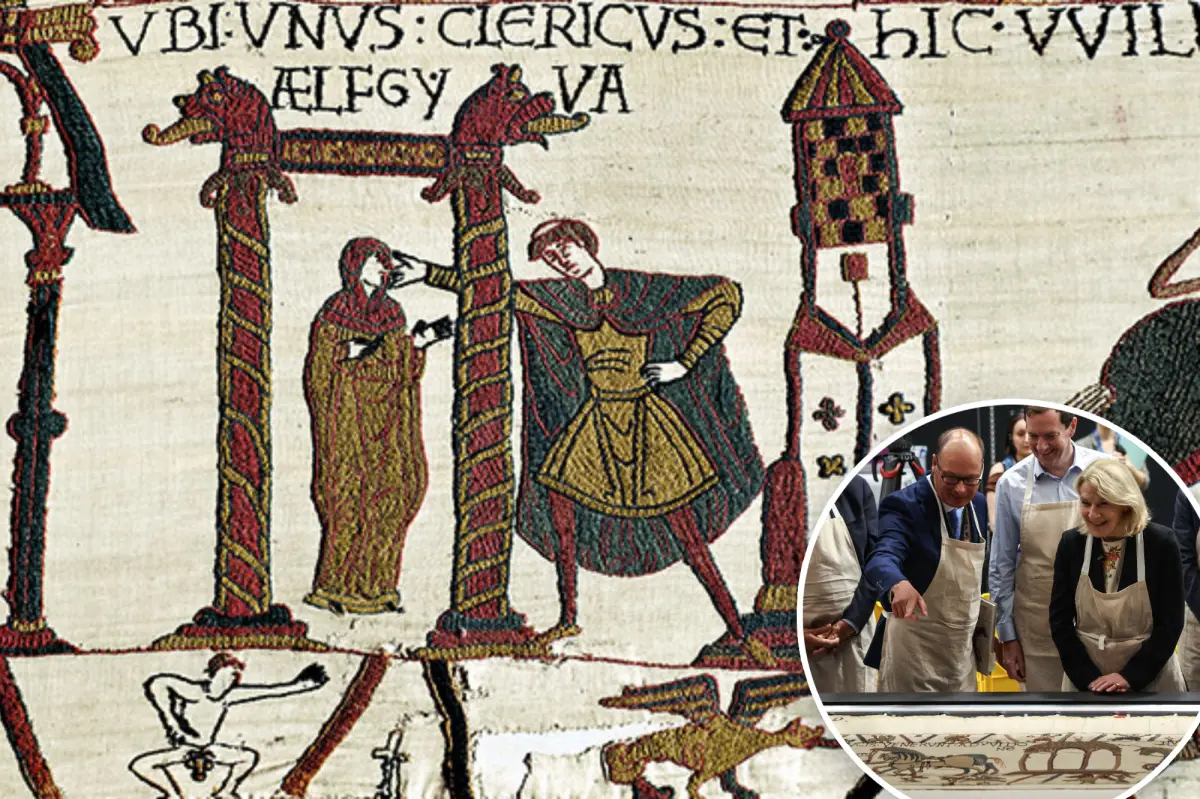
Within the tapestry’s dense narrative, there is a small, enigmatic vignette that has fascinated and tormented historians for years. It shows a clergyman gently caressing the cheek of a noblewoman, while beneath them, in the lower border, a naked man looks on with a knowing, disruptive presence. At first glance, it seems like a bizarre interruption, a strange detour from the political maneuvering and battlefield violence unfolding around it. But according to Michael Lewis, a curator at the British Museum, this tiny scene is not an idle doodle; it is a carefully crafted piece of character assassination. The woman, he argues, is none other than Emma of Normandy, wife of King Aethelred the Unready, mother of Edward the Confessor, and great-aunt of William the Conqueror. Emma had adopted the English name Aelfgyva during her marriage, and the tapestry labels the woman in the scene with that very name. The implication is devastating: the tapestry may be hinting that Emma had a secret affair with a powerful bishop, and that this illicit relationship was known, whispered about, and now immortalized in thread for posterity.
If that interpretation is correct, the scene is far more than a medieval whisper campaign; it is a direct attack on the legitimacy of the Norman Conquest itself. William’s claim to the English throne rested heavily on his family connection to Emma. When Edward the Confessor died without a clear heir, William pointed to his bloodline through Emma to argue that the crown was rightfully his. The tapestry, however, may be suggesting that Emma was unfaithful, having an affair with Alfwin, the Bishop of Winchester. In an age when legitimacy was everything, when kings derived their right to rule from lineage and divine blessing, the suggestion that your great-aunt was an adulteress could poison your entire claim. Lewis argues that this scene deliberately undermines William, that it makes the conquest feel less like a divine inheritance and more like a smuggled inheritance, built on shaky moral ground. It is a stunning assertion: that this celebrated piece of Norman propaganda may actually contain a buried subversive message, a needle-sharp jab at the very man it was supposedly created to celebrate.
What makes this even more human, and more tragic, is the figure of Emma herself. She was a woman caught between two worlds, married first to Aethelred the Unready, then after his death to the Danish king Cnut, always navigating the deadly currents of medieval politics with little more than her wits and her family ties. She was a survivor in a brutal world, a woman whose life was defined by the men who wanted power over England. To be posthumously accused, in a masterpiece of embroidery, of an affair with a bishop is to have her memory dragged through the mud in the most public way possible. And if she did have an affair, who among us could blame her? She was married to a king so ineffectual that he was literally known as “the Unready,” a man whose nickname derived from the Old English word “unraed,” meaning poorly counseled. She endured invasions, exiles, and the constant threat of violent death. The idea that she might have found comfort or alliance in the arms of a powerful churchman seems, frankly, the least surprising thing about her life. It is a reminder that behind the great political upheavals of history, there are real people with real appetites, fears, and secrets—and sometimes those secrets become the subtle stitches that hold a civilization’s story together.
And yet, the identity of the woman in the tapestry remains stubbornly shrouded in mystery, and not everyone is convinced by Lewis’s theory. The name Aelfgyva was, as historians are quick to point out, distressingly common in eleventh-century England. It could be Emma of Normandy, yes, but it could also be Aelfgifu of York, the first wife of King Aethelred, or Aelfgifu of Northampton, the wife of the Danish king Cnut. The tapestry’s creators gave us just enough of a hint to tantalize, but not enough to confirm, and that uncertainty has fueled centuries of speculation. Some scholars suggest the scene might not be an affair at all, but rather a betrothal, a blessing, or a lost story that the weavers assumed their audience would instantly recognize. The naked man in the border below could be a symbol of lust, a mythic figure, or simply a mischievous filler motif used to break up the visual monotony. We may never know for certain. But that ambiguity is precisely what makes the Bayeux Tapestry feel so alive, so modern, so human. History rarely comes to us in clean, definitive narratives; it is messy, subjective, and full of gaps. The tapestry invites us to lean closer, to squint, to argue among ourselves about what those long-ago embroiderers really meant by that intimate gesture, that awkward glance, that naked man peeking in from the margins.
In the end, the Bayeux Tapestry is not just a chronicle of kings and battles; it is a window into the human heart, with all its vanity, ambition, and vulnerability. The fact that this alleged sex scandal is woven into the fabric of one of the most important historical documents in existence says something profound about us. We have always been obsessed with the private lives of public figures, drawn to the gossip that humanizes those who seem untouchable. The tapestry’s return to Britain after a thousand years gives us another chance to marvel at its artistry, its violence, its strange flashes of humor, and its occasional glimpses of tender scandal. We may never know whether Emma of Normandy truly had an affair with the Bishop of Winchester, or whether the anonymous woman in the tapestry is someone else entirely. But the very existence of the scene reminds us that history is not a sterile collection of dates and treaties. It is a story told by people with biases and desires, people who gossip and judge and love and betray. The Bayeux Tapestry endures not because it tells us exactly what happened, but because it shows us that medieval people were just like us—navigating power, sex, and secrets, and doing their best to control the story. And as that tiny embroidered woman receives her bishop’s touch for the thousandth time, we are still leaning in, curious, scandalized, and utterly captivated.