



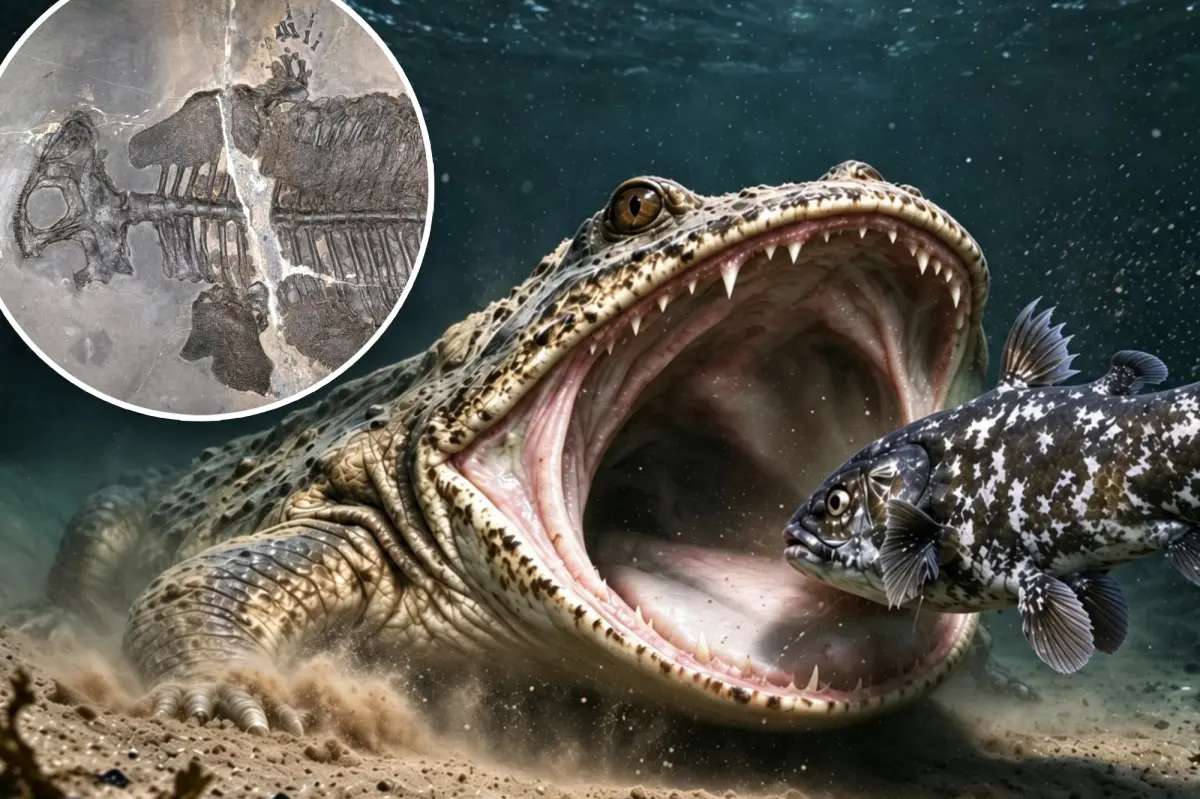
Was it a sea-lamander? In a word, yes — or at least, that’s the playful nickname now attached to a startling fossil that has palaeontologists rethinking a fundamental rule of nature. Scientists have uncovered the first-ever evidence of an amphibian that lived in the ocean, a creature that defies nearly everything we thought we knew about a class of animals defined by its careful relationship with fresh water. The animal has been named Gerrothorax maritimus, and it was a three-foot-long, chunky bottom-dweller that made its home on the seafloor during the Late Triassic, roughly 237 million years ago. The two nearly complete skeletons that support this conclusion were unearthed in a region of China that was once covered by a shallow sea, and the findings were published in the journal Nature Ecology and Evolution. For decades, scientists have accepted that amphibians are tied to fresh water. Today, none of the roughly 8,000 known species of modern amphibians are known to live in salt water, and fewer than 2 percent can tolerate even a small amount of salinity. Their skin is porous, which is essential for breathing and absorbing water, but that same permeability makes them vulnerable to the dehydrating effects of salt. Finding an ancient amphibian that not only survived but apparently thrived in the ocean is therefore more than a curiosity — it’s a discovery that shakes the foundations of amphibian evolution and forces us to imagine how strange and flexible life on Earth truly can be.
The story begins beneath the waves of an ancient seascape. During the Late Triassic, the area of present-day China where these fossils were found lay submerged under a marine ecosystem teeming with life. Turtles glided past, ichthyosaurs hunted in the open water, and a variety of marine reptiles occupied the roles that modern whales and sharks might fill today. Into this world came Gerrothorax maritimus, a creature that must have seemed out of place even then. It was a salamander-like animal, but with a squat head and a heavy, armoured body that made it look less like a delicate amphibian and more like a tank built to hug the seafloor. The researchers, led by palaeontologist Ryosuke Motani of the University of California, Davis, were initially cautious. Could these skeletons simply have been washed out to sea after death? That is a common problem when interpreting fossils found in marine sediments, because land-dwelling animals are occasionally swept into the ocean and buried there. But the evidence told a different story. The two skeletons were discovered nearly 19 miles from the nearest islands, and they were remarkably complete, with even the fingers preserved intact. That detail mattered enormously. As Motani explained, carcasses that float at sea tend to dry out, fall apart, and lose their limbs before they sink to the bottom. The fact that these animals still had their hands and feet suggested they had died more or less where they had lived. If they had drifted from land, their remains would have been battered and broken long before they reached the seabed. To make the case even more secure, scientists measured levels of strontium, a trace element that accumulates in bones, and found that it matched the composition of the ancient Triassic ocean. Taken together, the fossils show no sign of a displaced land animal; this was a true marine amphibian, living out its entire existence in salt water.
But how did it survive? That is the question that puzzled researchers most, and the answer lies in the creature’s remarkable anatomy. Modern amphibians depend on their damp, porous skin for gas exchange and water balance, which makes them exquisitely sensitive to salinity. When a freshwater amphibian is placed in saltwater, the surrounding salt draws water out of its body, causing dehydration and eventual death. Gerrothorax maritimus did not face this problem. Its body was covered in a bony carapace, a kind of protective armour that served two vital purposes. First, it shielded the creature from formidable predators. The Late Triassic seas were dangerous places, filled with reptiles that would have been happy to make a meal of a slow-moving amphibian. The thick armour would have made Gerrothorax a difficult mouthful. Second, and perhaps even more crucially, the carapace covered its porous skin, physically preventing seawater from coming into contact with the delicate tissues underneath. The amphibian did not have to rely on its skin to breathe in the way modern amphibians do; instead, it could take in oxygen through other means, and its armour acted as an effective barrier against the corrosive effects of salt. That still left the problem of drinking. If an animal cannot absorb water through its skin, it must drink through its mouth, and drinking seawater brings salt into the body. Here, the researchers suspect, the animal’s gills played a key part. They likely helped filter out salt and excess minerals, and the digestive system may have processed and excreted the rest. It was an elegant solution to a problem that no other known amphibian had ever managed to solve in this way.
The creature’s body also hints at how it lived. Gerrothorax maritimus was not a fast swimmer or an agile hunter. Instead, it was built for ambush. Its squat head, wide mouth, and heavy frame suggest it was a suction feeder, a predator that lay motionless on the bottom and waited for unsuspecting prey to drift too close. When a fish or other small animal came within range, the amphibian would simply open its mouth and suck it in, swallowing the prey along with a gulp of water. This is a hunting strategy used by many modern aquatic animals, and it would have required very little movement, allowing the creature to conserve energy while remaining hidden from predators. The same adaptations that made it a successful ambush hunter, however, would have made it almost helpless on land. Unlike most amphibians, which can move between aquatic and terrestrial habitats, this animal was probably unable to do much more than flop awkwardly on the shore. Its stocky, armoured body, described by Motani as “really chunky” rather than long and slender, would have made walking on land slow and exhausting. In all likelihood, Gerrothorax maritimus never left the sea at all. It was born in the ocean, lived in the ocean, and died in the ocean, completing its entire life cycle without ever touching a freshwater pond or stream. Such a lifestyle is unheard of among modern amphibians, and it makes this ancient species an extreme outlier, a creature that pushed the boundaries of what an amphibian could be.
This discovery matters far beyond the oddity of a single species. It reshapes the evolutionary story of a whole class of animals. For a long time, scientists have used the term “amphibian” to mean a creature that splits its life between land and water, but this fossil suggests the family tree was far stranger than we imagined. Gerrothorax maritimus was not merely an amphibian living in an unusual place; it was what Motani called a “very unusual member of the lineage,” a branch of the amphibian family that diverged from the ancestors of modern frogs, salamanders, and caecilians and took a completely different path. Its existence proves that ancient amphibians were capable of adapting to marine environments, something no modern amphibian has achieved. That insight has ripple effects for how we understand the Late Triassic world. At a time when the continents were still clustered together and the oceans were full of reptiles, this strange, armoured suction-feeder carved out a niche of its own. It found a way to thrive in an environment that should have been lethal, using its skeleton as both armour and a shield against salt. It also raises a tantalising question: were there other marine amphibians that we have not yet found? The fossil record is incomplete, and it is impossible to say whether this was a one-off evolutionary quirk or part of a broader trend. What is certain is that our assumptions about amphibian biology are no longer as solid as they once seemed. The definition of an amphibian, built around the idea of freshwater dependence, has been stretched, and perhaps we need to leave room for strange exceptions on the margins.
In the end, the story of the sea-lamander invites us to marvel at the inventiveness of evolution. Nature possesses a deep, patient creativity, and it often produces solutions that seem impossible until the evidence arrives. This was a creature with the face of a salamander, the body of a tank, and habits more like a bottom-dwelling fish. It had no business living in the ocean by the standards of modern biology, but it did anyway, likely waiting in the dark depths of a Triassic sea while ichthyosaurs prowled overhead and turtles swam past. It is a reminder that the past was not simply a simpler version of the present; it was filled with animals that operated under different rules, solved different problems, and flourished in environments that seem wholly hostile to their relatives today. The name maritimus captures that defiance of expectation, and the nickname “sea-lamander” captures the playful wonder of it all. Every fossil like this is a small window into a world we can never directly visit, and every discovery forces us to rewrite the textbooks. There are likely many more strange creatures hidden in the rocks, waiting to be uncovered, waiting to surprise us. If a three-foot, armour-plated amphibian could spend its whole life in the sea, then we have much to learn about the resilience and adaptability of life on Earth. The sea-lamander is no longer a fantasy; it is a fact, and it proves that truth can be stranger — and more wonderful — than we ever expected.