



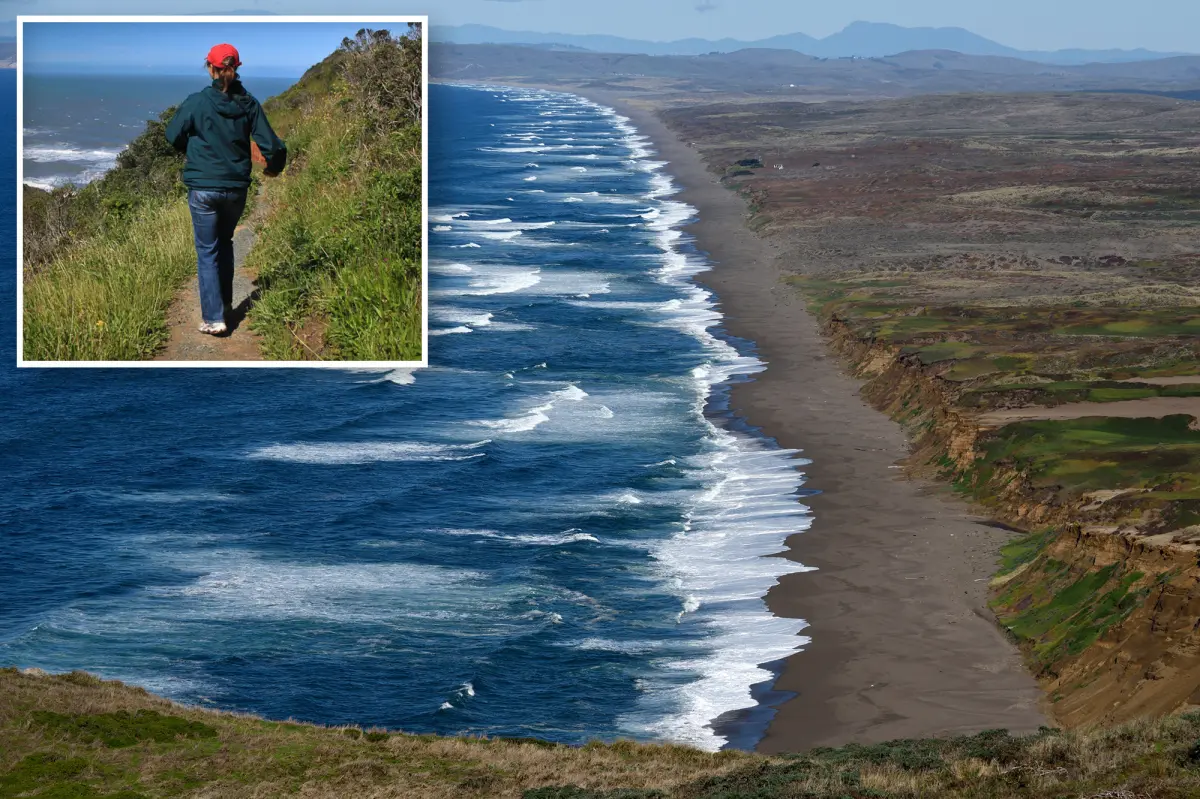
If you have ever stood at the edge of a California bluff, watching the Pacific surge against the rocks far below, it is easy to believe the ground beneath your feet has been there forever. The cliffs seem solid, ancient, permanent—a natural rampart holding back the ocean. But a new study from the University of California, San Diego, offers a far more unsettling truth. Those cliffs, which form roughly 70 percent of California’s iconic coastline, are not permanent at all. They are eroding, collapsing, and sliding into the sea in ways that can be sudden and catastrophic. In some places, the cliff edge is retreating at astonishing speeds. The study found that erosion is especially intense in parts of Northern and Central California, including Humboldt, San Francisco, San Mateo, and Monterey counties, where sections of coast have lost more than 30 feet in a single year. In the most extreme cases, the loss has reached more than 70 feet in one year. That is not the kind of change you might expect to notice only over centuries or generations; in some places, a beach, a trail, or a backyard can be reshaped in a matter of seasons. The researchers describe this as a “significant hazard to the coastal community,” and their warnings are rooted in more than just numbers. Behind every measurement is a place where people live, work, and play—and a reminder that the coastline is alive, moving, and not always on our side.
How did scientists come to this conclusion? They used lidar, a laser-based mapping technology that can measure the shape of the land with remarkable precision. By comparing detailed scans of the entire California coast taken in 2016 and 2023, researchers were able to see exactly where cliffs had changed and by how much. The results, published by the UC San Diego team, show that the problem is widespread: statewide, 65 percent of cliffs showed a measurable change over those seven years. On average, cliff tops across California eroded by about 1.6 inches per year. That may sound small—a few inches, a little bit of dirt—but averages can be misleading. In a state with thousands of miles of coastline, some cliffs stayed largely the same while others lost dramatic amounts of ground. The real story is not a slow, uniform wearing away; it is a patchwork of danger zones, some of which are moving at rates that are hard to comprehend. The study’s lead author, Danghan Xie, put it plainly: “The cliffs are not stable. They erode and collapse over time. We’ve seen many sad news stories about fatal cliff landslides.” That honesty cuts through the technical language. The numbers are not just interesting geological facts. They are warnings about places where the ground can give way without much notice, taking roads, homes, and even lives with it.
Nowhere was the change more stunning than at the Lost Coast Headlands in Humboldt County. There, between 2016 and 2023, the cliff top retreated by 22.3 meters per year—about 73 feet. Over the seven-year study period, that is a loss of more than the length of a football field. Adam Young, a coastal geomorphologist at UC San Diego, emphasized just how dramatic that is. “Seventy feet per year is a lot,” he said. “Over the seven-year study period that is more than the length of a football field.” The area also experienced a single landslide involving more than 1.4 million cubic yards of rock and soil. It is hard to imagine that amount of material moving at once, but for the people who live near or travel through these landscapes, it is a real and present danger. The study also found cliff-top retreat rates of 10 feet per year or more at several beloved and well-known places: the King Range, Redwood National Park, Point Reyes National Seashore, Big Sur, Vandenberg Space Force Base, Palos Verdes, and others. These are not remote or forgotten corners of the state. They are places where visitors gather to take photos, where families hike along trails, and where communities have built homes and roads close to the edge. The beauty of these cliffs is undeniable, but this research makes clear that their beauty is part of a dynamic, restless system. The ocean does not simply kiss the shore; it eats away at it, undermines it, and, at times, takes it back.
Beyond the raw data, there is a deeply human dimension to this story. Erosion is not just about geology; it is about safety, memory, and loss. A cliff that collapses can destroy property, close highways, and cut off communities. It can also kill. Landslides are especially dangerous because they are often sudden and difficult to predict. A bluff may appear stable for months or years, then fail during a storm or after a period of heavy rain. The researchers hope that by identifying where erosion is happening and how fast, they can help public agencies, emergency managers, and everyday residents make better decisions. Knowing which areas are most vulnerable could influence where to build, how to maintain roads, and when to close certain trails or viewpoints. It could also help people understand that the ground near a cliff is not safe simply because it looks solid. The lead author’s mention of “fatal cliff landslides” is not an exaggeration. California has seen tragic accidents in which people were standing too close to the edge when the ground gave way, and it has seen workers and drivers killed when slopes collapsed onto roads. This study is not meant to frighten people away from the coast; it is meant to help them live with it more wisely. That means respecting the edge, heeding warning signs, and accepting that the coastline is not a fixed feature of the landscape but a boundary that is constantly being renegotiated by land and sea.
The timing of the study adds even more urgency to its findings. Scientists have been warning that a historically strong El Niño could bring stronger than usual waves and higher tides to California’s shores. Those conditions are exactly the kind of force that accelerates cliff erosion. Big waves slam against the base of cliffs, carving out notches, weakening the rock, and making collapses more likely. When combined with heavy rainfall, which soaks the ground and adds weight to already fragile slopes, the risk can rise sharply. The coming months could therefore bring new landslides and new damage, especially in the same places where the UC San Diego researchers already documented rapid retreat. In response, the scientists have created an online tool called the California Coastal Cliff Erosion Viewer, available to the public on the university’s website. Anyone can look up a specific stretch of coast and see the erosion rate researchers measured. The viewer is expected to be updated potentially twice a year as new lidar data becomes available. This is a powerful example of how science can be put to practical use. Instead of relying on rumors, anecdotes, or outdated assumptions, residents, planners, and visitors can look at current information and make more informed choices. For someone living near a bluff, that might mean knowing whether their property sits in a high-risk zone. For a hiker, it might mean understanding that a certain trail is more dangerous than it looks. For a public works department, it might mean prioritizing repairs and reinforcements before disaster strikes.
The most painful reminders of these dangers can be seen along Highway 1, the scenic road that hugs much of California’s coast. Repeated landslides in Northern California have blocked portions of the highway many times over the years, forcing long detours and expensive repairs. The San Francisco Chronicle has reported on the ongoing struggle to keep the roadway open as the cliffs around it keep failing. Those efforts have already cost lives. Last year, in Humboldt County, a landslide killed a contractor who was working for the state transportation department. That single tragedy captures the heart of this story: erosion is not an abstract process happening far away. It is a force that intersects with ordinary life in sudden and devastating ways. A person can go to work one morning and be gone by afternoon because a hillside let go. The cliffs, for all their beauty, deserve our attention and our respect. This study gives Californians a clearer picture than ever before of what is happening along the edge of the state. The coast is not crumbling because of some unusual accident; it is doing what coastlines have always done. But with more people living closer to the edge, and with climate change and stronger storms making the ocean more powerful, the consequences are greater than they used to be. The best response is not to pretend the danger does not exist, nor to abandon the coast entirely. It is to use the knowledge we have, plan carefully, and treat the land with a sense of humility. California’s shoreline will remain one of the most beautiful places on Earth—but it is not unchanging. It is alive, restless, and constantly reshaping itself. Learning to listen to that rhythm, and to the scientists who study it, may be the most important step we can take.