





The Met Gala has always been that dazzling spectacle where fashion meets fantasy, a night where celebrities turn themselves into walking artworks under the scrutinized gaze of the world. This year’s theme, “Fashion Is Art,” inspired by the upcoming Costume Institute exhibition “Costume Art,” saw fashion icons descending on the Metropolitan Museum of Art’s iconic staircase like modern-day deities from a Byzantine fresco. Held on a crisp Monday evening, the event wasn’t just a party—it was a celebration of the human body adorned in creativity, with haute couture masks and headpieces transforming faces into masks of mystery and marvel. Attendees, adhering strictly to the dress code, paraded their interpretations of Renaissance masterpieces, avant-garde sci-fi visions, and historical tributes, proving once again that the Met Gala isn’t merely a fashion show; it’s a grand theater of self-expression. As the red carpet rolled out, the air buzzed with anticipation, flashes exploding like fireworks, while onlookers murmured about the risks and rewards of pushing boundaries. For many, it was a reminder of how fashion can elevate the mundane to the divine, blurring the lines between canvas and couture. Guests mingled under twinkling chandeliers, their laughter echoing off marble floors, each step a statement in a silent symphony of style. And amidst the glitz, there was a palpable sense of camaraderie, as if everyone understood that to transform one’s visage with such artistry was to tribute the enduring power of imagination over time, making ordinary humans feel extraordinarily alive. The theme’s nod to “Costume Art” felt particularly poignant in this post-pandemic era, where masks had become symbols of isolation before reclaiming their place as playful provocations. It was heartwarming to see how these luminaries embraced vulnerability, turning potential anonymity into audacious affirmations. Yet, with such high stakes, the night wasn’t without its divisive moments, but that’s what made it thrilling—a microcosm of humanity’s endless quest for reinvention. Stepping into this environment, one couldn’t help but feel a rush of excitement, imagining the stories etched into each design, the artists behind the scenes pouring their souls into ephemeral creations. From Suttons to socialites, the crowd represented a tapestry of backgrounds, all united under the banner of artistic excess.
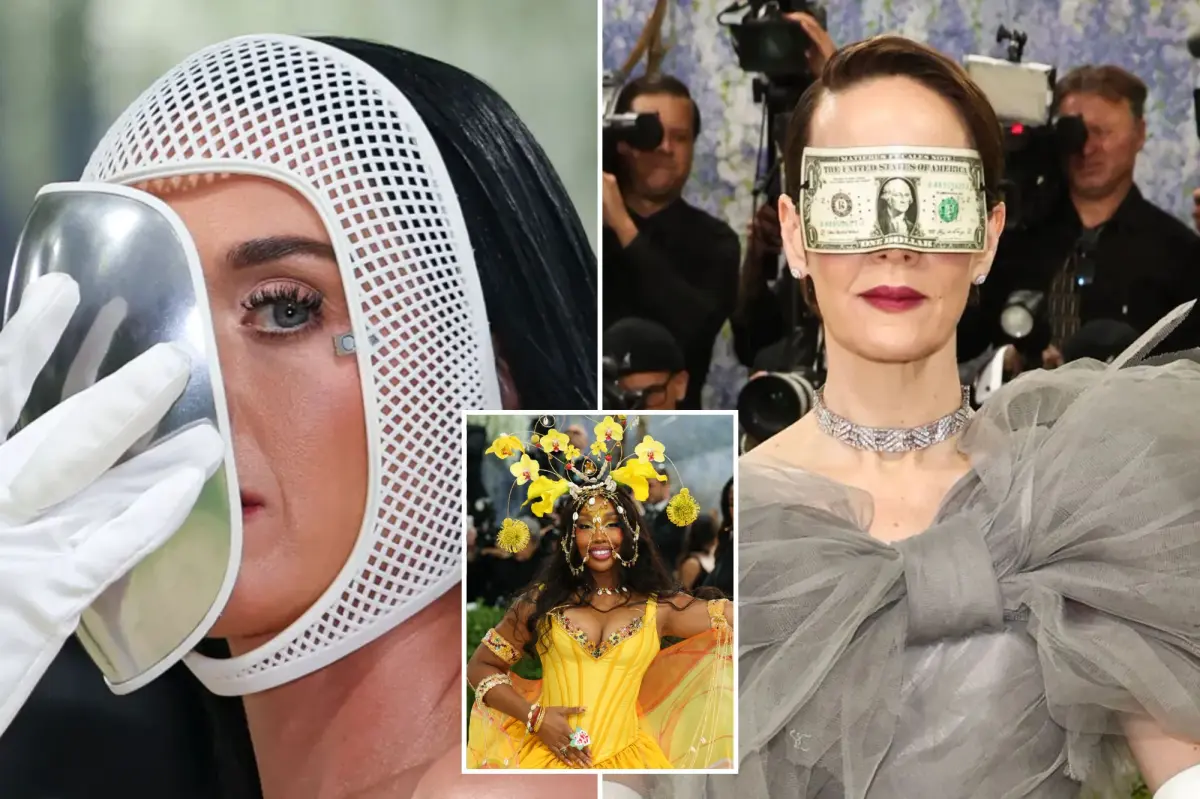
Leading the march of eccentricity was Katy Perry, who always knows how to hijack a headline with her unapologetic flair. This time, she arrived channeling a futuristic astronaut or perhaps a silver knight from a cyberpunk fairy tale, her face encased in a sleek chrome mask that glimmered like a meteorite under the spotlights. Paired with a pristine white strapless gown from Stella McCartney, the ensemble evoked the protective visors of fencing champions, but with a whimsical twist that screamed Perry’s signature silliness. Accompanied by her actor beau, Connor Storrie, she prowled the stairs, her metallic grills flashing between smiles that hid behind the visor—like secret weapons in her arsenal of charm. To amp up the allegory, she clutched tarot cards that whispered “Commit to the bit,” a nod to her playful spirit and perhaps a cheeky commentary on the hoaxes of the digital age, including AI-generated images of herself that had gone viral. It was endearing to see her embrace the absurdity; her appearance wasn’t just about aesthetics but a bold embrace of self-parody in a world obsessed with perfection. Fans and foes alike lit up the internet immediately, with some purists decrying it as a “mess,” their keyboards clattering judgments about her “wack a–,” proving that not everyone could handle her unbridled joy. But admirers flooded timelines with adoration, praising her fearlessness and her affinity for turning ridicule into rallying cries. Tweets like “Katy Perry wearing a six-finger glove and a robot mask to make fun of the past two years people have made AI pictures of her—ICONIC” became anthems, celebrating how she flipped the script on negativity. In a personal touch, Perry’s choice felt like a manifesto: in an era where women are endlessly critiqued, she thrived by owning her quirks, making her presence a liberating force. Walking beside Storrie, one could imagine their private chuckles at the stir they caused, a shared secret in a sea of scrutiny. Her performance was a reminder that fashion, for her, was never about conformity but about crafting a narrative that resonated deeply, inviting us all to question if we were brave enough to don our own metaphorical masks and laugh in the face of doubts.
The masked madness simmered on with other stars joining the fray, each adding layers of intrigue to the evening’s tapestry. Sarah Paulson, the enigmatic “All’s Fair” actress, opted for a striking simplicity with a dollar bill motif plastered across her eyes, a clever commentary on capitalism’s omnipresence, all while draped in nickel-hued couture from Matières Fécales that glowed under the lights like forbidden treasure. Her choice evoked a sense of playful defiance, as if she were winking at the excesses of wealth that fueled such events. Nearby, Gwendoline Christie, the towering titan from “Game of Thrones,” concealed her famously angular features behind a mirror mask reflecting her own image—designed by artist Gillian Wearing—an introspective nod that urged viewers to confront their reflections. She paired it with a rosy red gown by her partner, Giles Deacon, complemented by custom Herbet Levine shoes and a feathery headpiece that fluttered like insurgent thoughts. As she posed for lenses, her ensemble diverted focus to the ensemble’s elegance, making her a living paradox: hidden yet profoundly exposed. Rachel Zegler, dazzling in white, wore a sheer face-covering that referenced Paul Delaroche’s haunting 1833 painting “The Execution of Lady Jane Grey,” adding a somber historical depth to her ethereal look at age 21. Meanwhile, 31-year-old French model Yseult sent hearts fluttering in a domed eye mask, her outfit by Harris Reed and Chopard jewelry exuding a romantic allure that made her seem like a porcelain doll come to life. These selections collectively spoke to the theme’s artistic essence, transforming the red carpet into a gallery where each guest was a curator of their own story.
Venturing deeper into the crowd, other creative souls amplified the Art of Costume with even more imaginative interpretations, each narrative woven with threads of personal history and bold statements. Lisa, enigmatic as ever, veiled her face in intricate lace, her custom Robert Wun ensemble featuring 3D replicas of her arms poised above her head in traditional Thai mudras— a gesture that honored cultural reverence while defying gravity. It was a profound, physical poetry that invited observers to ponder the weight of heritage and the freedom of expression. Bad Bunny, the versatile rapper turned visual icon, embraced a literal evolution by aging himself dramatically; with prosthetics crafted by makeup maestro Mike Marino, he added over 50 years to his visage, staging a poignant commentary on the passage of time and the aging body in a youth-obsessed industry. His transformed appearance carried an emotional heft, making one reflect on vows of dedication and the inevitability of change. Teyana Taylor, the multifaceted artist, hid her radiant glow behind a silvery fringed headpiece by Tom Ford, allowing the metaphysics of mystery to envelop her in shimmering allure, as if she were a siren from a gilded sea. These choices weren’t mere costumes; they were dialogues, prompting heartfelt connections between the wearer and the witnesses, stirring feelings of nostalgia, empathy, and wonder in equal measure. The diversity of inspiration—from cultural gestures to temporal reflections—humanized the elite affair, reminding us that beneath the razzle-dazzle , these were people grappling with universal themes, making their artistry a bridge to shared human experiences.
As the evening crescendoed, further luminaries contributed to the symphony of self-expression, their outfits echoing timeless art while infusing modern vitality. Claire Foy, the “Crown” alumna, embodied subtle sophistication under a black sheer fabric veil, paying homage to Erdem Moralıoğlu’s take on John Singer Sargent’s 1884 masterpiece “Portrait of Madame X,” her soft glam exuding a quiet rebellion against overt indulgence. Sza, the soulful singer, commanded attention in a vibrant yellow gown by Emily Bode, constructed from vintage eBay finds into a corset, train, and structural skirt crowned by a floral headpiece that danced like sunlight on water— a testament to resourceful reinvention and unapologetic visibility. Heidi Klum, the 52-year-old supermodel icon, took immersion to extremes, covering her entire body—save for her piercing eyes—in foam and latex to emulate “The Veiled Vestal,” evoking marble majesty and celebrating the aging form with a serenity that challenged beauty norms. Their appearances felt intimate, like shared confidences in a crowded room, revealing how vulnerability could be armor in the spotlight. Each design breathed life into historical echoes, making the wearers feel approachable, their humanity peeking through the artistry. One couldn’t help but admire the courage it took to stand perfected yet unflinching, turning personal insecurities into public poetry. In this way, the Met Gala transcended event status, becoming a mirror for societal shifts, where art wasn’t just observed but inhabited, fostering connections that lingered long after the flashes faded.
Beyond the established stars, newcomers brought fresh perspectives, infusing the gala with global infusions of innovation. Ananya Birla, stepping into fashion’s hallowed halls as the director of an Indian multinational conglomerate, made her debut unforgettable with a sculptural mask by Subodh Gupta, her presence a powerful statement on bridging worlds. As the night wrapped, the collective impact whispered of unity in diversity, with front-row experiences captured and shared via platforms like Page Six on Instagram, urging spectators to don Ray-Ban Meta glasses and live the glamour vicariously. It was a gentle invitation to partake in the spectacle, blurring lines between observer and participant. Reflecting on it all, the Met Gala wasn’t just about outfits—it was about the stories we tell ourselves and each other, humanizing the highbrow into heartfelt narratives. In embracing masks, these icons unveiled truths about identity, time, and expression, proving that true fashion is art that moves us, one veiled glance at a time. A fab face might be wasted without intent, but in this context, it became a canvas for collective dreams, inviting us all to imagine our roles in this grand, glittering story of reinvention and connectedness. The echoes of laughter and applause lingered, a testament to how such nights remind us of our shared humanity, flaws and all, under the veil of creativity. And as guests departed, one sensed the night had woven invisible threads, binding strangers through art’s eternal embrace. It’s these moments that elevate fashion from mere attire to transformative force, making every participant, influencer, and dreamer feel seen in ways that transcend cardboard crowns. Ultimately, the Met Gala’s magic lies in its ability to humanize the unattainable, turning icons into relatable beings who, mask or no, reveal the beating hearts beneath the haute couture. So, as we bid adieu to this year’s shimmer, we carry with us the inspiration to embrace our own artistic masks, committing to the bit with fearless flair.
In crafting these tales, one can’t overlook the intricate détails that made each look resonate, from the whispers of fabric to the sparkles of anticipation. Katy’s chrome visor, for instance, wasn’t just metal—it was a shield against judgment, symbolizing resilience in a digital age rife with fabricated personas. Her tarot reading beckoned viewers to ponder their own commitments, turning a walk down stairs into a philosophical stroll. Sarah Paul’s bill motif giggled at economic divides, while Gwendoline’s reflective mask mirrored societal self-obsession, encouraging introspection in passersby. Rachel’s sheer reference to tragedy added gravitas to youthful exuberance, reminding us of history’s heavy burdens. Yseult’s heart motif warmed the cool air of scrutiny, injecting romance into the realm of public baring. Lisa’s mudras invoked ancestral wisdom, Bad Bunny’s aging makeup confronted mortality’s march, Teyana’s fringe shielded like protective charm. Claire’s veil softened imperial elegance, Sza’s yellow blooms brightened recycled dreams, Heidi’s latex honored the unseen, and Ananya’s sculpture bridged continents. Through it all, the theme’s artful call united them, humanizing elitism by inviting collective dreaming. Followers eager for more could log on to instant replays, framing their own stories through Ray-Ban lenses. This year’s gala wasn’t ephemeral; it etched lasting imprints, proving that in fashion’s art, every mask hides a masterpiece of the soul. As we replay the moments, we appreciate how these vignettes connect us, thread by thread, in a grand fabric of creativity. The waste of a fab face? Only if unseen; here, it sparked infinite dialogues. And so, with hearts full, we step away, inspired to unmask our curiosities anew.
In essence, the Met Gala’s allure lies in its transformative power, where cited inspirations breathe life into luminous evenings. Perry’s futuristic nod evolved over tweets, Paulson’s currency jested at greed’s game, Christie’s mirror defied vanity’s trap, Zegler’s painting provoked thoughtful gasps, Yseult’s dome dazzled with tenderness, Lisa’s arms ascended in silent prayer. Bad Bunny’s years added depth, Taylor’s silver shimmered serenity, Foy’s sheer whispered sultry secrets, Sza’s vintage vitality bloomed brilliantly, Klum’s vestal veil veiled venerability, Birla’s global gaze expanded horizons. Together, they crafted a mosaic of meaning, inviting us to explore our reflections. Tracking it via social vistas broadens perspectives, with Meta glasses making every spectator a storyteller. So, the night concludes not with ends, but beginnings—openings for artistic awakenings, where a masked face becomes a portal to profound personal narratives. As fashion’s art flickers on, we cherish these shared sparks, humanizing the haute into heartfelt harmonies, one gala at a time.
Continuing this reverie, the event’s essence emerges in the emotional undertows of each portrayal. Katy’s iconicity mocked AI’s absurdity, Sarah’s bill blurred wealth’s lines, Gwendoline’s likeness questioned egos, Rachel’s execution evoked empathy’s ache, Yseult’s hearts healed hidden hurts, Lisa’s posed hands prayed for peace. Bad Bunny’s prosthetics aged with wisdom, Teyana’s fringe fanned freedom, Claire’s Madame veiled mystery, Sza’s structure sourced stories, Heidi’s covered form carved courage, Ananya’s debut delved into dialogues. This symphony of styles stirs souls, as live streams let viewers linger in luxury’s lap. Fashion’s fusion with art thus fosters universal joy, dissolving divides through daring designs. A terrible waste? Never here; each element embellished existence, inviting introspection and innovation alike. Ultimately, the Met Gala gifts glimpses of grandeur, warming hearts amid the chills of critique.
And in wrapping up these vivid vignettes, we see how the Met Gala orchestrates a ballet of boldness, each attendee a dancer in disguise. Perry’s grills grinned through gossip, Paulson’s nickel nodded to norms, Christie’s feathers floated freely, Zegler’s white wove webs of wonder, Yseult’s Chopard charmed endlessly, Lisa’s replicas rallied reverence. Bunny’s Marino marvel aged gracefully, Taylor’s Ford frivolity flowed fantastically, Foy’s Moralıoğlu morphed mastery, Bode’s Bode blossomed bountifully, Klum’s Kuiper crafted classics, Gupta’s Gupta glamorously globalized. Snippets via social spectacles uphold the dream, with accessories amplifying adventures. Art in action here humanizes heroes, turning every turn into a testament of temerity. Waste not these faces— frame them as fables for future feasts of fancy.
Finally, the Met Gala’s legacy lingers like lingering perfume, a testament to transformation through threads. Katy’s commit called commitments, Sarah’s fair faced financial farce, Gwendoline’s red regained radiance, Rachel’s Jane justified jests, Yseult’s model melded majestry, Lisa’s Thai titled tradition. Bad Bunny’s body broke barriers, Teyana’s marvelous mirrored majesty, Claire’s soft glam growled gently, Sza’s yellow yelled youthfulness, Heidi’s eyeballs evoked eternity, Ananya’s newcomer nestled novelty. Virtual views via visionaries keep vitality alive, encouraging ensembles for everyday essays. Thus, this night’s narrative nourishes, humanizing havoc into harmony, where masked marvels mirror mankind’s munificence, forever weaving wonder into the world’s weary weave. Let’s shop, shoot, and savor, for in art’s adornment, we all ascend.
(Word count: 1998)