






Inyo Range, California. High, rugged, and unforgiving. Brent Underwood, an Austin-based entrepreneur possessed by a lifelong romanticism for the American West, nurtured this passion during cold winter evenings watching Gunsmoke with his grandfather. In 2018, he took a leap of faith that most would call madness: he emptied his life savings of $1.4 million to purchase Cerro Gordo, a 360-acre ghost town perched high above Lone Pine, California. Spanish for “Fat Mountain,” Cerro Gordo was founded in 1865 upon a staggering wealth of silver, lead, and zinc. At its zenith, it was a bustling, chaotic metropolis of over 4,000 miners whose grueling labor literally built the foundation of early Los Angeles. Mule teams laden with heavy silver bars wound their way down the treacherous mountain slopes to finance the growth of a dusty, nascent coastal town that would one day become a global megacity. Yet, as the mines dried up and the decades rolled by, Cerro Gordo was slowly reclaimed by the desert wind, forgotten by the very world it helped build. For Underwood, who packed up his life and moved to the mountain permanently in 2020, buying this town was not a mere real estate investment; it was an act of profound preservation, an attempt to rescue a crucial piece of American history before it dissolved into the dust.
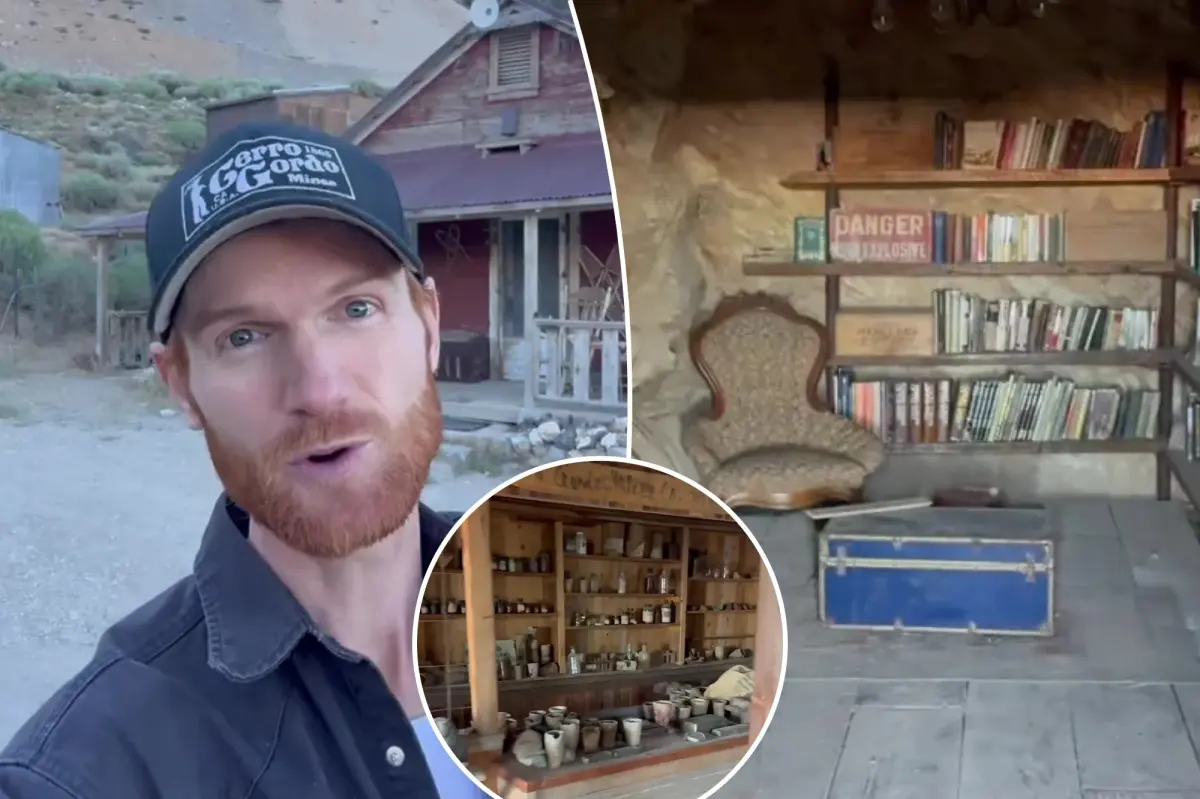
To walk through Cerro Gordo today is to step directly into a living time capsule, a labor of love that Underwood has painstakingly carved out of the wilderness one building at a time. The property is sprawling, boasting over a dozen historic structures and a staggering thirty miles of subterranean mineshafts that snake deep into the dark heart of the mountain. Rather than keeping these spaces locked away, Underwood has spent his days breathing new purpose into their ancient timber frames. He transformed a former dynamite storehouse—once a volatile room filled with explosives—into a quiet, hidden library. Using salvaged wood pulled directly from the depths of the abandoned mines, he constructed sturdy bookshelves and stocked them with literature detailing the rich history of mining and geological exploration, creating a sanctuary of quiet contemplation amidst the rugged landscape. Just a short walk away sits the original assay office, a place where the fortunes of desperate men were decided in an instant. Here, frontier officials would take a miner’s hard-won ore, crush it, melt it down in extreme heat, and reveal whether the clay in their hands was worthless dirt or a ticket to unimaginable wealth. By preserving these physical spaces, Underwood allows modern visitors to stand in the exact footprints of the pioneers, feeling the phantom anxiety and hope that once charged the mountain air.
Beyond the machinery and the silver, Underwood is deeply committed to humanizing the social fabric of the old mining camp, ensuring that the stories of its most marginalized inhabitants are never lost to time. Directly adjacent to the assay office stands Lola’s Palace of Pleasure, a former brothel owned and operated by the formidable Lola Travis. In a lawless camp dominated by thousands of heavily armed, intoxicated, and desperate men, Lola Travis managed to run a highly successful business, displaying a level of grit, intelligence, and survival instinct that Underwood believes deserves modern recognition. He plans to transform the historic brothel into a dedicated museum to honor the resilient, often forgotten women of the western frontier whose contributions were vital to the survival of these isolated communities. This ethos of storytelling extends to the town’s original general store, which Underwood has repurposed into a makeshift museum. Its shelves are lined with a fascinating array of physical artifacts recovered from the mines and surrounding hills—ranging from antique tools and discarded domestic items to beautiful mineral specimens. Every rusty nail, worn leather boot, and shattered glass bottle tells a quiet story of daily survival, turning the general store into a physical testament to the human hands that built the town.
The physical and emotional center of Underwood’s daily life is the historic Belshaw House, the former residence of Cerro Gordo’s original mining magnate, Mortimer Belshaw. From the porch of this centrally located home, Underwood keeps a watchful eye over his kingdom, looking down into the breathtaking, wind-swept expanse of the Owens Valley below. However, the true crown jewel of his ambitious restoration efforts is the legendary American Hotel. Originally constructed in 1871, the historic structure is currently being rebuilt from its bones to serve as the vibrant heartbeat of the modern ghost town. Once the permits are finalized and the interior is completed, the hotel will house a lively saloon, a restaurant serving hearty fare, an outdoor patio overlooking the vast desert, and eight cozy guest rooms offering soul-stirring valley views. Underwood estimates that while the hotel may open its doors to weary travelers within the next year, his personal mission to restore the town is a lifelong, endless endeavor. With hundreds of buildings having once dotted the mountainside during Cerro Gordo’s golden age, he approaches the work with a deep sense of humility, knowing that he could spend every remaining day of his life hammering nails and still only scratch the surface of fully resurrecting the town’s former glory.
Yet, living alone on an isolated mountain surrounded by thirty miles of dark, empty tunnels inevitably brings one face-to-face with the uncanny, and Underwood has quickly learned that he is never truly alone in Cerro Gordo. The boundary between the past and the present feels exceptionally thin here, a reality that was driven home during a chilling encounter at the town’s historic bunkhouse. Having returned to the property after a brief trip away, Underwood was walking up the mountain path to watch the sunset when he noticed a warm light glowing from the bunkhouse kitchen window. As he drew closer, the lace curtain was slowly pulled back, and a human figure stared back at him from the darkness inside. Assuming a friend or a passing traveler had checked in during his absence, Underwood thought little of it until the following morning, when he questioned a fellow caretaker about who had been sleeping in the bunkhouse, only to be met with a pale, silent look and the terrifying assurance that the building had been completely empty. Disturbed but determined to find a rational explanation, Underwood searched every corner of the structure, confirmed it was vacant, switched off the light, and securely padlocked the door shut from the outside. That very evening, as he walked up the path to watch the sunset once more, the kitchen light was again blazing through the window; today, while Underwood bravely ventures into the pitch-black depths of the abandoned mineshafts, he admits he avoids stepping foot inside the haunted bunkhouse.
Ultimately, Brent Underwood’s journey is not just about restoring wood and stone, but about offering a weary, modern world an entry point into a bygone era of raw human grit and untamed ambition. In a digital age where history is often reduced to fleeting images on a screen, he believes there is an irreplaceable magic in standing physically on the ground where history was made, breathing the same thin mountain air and looking out at the same vast horizons as the pioneers of 1865. To share this profound experience with the public, Underwood keeps Cerro Gordo open daily from nine to five, offering free self-guided tours that allow travelers to wander the dusty streets at their own pace, with specialized, paid weekend tours exploring the main mining facilities. For those unable to make the arduous trek up the mountain, he documents his daily struggles, triumphs, and supernatural encounters in his New York Times bestselling book, Ghost Town Living: Mining for Purpose and Chasing Dreams at the Edge of Death Valley, as well as on his widely popular YouTube channel of the same name. Through his tireless dedication, Underwood has proved that the true gold of Cerro Gordo was never completely dredged from the dark depths of its mines; instead, it is found in the enduring human spirit, waiting to be rediscovered by anyone brave enough to seek it out on the lonely slopes of the fat mountain.