




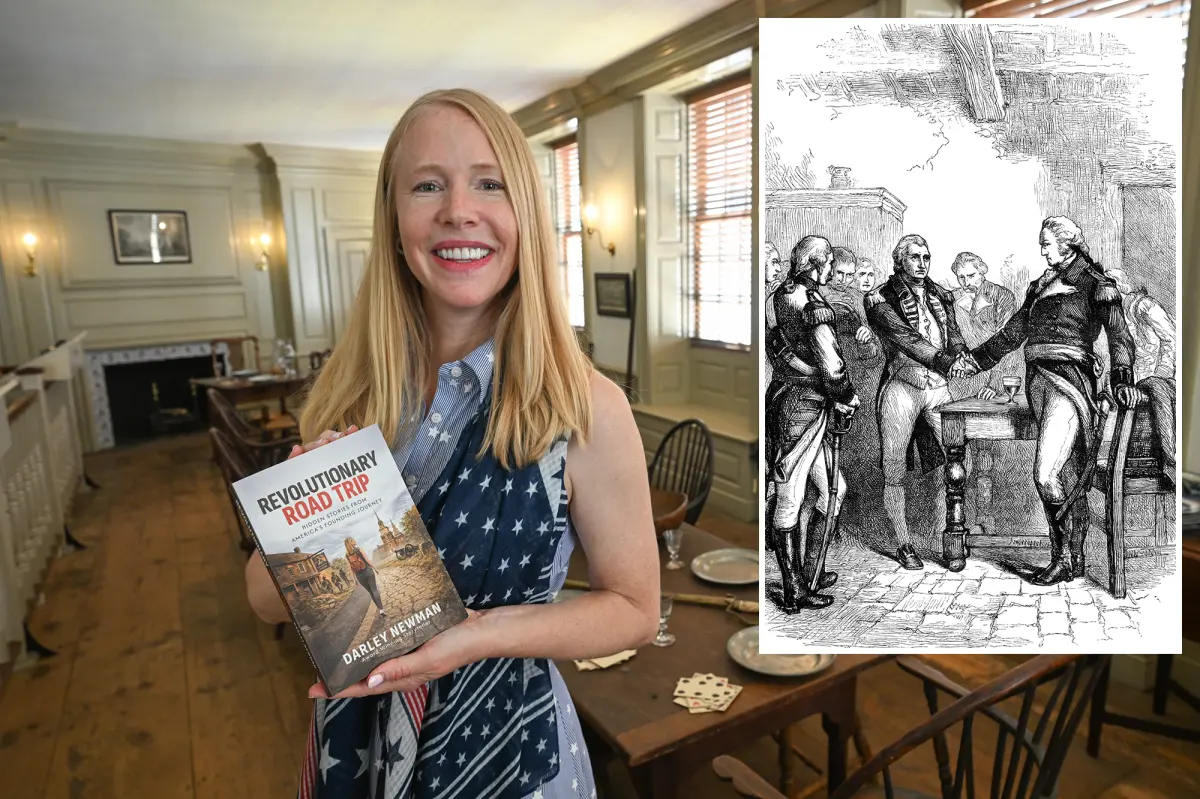
As the United States rapidly approaches its historic semiquincentennial—celebrating 250 years since the signing of the Declaration of Independence—patriots, history buffs, and casual travelers alike are looking for unique ways to connect with the nation’s founding era. While textbook accounts often paint the Founding Fathers as solemn, stiff figures frozen in cold marble or oil paintings, the reality of their daily lives was far more vibrant, social, and distinctly spirited. Renowned Emmy Award-winning television travel host Darley Newman recently embarked on an extensive journey through the original thirteen colonies for her popular PBS series, Travels with Darley, and her highly anticipated book, Revolutionary Road Trip. Her adventures led to an incredibly humanizing and lighthearted conclusion: the architects of American democracy loved to party, and they did so with remarkable enthusiasm. In the late 18th century, taverns and public houses were not merely establishments for eating and drinking; they functioned as the true, beating hearts of the revolution. These warm, candlelit community hubs served as local town halls, information exchanges, and makeshift military headquarters where revolutionaries debated enlightenment philosophy, traded crucial wartime intelligence, planned bold battlefield strategies, and celebrated hard-fought victories over overflowing bowls of spiced rum punch, hearty ales, local whiskies, and rustic comfort food.
For those looking to walk directly in the footsteps of national legends, Manhattan’s Financial District offers the ultimate starting point at the legendary Fraunces Tavern. Established in 1762 on Pearl Street, this historic treasure stands proudly as the oldest surviving building in Manhattan, having originally been constructed in 1719. Fraunces Tavern is perhaps most famous as the emotional site where General George Washington delivered his historic farewell address to his officers in December 1783, bringing tears to the eyes of battle-hardened soldiers. Yet, the tavern’s walls also whisper darker tales of American political history; it was here that New York Post founder Alexander Hamilton shared a tense, final dinner with his bitter rival, Vice President Aaron Burr, a mere week before their fateful, deadly duel across the Hudson River in Weehawken, New Jersey. The tavern was also a favorite spot for other legendary patriots, including Samuel Adams, John Hancock, and John Jay. In a humorous nod to modern convenience, Newman notes that Washington even ordered meals to go from the establishment, playfully cementing his legacy as New York City’s very first “Door Dasher.” Today, Fraunces Tavern operates as a beautiful hybrid of a museum and a working tavern, celebrating the nation’s 250th anniversary by serving a authentic three-course colonial menu featuring braised rabbit legs, stuffed quail crépine, and cherry trifle. Visitors can wash down these historic delicacies with “Presidential Punch”—a potent, historically inspired concoction of rye whiskey, orange liqueur, rum, bitters, lemon juice, and peach iced tea designed to mimic the flavors favored by the Founders.
Moving north into the picturesque and strategically vital Hudson Valley, travelers can uncover the fascinating stories behind the Olde Bryan Inn in Saratoga Springs, Baird’s Tavern in Warwick, and Sweet Clover Farm in Highland Mills. The Olde Bryan Inn began its life as a modest log cabin before being purchased in 1787 by Revolutionary War hero Alexander Bryan. During the conflict, the inn was uniquely positioned to host both American and British forces, allowing Bryan to operate as an essential spy for the Patriot cause; the intelligence he gathered right at the bar ultimately helped secure the American victory at the Battle of Saratoga, widely considered the turning point of the entire war. Further southwest, the historic Baird’s Tavern, built in 1766 along the busy King’s Highway, hosted both George and Martha Washington. General Washington’s personal diaries record that he stopped here in 1783 to enjoy a refreshing glass of “grog”—a classic naval mix of watered-down rum—while commanding the Continental Army, and visitors today can still view the second-floor bedroom, complete with a canopy bed from the 1780s, where Martha Washington is believed to have stayed. Nearby, at the family-owned Sweet Clover Farm in Highland Mills, the revolutionary spirit is preserved through modern craft distilling on land originally owned by Aaron Burr. This beautiful farm distillery produces exceptional vodka, gin, and bourbon, including their signature “Bulls Head” bourbon, which pays direct homage to the long-lost Bulls Head Tavern in Lower Manhattan where George Washington established his temporary military headquarters in November 1783.
Crossing the state line into New Jersey reveals an equally rich tapestry of revolutionary hospitality, beginning in the historic collegiate town of Princeton at the legendary Nassau Inn and its famous Yankee Doodle Tap Room. Originally known to locals as the College Inn, this prominent lodging house experienced the harsh realities of war firsthand when it was occupied by British redcoats during the conflict. Following the British retreat, the inn became a safe haven for members of the Continental Congress, who lodged there while meeting in nearby Nassau Hall, which briefly served as the nation’s temporary capitol building in 1783. It was inside the cozy rooms of the Nassau Inn that American leaders raised massive punchbowls to toast both the triumphant victory at the Battle of Yorktown and the official signing of the Peace Treaty that guaranteed American independence. Today, the inn’s beloved Yankee Doodle Tap Room keeps this celebratory atmosphere alive, anchored by an incredible, thirteen-foot-long mural painted by the iconic American illustrator Norman Rockwell. The mural, which colorfully depicts the satirical colonial anthem “Yankee Doodle,” is bound to the building in a hilariously permanent way; Newman reveals that while art curators have long wanted to move the masterpiece to a proper museum, Rockwell painted the scene directly onto a primary load-bearing wall, meaning any attempt to extract the artwork would cause the entire historic tavern to collapse.
Further exploration of New Jersey’s craft beverage landscape highlights how local independent business owners are investing their own resources to keep the architectural and cultural history of the American Revolution alive for future generations. In Hillsborough Township, Flounder Brewing Co. operates out of a beautifully restored, 250-year-old timber barn that stands directly along the historic Washington–Rochambeau Revolutionary Route. This preserved 680-mile trail marks the precise path marched by General Washington and French General Rochambeau’s allied forces during their decisive 1781 march from Rhode Island to Virginia, which culminated in the final victory at Yorktown. Rather than tearing down the dilapidated historic structure to build a cheap, modern warehouse, brewery founder Billy Jordan undertook a painstaking and expensive restoration of the barn to honor the land’s history, celebrating the space today with their specially brewed “Victory Town Ale.” Similarly, in Morristown—famously recognized as the “military capital of the American Revolution” because Washington and his army survived two brutal winters there—Glenbrook Brewery steps up to preserve local heritage. As the very first brewery in Morristown, Glenbrook has partnered with Laird & Company, the nation’s oldest licensed distillery (established in 1780), to brew a special “250th Anniversary Ale, Established 1776.” The brewery has quickly become a favorite community gathering place where local historical reenactors, still dressed in full Continental uniforms and wool coats, head after a long day of mock battles to relax, talk history, and share a cold pint.
The journey through America’s revolutionary watering holes concludes with a delightful reminder that history does not only belong in grand brick museums or fine-dining establishments, but can also be found in the most unassuming everyday places, such as the beloved Galloping Hill Inn in Union, New Jersey. This cherished, classic roadside hot dog stand, famous for serving sweet birch beer on tap alongside snap-hot dogs, sits directly alongside Galloping Hill Road. In 1780, this very road saw the heavy march of British troops advancing toward the fierce Battles of Connecticut Farms and Springfield. Near the stand, a stone monument proudly reads, “Here the British turned,” commemorating the exact spot where local New Jersey militia forces successfully repelled the invading royal army and forced a retreat, prompting a glowing direct quote from George Washington, who praised the New Jersey soldiers for flying to arms universally and acting with a spirit equal to anything he had witnessed throughout the entire war. As the United States prepares to celebrate its momentous 250th birthday, embarking on a historic pub crawl through New York and New Jersey provides an incredibly fun, tangible, and humanizing way to connect with the past. By raising a glass of local craft beer, sipping a traditional rum punch, or sharing a meal in these historic spaces, modern travelers can honor the brave men and women who fought for freedom, keeping the warm, social, and brilliantly rebellious spirit of the American Revolution alive for centuries to come.