





The Italian Renaissance is frequently remembered as an era of unparalleled artistic brilliance, architectural marvels, and intellectual rebirth, yet beneath this glittering surface lay a darker, fragile world dominated by fierce political rivalries, dynastic ambitions, and a profound vulnerability to sudden mortality. No family embodied this duality more dramatically than the house of Medici, the legendary dynasty that bankrolled the European Renaissance and ruled Tuscany with calculated precision. In October of 1587, a sudden tragedy struck the family that would spark a centuries-old mystery and cast a dark shadow over their legacy for generations to come. Grand Duke Francesco I de’ Medici and his highly controversial second wife, Bianca Cappello, retreated to their luxurious villa in Poggio a Caiano, seeking a quiet respite in the beautiful countryside outside Florence. Within days of their arrival, however, both fell suddenly and violently ill with agonizing, fluctuating fevers, ultimately dying just eleven hours apart from one another. The sheer speed of their demise, combined with their highly contentious relationship with Francesco’s younger brother, Cardinal Ferdinando de’ Medici, instantly ignited rumors of foul play. Popular gossip whispered that the Cardinal, desperate to claim the ducal throne and rid the family of Bianca—whom many court gossips openly despised—had orchestrated a cold-blooded double murder using arsenic. For more than four hundred years, this sensational narrative of fratricide and political poisoning persisted in history books, literature, and folklore, casting Ferdinando as a ruthless, power-hungry villain who was willing to destroy his own blood to secure his political destiny. Yet, this dramatic tale ignored the quiet, ecological reality of the Renaissance landscape, where the ultimate arbiter of life and death was often not a scheming sibling with a vial of poison, but a microscopic threat carrying devastating illness. Today, thanks to a pioneering collaboration of international scientists, the historical gossip has finally been confronted with hard genetic evidence, transforming our understanding of the past and offering a deeply humanizing closure to a centuries-old tragedy.
To truly understand the tragic end of Francesco and Bianca, one must look beyond the gilded halls of their magnificent palaces and examine the perilous environment in which they lived, a landscape where even the vast wealth of the Medici could not buy protection from nature’s deadliest elements. During the sixteenth century, the beautiful, rolling hills of Tuscany were punctuated by vast, swampy wetlands that served as ideal breeding grounds for clouds of disease-carrying mosquitoes. The local populations lived in constant, anxious dread of what they termed “febbre terzana”—or tertian fever—which we now recognize as malaria, a word itself derived from the Italian for “bad air.” This insidious disease was deeply endemic to central Italy, keeping the population in a perpetual state of anxiety during the warm summer and autumn months when marshlands thrived. When Francesco and Bianca fell ill, the court physicians of the era struggled desperately to comprehend the invisible enemy invading the ruler’s body. Armed only with the rudimentary medical knowledge of the time, doctors turned to the standard, albeit highly counterproductive, practices of Renaissance medicine, most notably bloodletting. Believing they were restoring balance to the body’s humors, they repeatedly drained the weakened sovereign and his wife of their vital fluids, a torment that undoubtedly hastened their deaths rather than curing their ailments. The agonizing nature of their final days was meticulously logged by court scribes, who detailed the relentless, cycling fevers, severe dehydration, and physical decline that characterized their final hours. Despite these contemporary clinical descriptions, which pointed directly to a severe, natural infection, the human appetite for political drama and conspiracy theories ensured that rumors of arsenic poisoning overshadowed the medical realities of malaria, leaving a historical stain on the family that would endure for generations.
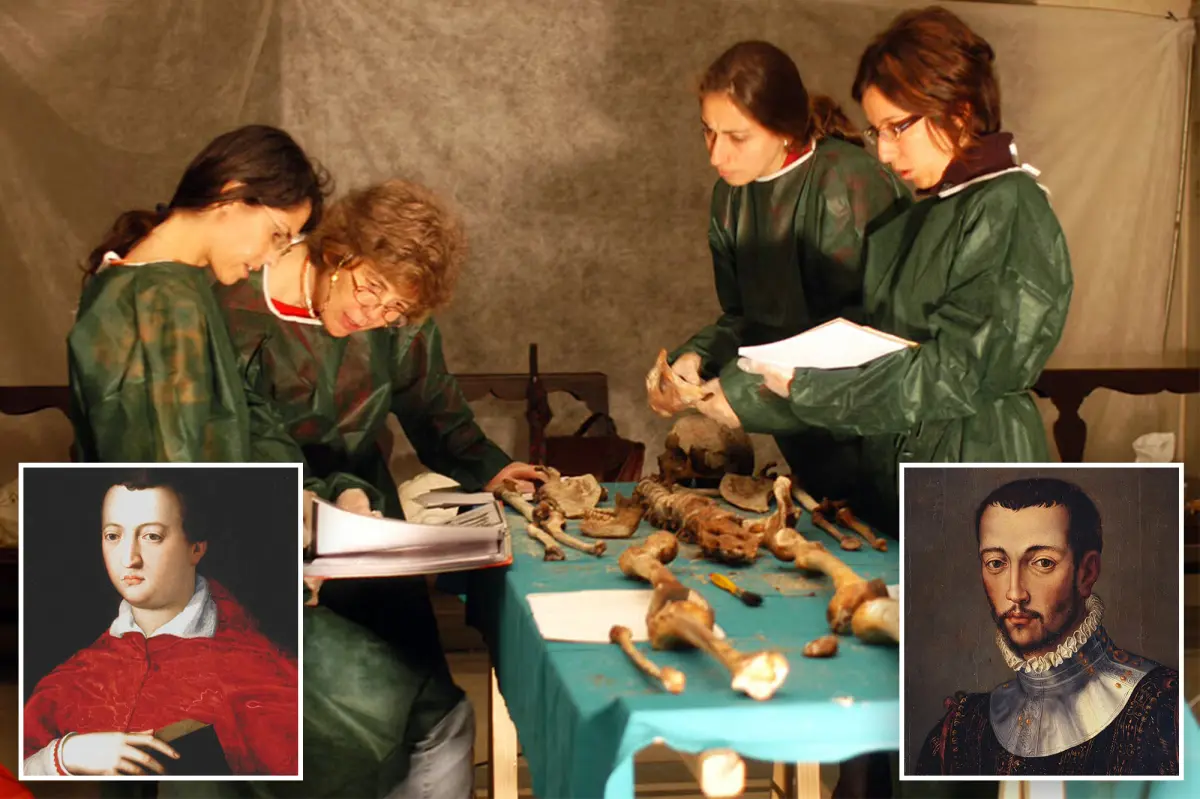
Now, a modern scientific endeavor has finally stripped away the layers of historical myth, utilizing cutting-edge genomic tools to act as an objective investigator into the Medici family’s final days. Led by Serena Tucci, an assistant professor of anthropology at Yale University, and working alongside a dedicated team of paleopathologists from the University of Pisa in Italy, researchers set out to conduct the first-ever genetic analysis of the brothers’ skeletal remains. The scientific team approached the task with a profound sense of historical stewardship, knowing they were handling the physical remnants of individuals who had once shaped the course of Western history. They focused their efforts on analyzing the ancient DNA extracted from the mineralized matrices of ribs belonging to Grand Duke Francesco I de’ Medici, as well as those of his younger brother, Giovanni de’ Medici. Giovanni had tragically predeceased Francesco by twenty-five years, dying in 1562 under similarly sudden and febrile circumstances at the tender age of nineteen. By utilizing advanced laboratory techniques designed to isolate highly degraded and ancient genetic material, the scientists hoped to bypass centuries of speculation and locate direct, biological evidence of the pathogens that had truly claimed the lives of these two Renaissance noblemen. This painstaking process required extracting DNA from centuries-old bone dust, a delicate operation where researchers had to carefully separate authentic historic DNA from modern environmental contaminants and human touch, ensuring that any discoveries made would be scientifically indisputable and capable of standing up to rigorous academic scrutiny. The paleogeneticists worked in highly specialized, sterile cleanrooms, wearing protective gear to prevent any modern DNA from clouding the ancient genetic signals. The physical act of drilling into the centuries-old bone samples was both a delicate surgical procedure and an act of profound curiosity, bridging the gap between historical biography and laboratory science.
The results of this molecular detective work, recently published in the prestigious journal iScience, provided a breathtaking breakthrough that decisively altered our understanding of the Medici family’s history. Within the ancient bone structures of both brothers, the research team discovered the unmistakable genetic signatures of Plasmodium falciparum, the single-celled parasite responsible for the most severe, fatal, and agonizing form of human malaria. Specifically, in the skeletal remains of young Giovanni de’ Medici, the scientists identified a previously unknown, novel strain of Plasmodium falciparum, offering concrete physical confirmation of his cause of death and showing how the disease plagued the family across generations. More astonishingly, the genetic analysis of Grand Duke Francesco’s remains yielded not only the molecular traces of P. falciparum but also a second parasite species, Plasmodium malariae, proving that he was suffering from a devastating, multi-species malarial infection at the time of his sudden demise. This double-pathogen assault would have completely overwhelmed his immune system, triggering the catastrophic and erratic fevers described so vividly by his helpless court physicians. By directly detecting the physical presence of these deadly parasites within the very bones of the deceased, the Yale and Pisa research team succeeded in providing the first-ever direct genetic proof of malaria in these historic figures. This landmark discovery effectively dismantles the malicious poisoning narratives, replacing historical gossip with concrete, empirical data that highlights the indiscriminate and lethal power of infectious disease during the Renaissance, showcasing that microbes could fell even the mightiest rulers of the world. The genetic signatures survived for nearly half a millennium inside the protective, mineralized microenvironments of the skeletal remains, showing how nature preserves its own records of mortality. This direct scientific evidence finally silences the long-lived rumors that had plagued history books, demonstrating that the primary cause of Francesco’s death was a tiny parasite rather than a vial of arsenic.
While this scientific revelation serves as an intellectual triumph, it also carries a deeply humanizing weight, quietly rewriting the historical legacy of an accused family member and offering a form of posthumous justice. For over four centuries, Cardinal Ferdinando de’ Medici was remembered not just as a patron of the arts and a competent ruler of Florence, but as a cold-blooded fratricide who allegedly poisoned his own brother and sister-in-law to satisfy his thirst for absolute power. This scientific discovery acts as an unbiased defense attorney, lifting the heavy shroud of accusation that has long tattered Ferdinando’s historical reputation. As Dr. Serena Tucci noted, while it is scientifically impossible to completely disprove the presence of poison without a time machine, the discovery of severe, concurrent malaria infections in the remains provides an overwhelmingly logical, scientifically grounded explanation for their rapid deaths. The persistent rumors of poisoning, Tucci suggested, likely flourished precisely because the public lacked any concrete, scientific means to verify the true cause of death, leaving a vacuum that was easily filled by political intrigue, gossip, and sensationalism. By grounding this historical drama in the biological reality of the natural world, the study humanizes the entire narrative, forcing us to view these powerful Renaissance figures not as characters in a Shakespearean tragedy of betrayal and murder, but as vulnerable human beings who succumbed to a common and devastating environmental threat. It reminds us that the human impulse to construct elaborate conspiracies around sudden deaths is not a modern phenomenon, but a timeless trait that often obscures the simpler, more tragic realities of our shared vulnerability to the natural world. The scientific vindication of Ferdinando de’ Medici highlights how modern genetics can help clear the historical record, ensuring that our understanding of past human behaviors and relationships is based on objective truth rather than centuries-old propaganda and court drama.
The implications of this innovative research extend far beyond solving cold cases from the Italian Renaissance, highlighting the incredible potential of paleogenomics to bridge the gap between our historical past and our collective global future. As Gisella Caccone, a senior research scientist in Yale’s Department of Ecology and Evolutionary Biology and co-author of the study, emphasized, recovering and sequencing centuries-old DNA does much more than satisfy our historical curiosity. By identifying and studying historical strains of Plasmodium falciparum, scientists can gain invaluable insights into how this lethal parasite has mutated, adapted, and evolved over hundreds of years in response to human interventions and environmental shifts. Understanding the evolutionary velocity of such deadly pathogens is critical for modern medicine, as it enables epidemiologists and geneticists to build more accurate predictive models, design more effective treatments, and develop adaptive strategies to combat drug-resistant malaria in our contemporary world. In this way, the painstaking analysis of the bones of Francesco and Giovanni de’ Medici transcends the realm of historical biography, turning centuries-old skeletal remains into crucial allies for modern global health initiatives. Ultimately, this research demonstrates that by looking backward into the ancient fabric of human remains, we can not only uncover the intimate truths of how our ancestors lived and died, but we can also forge the scientific keys necessary to build a healthier, more resilient future for generations to come. The past, as it turns out, is written in our bones, and those bones contain blueprints that are highly relevant to our modern survival. By viewing history through the lens of evolutionary biology, we can appreciate that the battles fought by Renaissance rulers against infectious disease are the very same struggles we face today, making their skeletal remains not just museum relics, but active guides for current scientific discovery. Using historical specimens can not only help us understand our past better, but also it can help build a better future where modern science can finally vanquish the very diseases that once brought down empires.