



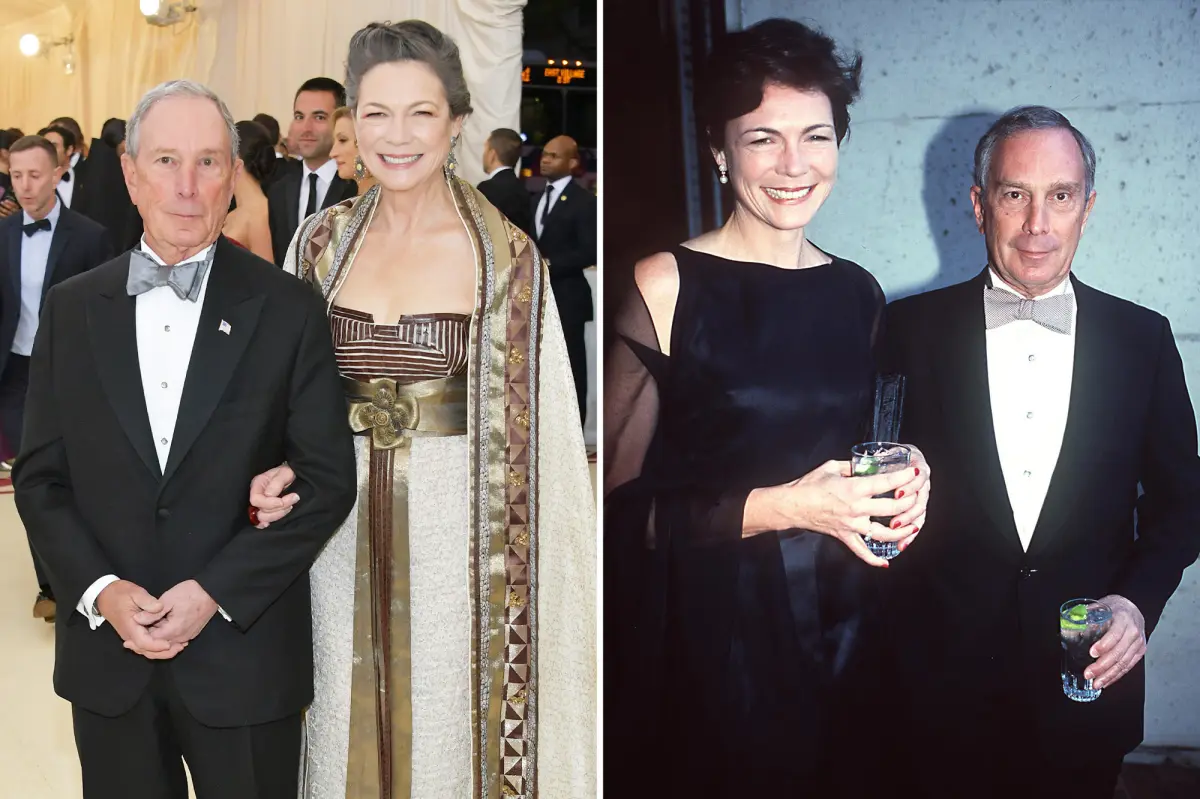
After more than twenty-five years together—long enough for friendships to harden into family, for careers to rise and fall, for children to grow into adults—Michael Bloomberg and Diana Taylor finally made it official. On a quiet Monday afternoon, inside the elegant confines of their Upper East Side townhouse, the former New York City mayor and his longtime partner exchanged vows in a small, private ceremony. There were no cameras, no grand political fanfare, no elaborate guest list. Instead, the room was filled with the people who mattered most: Bloomberg’s daughters, Emma and Georgina, and a tight circle of family and close loved ones. For a man who has spent much of his life in boardrooms, campaign war rooms, and the public eye, it was a strikingly intimate scene—a moment not of spectacle but of quiet devotion. At eighty-four, Bloomberg had been married before, served three terms as mayor, launched a presidential bid, and given away hundreds of millions of dollars. Yet on this afternoon, none of that seemed to matter. What mattered was the woman standing beside him, the partner who had been there for more than two decades, and the simple promise they had finally chosen to make to each other. It was a reminder that some of life’s most significant moments do not need to be broadcast to the world. They only need to be felt.
The story of how they met has the charm of a New York fable. Twenty-six years ago, Bloomberg was preparing to run for mayor for the first time, a businessman with no political experience but an outsized ambition to transform the city. Taylor, a thoughtful and accomplished financial executive, had no idea that a routine civic meeting would change her life. At a Citizens Budget Commission meeting, the two were seated next to each other—a stroke of luck, a coincidence, a chance arrangement of chairs. They began talking, and something clicked. It was not a dramatic, whirlwind romance with grand gestures and urgent declarations. It was slower, deeper, more real. They discovered a shared curiosity about policy, a mutual respect for serious work, and a comfortable ease in each other’s company. Over the months and years that followed, that initial conversation grew into a lasting bond. Bloomberg was still legally married to Susan Brown at the time, but that marriage had effectively ended years earlier; he and Brown had been together from 1976 until 1993. Taylor, too, had been married before and understood the complications of love and life. Neither of them was looking for a fairy tale. They were looking for something sturdier—a companion, a confidante, a partner in every sense. And in each other, they found exactly that. The chance seating at that meeting turned out to be one of those rare pivot points in life, a seemingly insignificant moment that quietly redirects everything that follows.
As a couple, they became one of New York’s most enduring and intriguing partnerships. While Bloomberg occupied the mayor’s office, Taylor was not merely a supportive spouse standing in the background. She was a public servant in her own right, serving as superintendent of banking for New York State in Governor George E. Pataki’s administration. That meant the two of them were, in a sense, colleagues in the business of governing, each navigating the complex currents of public life. Taylor understood the pressures of the job in a way that few partners could. She knew what it was like to be held accountable, to face the press, to make decisions that affected millions of people. And she was frequently at Bloomberg’s side at City Hall events, a steady and poised presence amid the swirl of politics. But their relationship was never defined solely by titles or obligations. They were also simply a couple—two people who enjoyed each other’s company, who traveled together, who built a shared life outside the glare of official duties. They attended galas and art openings, celebrated holidays with their blended family, and navigated the ordinary rhythms of daily life in a city that never stops moving. Through it all, they seemed to understand something essential about each other: that love is not about grand public declarations but about showing up, day after day, for the person you have chosen to walk through life with.
Perhaps the most public test of their partnership came during Bloomberg’s 2020 presidential campaign, when old comments he had made about women resurfaced and threatened to derail his candidacy. It was a moment that could have driven a wedge between any couple. Instead, Taylor stepped forward, not as a campaign surrogate reading from a script, but as a partner defending the man she knew better than almost anyone. At a “Women for Mike” rally in Texas, she did not try to excuse the past or spin the narrative. She met it head-on with a blend of bluntness and grace. “It was 30 years ago. Get over it,” she told CBS News, dismissing the idea that a decades-old remark should define the man she had loved for years. She went further, insisting that in none of the accusations was Bloomberg accused of doing anything other than saying something nasty to a woman. “That is not who he is. Life has changed,” she said. It was a raw, personal defense, the kind that only someone with real intimacy can offer. She acknowledged the world she came from—a world of “bro culture” where crude comments were part of the landscape—but she also insisted that both she and Bloomberg had evolved. “We have come a very, very long way and Michael Bloomberg has been at the forefront of that change,” she added. It was not a perfectly polished political response. It was messier, more human, more honest. And in that honesty, Taylor revealed something about the resilience of their relationship: they had weathered storms before, and they would weather this one too.
Beyond the campaigns and the headlines, their life together has been built on shared values and a commitment to something larger than themselves. Taylor has long been involved in the arts and public service, and in 2021 she was approved as chair of the board of directors of the New York City Ballet—a role that speaks to her deep appreciation for culture and her ability to lead in yet another arena. Bloomberg, for his part, has become one of the most consequential philanthropists in the world, pouring billions into public health, climate change, education, and gun safety. Their relationship has been a kind of partnership of purpose, two people who believe that their good fortune carries with it an obligation to give back. They have also remained deeply engaged in the political life of the country. Bloomberg, who has switched party affiliations over the course of his career, reportedly gave $80 million to Democrats ahead of the midterm elections—a significant sum that underscores his continued influence in national politics. Taylor has been by his side through all of it, not as a passive observer but as an active participant in the conversation. She has her own opinions, her own accomplishments, her own voice. And in their decades together, she has proven again and again that she is not defined by her relationship to a powerful man. She is a force in her own right, someone who brought her own intelligence, warmth, and determination to the partnership.
Now, at eighty-four and seventy-one, they have finally chosen to make their commitment official. It is tempting to wonder why they waited so long. Perhaps they did not feel the need for a ceremony to validate what they already had. Perhaps life simply got in the way—campaigns, careers, responsibilities, the steady accumulation of days and years. Or perhaps they were waiting for the right moment, a quiet Monday when the world was not watching, when the only thing that mattered was the presence of family and the promise they were ready to make. In the end, the wedding was not a beginning but a celebration of something that had existed for a long time. It was an acknowledgment, in front of the people they loved most, that they had chosen each other again and again, through every challenge and every triumph. It was a reminder that love does not always follow the expected timeline. Sometimes it moves slowly, patiently, building a foundation so solid that the ceremony itself becomes almost symbolic. For Michael Bloomberg and Diana Taylor, the decades they spent together before saying “I do” were not wasted years. They were the years that made the promise possible—years of trust, partnership, and quiet devotion. And on that Monday afternoon, in the home they shared, they finally gave that devotion a name. It was a small ceremony, but it held a lifetime of meaning.