




The world felt the ground shift beneath its feet the day the announcement came; the relentless pulse of a Hollywood that thrives on endless motion momentarily went quiet, but only for a beat. When the icon known as Dolly Parton left this earth at the tender age of eighty, succumbing after a quiet, private battle with cancer, the world didn’t just mourn her passing—it lashed out to grasp her memory with a ferocious, almost desperate intensity. In the very first hours following the heartbreak, something extraordinary happened not in the hospital rooms or at her Tennessee estate, but in the quiet, glowing aisles of digital retail. It wasn’t just her music that people sought; it was her denim. Fashion-minded fans, people who had followed her career, and even those who merely adored the idea of her big blonde hair and milky smile, began flooding search engines and online shops. Their mission was single-minded: to get their hands on a pair of the legendary Joleans, the jeans she had crafted with Khloé Kardashian for the latter’s denim brand, Good American. The world of commerce experienced a jolt of static, an electrical spike, as people came to realize that the woman who famously “wore the pants” had left something deeply personal behind in the tightly stitched seams of her last great fashion collaboration.
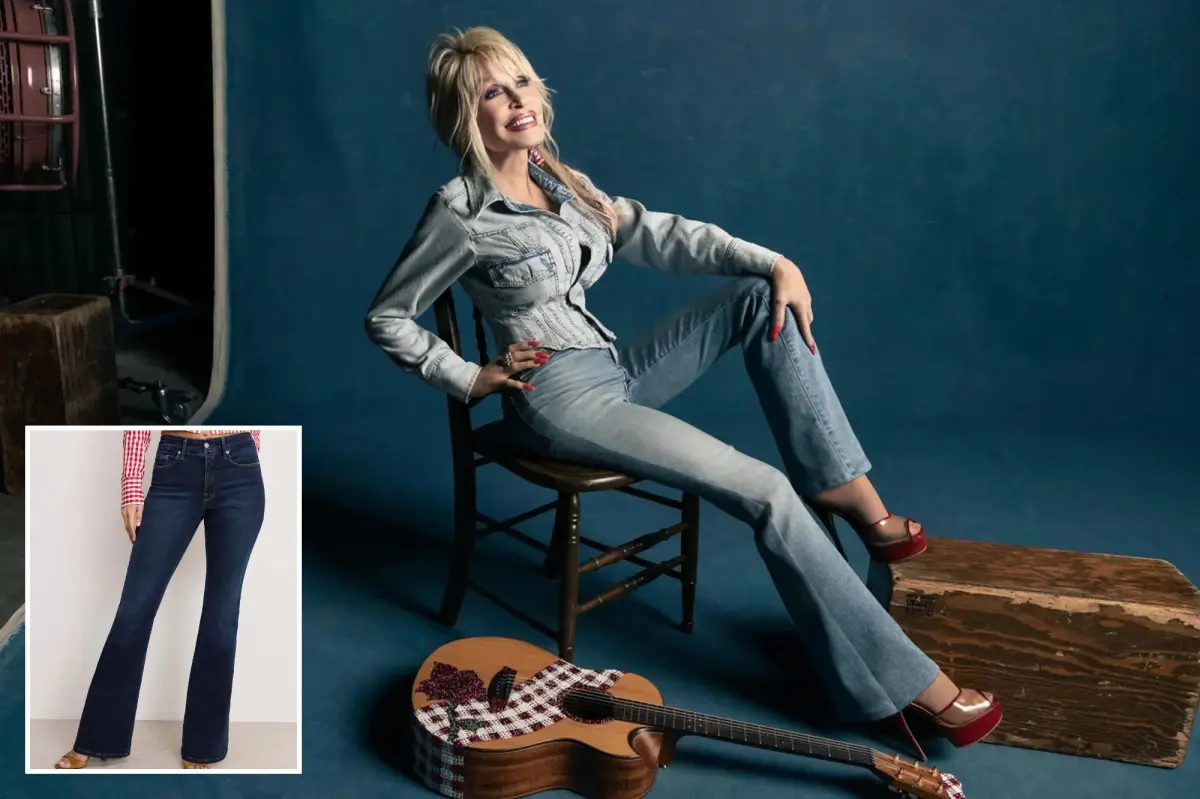
To understand this frantic search, one must look back at the peculiar genesis of the Jolean *collaboration that had simmered in the background of Dolly’s final years. It was a union of unlikely brandmates: the Nashville sire and the reality-TV born mogul, melding the timeless art of country curves with the modern, inclusive fit philosophy of Great American. When launched in April of 2025, the initial mood was modest, a gentle ripple in the vast ocean of celebrity fashion, where every star has a skincare line or a sweatshirt drop. Yet this had a particular magic: it had a name that was a wink to the music world—”Joleans” (think ‘Jolene’ but literally wearable), and it was engineered with precision to flatter the female silhouette that Parton had championed for decades in her cascading wigs and skin-tight outfits. The jeans were strict: they hugged the thigh, cinched the wasp-waist, and created a silhouette that felt both lewd and legendary, all while innocent enough for a Sunday barbecue. The reign of monarchy, however, was informed in April 2026 when Dolly launched the third and final collection of the partnership. The lineup was a dizzying tribute to her own aesthetic history—bedazzled straight-leg pants that glimmered under stage lights, gothic lace-up denim corsets that looked like beloved relics, and handsomely cut, flowing bellbottom trousers that swayed with the same sensuality as her hips.
At first, they enjoyed steady, predictable sales—liked by admirers, worn by stylists, and quietly shifted inventory into the world, never breaking records but finding their feet in the wardrobes of imaginative women. Howeverrophic, the unpredictable nature of fate was about to intercede. When the news of her passing broke on August 25, it wasn’t just a spike in search volume—it was a tidal wave. Google searches for her jeans went absolutely berserk, surging nearly 5,000% merely three hours after the sad act. The eBay marketplace, hotel closets, even high-street outlets, went into a state of retail shock, as if a spiritual switch had turned on Desire. Lyst, the fashion-tracking platform, reported a sudden surge in “Americana” fashion—a goddamned bolt of a trend appearing straight out of the dust. Everyone was wantingsomething, anything, that smelled of wash-day and stage smoke. The denim wasn’t just a piece of clothing anymore; it was a relic of a dying era, a segment of the American dream that people wanted to wrap around their waists to feel a hug from a woman who was no longer alive. And in that specific blank space of grief, the pants became the anchor.
As the demand skyrocketed, reality hit the complicated infrastructure of retail with a glaring harshness: there was absolutely no supply to meet the gnawing hunger. The Joleans, in every butchered size, from the tiniest 24-inch waist to the flourishing plus sizes, had all but disappeared from the stockrooms. On the Good American website, various products that were briefly “available” shifted to “out of stock” within hours, pixel by pixel, as if the boxes were evaporating into thin air. The famous Herald Square Macy’s, that cathedral central to American commerce, reported waning inventory; a rack of high-rise flares that had once held pairs in ten sizes was whittled down to a meager four, each remaining pair sitting like lone soldiers on a battlefield, with shoppers asked to unscrew them off the wire hangers with rubbing and toothAnd-tiger attempts. In the wake of this newfound scarcity, the secondary market exploded. The RealReal, once flush with labels and designer wear, found its shelves stripped bare of any Joleans; on eBay, as of this writing, only six listings remain, each one a grail for a collector, bid upon with the fever of a stock market frenzy. The public’s need to retain a piece of the singer scaled into a pathological level of grief-induced luxury.
It wasn’t just about getting a piece of denim; it had become a profound matter of spirit and connection. The testimonies from devoted fans paint a rich picture of why this specific clothing item carries such profound weight. “I really hope the line continues,” said Lindsay Lind, a TikTok content creator who “loves” her high-waisted Joleans, pushing aside the fear that her new favorite fabric might be unattainable in future. For her, the jeans represent that tangible link that justifies the days of endless scrolling for stock. Stylist Christie Moeller, buzzing from Las Vegas, has always been a fierce advocate for the line, specifically recommending it to clients like Drew Barrymore. But in moeller’s praise is the coveted element of fine material design. “They have that very Dolly combination of denim, glamour and a little bit of drama,” she sings, before adding a lowdown whisper: “plus that yoke detail really makes your booty look good!” Yet the meaning was bigger than physics. Lea Bryant, a woman running a social club in Nashville, a place where Dolly’s presence is practically ethereal, framed the centuries-white and incorporated hit: “Having a piece connected to Dolly feels meaningful,” she declared. Describing Dolly as “an inspiration,” Bryant admits the jeans may also have the magic of a good fit for real bodies—but her desire to support “that legacy” outweighs vanity; this is about connecting to the glow her talent once had.
In this new obsidian, the emotional future is the greatest question of all. The Post has reached out to Good American for comment, yet remains silent in the carotid noise. For now, the universe has drawn a curtain of harsh uncertainty. If he himself Good American decides to re-stock these permanent staples, or if they choose to retire the series with the passing of its creator, they hold a massive responsibility for answering the crowds. Despite the director’s calculated analysis, the sudden hunger for the thread will multiply into a ferocious display of fervent fan behavior as those who didn’t get their car count quickly. Sometimes, research of what happens after a death is oftentimes an eerie mix of commercialism soothing the primal fear of loss. People frantically buying jeans weren’t just looking to fill wardrobes; they are trying to fill a place left cold in their hearts with the warmth of a yoke, Dolly’s chosen signature splash. As the world mourns, these jeans become a memoir more than a product; they are a literal claim of “I knew her style,” even if you’d only just discovered her.
Perhaps this fervor reveals the ultimate power of her mythos. Dolly Parton was an icon of meticulous construction, a woman who famously powdered her face and sealed her secrets; her clothes were always, to a definition, a privilege. But the jeans go farther than the rhinestones. They are made for the working thighs, the motherly hips, the softbellies—they are inclusive. When she passed, her fans want to wrap themselves in that comfort, to pay homage in the language they know best: wearing a piece of her to feel closer to her clarity. They cannot sit at her feet, dim and watch her play a tune again, so they clasp his legs of these pants, and then they sing, internally, “Jolene, Jolene,” with their knees pressed into the cheap wash, curved over the silhouette. The line might stay, or it might vanish; but the pounds of it our lives is carried the terrible weight. She wore the pants—and now, in the surreal aftermath of their sudden absence, the millions left behind are desperately trying to fill those pants, to inherit a little dust andouille spirit, and to hold a ghost close in the seams.