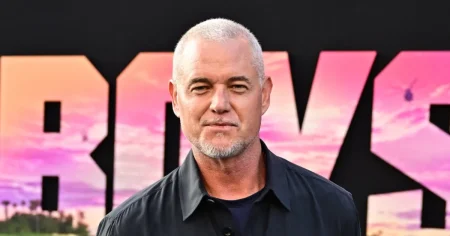




It began like so many other trips to the hospital, the kind that had become a strange and exhausting rhythm for Rebecca Gayheart and her family. Eric Dane was being admitted again, and while the fear was always there beneath the surface, Gayheart had learned to trust a fragile kind of optimism. He had been in and out of hospitals many times since his ALS diagnosis in 2024, and each time, the doctors had managed to patch things up. He would stabilize. He would come home. They would settle back into whatever version of normal existed that week, knowing full well that their life had become a moving target. So when Dane was driven away that final time, Gayheart did not clutch his hand and prepare for a goodbye. She thought about logistics, about the dinner she had planned, about the event she needed to attend. She told him she would be back. She had no idea, she later confessed, that this was the end of their story. Neither did their daughters, Billie and Georgia, then sixteen and fourteen. The language of the hospital was so familiar to them by then that they had stopped translating every beep and whisper into meaning. It would take several days before the truth settled over them like a heavy blanket: this last trip would not end with Eric coming home.
By the third day in the hospital, something shifted. Rebecca Gayheart, speaking with Maria Shriver on the Today show, remembered the exact moment when the atmosphere changed. It was not a single dramatic declaration from a doctor, but rather a subtle accumulation of signals. The tone of the medical conversations grew quieter, more careful. The information delivered was different now, less about recovery and more about managing the end. The family realized that they were no longer waiting for Eric to get better. They were waiting for him to leave. Dane, known for his roles in Grey’s Anatomy and Euphoria, was fully aware of what was happening. His verbal skills had deteriorated significantly by then, but Gayheart could still understand him most of the time, and so could his daughters and his closest friends. They communicated in fragments, in glances, in the small language of people who have loved each other long enough to fill in the gaps. He was still present, still making choices, still in control of how he would let go. Gayheart recalled a particular moment when Eric decided to make some decisions about his own death, and she respected that deeply. He was not a passive passenger in his final days. He was steering, as much as his failing body would allow, toward the door he was about to walk through.
Theirs was not a simple love story in the conventional sense. Rebecca Gayheart and Eric Dane were married for fourteen years, and in 2018 they filed for divorce. But when Dane received his ALS diagnosis, something in Gayheart shifted. She later had the divorce dismissed in 2025, a legal decision that spoke to an emotional recommitment made in the trenches of illness. She chose to return to him, not out of obligation but out of a deeper sense of love and humanity. Caring for someone with ALS is an all-consuming task, one that she described as a constant process of figuring things out as they went. There were so many decisions to make, so many adaptations, so many hours spent navigating a healthcare system that offers no map for the fluctuating terrain of a progressive neurological disease. Gayheart admitted she suffered from what she called “decision fatigue,” that bone-deep exhaustion that comes from having to make choices big and small every single day, often with incomplete information. And yet, through it all, she remained by his bedside, recommitting to their family, to their daughters, to the man she had once promised to love in sickness and in health. That promise took on new weight when they realized they were no longer waiting for a cure but walking alongside a terminal illness. It was not romanticized. It was messy, heartbreaking, and full of the quiet grace of simply showing up.
In those final days, the family turned a sterile hospital room into a cocoon of tenderness. Rebecca Gayheart described how she and her daughters essentially camped out with Dane. They brought in battery-operated candles, the kind that flicker safely without the risk of an open flame, and they placed them around the room like tiny vigil lights. They played his favorite music, letting the melodies fill the space with memories and meaning. They had family sleepovers, the four of them squeezed into a space designed for illness, trying to make it as comfortable and as beautiful as any hospital room could possibly be. There was something almost defiant about it, this insistence on creating intimacy within such a clinical setting. They were not just waiting for Eric to die; they were surrounding him with love until the very last moment. Gayheart painted a picture of a family trying to hold on to the ordinary even as the extraordinary was happening. It was a way of saying, we are still here, we are still together, and this is still our life, even if it is ending. The candles were not real, but the love was. The songs were familiar, but they carried new meaning now. And the girls, who had watched their father lose so much, were witnessing something else: the way a human being can choose to leave with dignity, surrounded by the people who knew him best.
There is a common, well-meaning refrain that people offer to those who have lost someone to a long illness: “At least you knew. At least you had time to say goodbye.” But Rebecca Gayheart gently pushed back against that, and her words carry a deep and painful truth. They did not know, not really. No one can tell you what the journey looks like, because it is different for every patient. There is no road map for ALS, no checklist that tells you which trip to the hospital will be the last, which ordinary Tuesday will become the one you replay forever. Even when you think you are prepared, the end arrives in its own shape and at its own speed. Gayheart admitted she was not prepared for how quickly Dane’s life slipped away once the shift happened. The rapidity of it stunned her, even after months of watching the disease take so much. She said that ALS was both a blessing and a curse for her husband. It was a curse because it stole his body, his voice, his independence. But it was also a blessing in the way it changed his interior life. Eric Dane became a different person, in a way. He suddenly valued his life with a fierce clarity. He was present in every minute, intentional about how he spent his days, aware of what mattered and what did not. He was becoming more alive mentally even as he was losing all of his physical abilities. For their daughters, watching that paradox was particularly hard. They saw their father awakening to the preciousness of life just as he was saying goodbye to it. It was overwhelming, Gayheart said. It was a blur.
Yet out of that blur, something lasting has emerged. Eric Dane’s posthumous memoir, My Book of Days: A Memoir in Moments, was released on the very day Gayheart appeared on Today. The title is fitting, because his life after the diagnosis became a meditation on time itself. He was no longer measuring his days in years or even months, but in the small, sacred increments of moments. The memoir is a gift left behind, a way for his daughters to hear their father’s voice again, to understand his thoughts, to witness his journey even as they continue their own. Rebecca Gayheart’s decision to speak about his final weeks is itself an act of love, a way of honoring the truth of what it means to care for someone at the end of their life. She did not present a sanitized version of grief. She spoke openly about the exhaustion, the uncertainty, the strange comfort of hospital sleepovers, the battery-powered candles, the music, the slow dawning of the end. In doing so, she reminded all of us that we are never truly prepared for the final goodbyes, no matter how many times we have practiced them in our minds. The only thing we can do is show up, again and again, even when we do not know it is the last time. Because that is what love looks like in the end. It looks like a woman telling her husband she will be back, with no idea that she is about to keep that promise in a way she never imagined. It looks like a family holding vigil in a hospital room while a man who fought through every moment of his illness teaches them, one last time, how to be fully alive. It looks like Rebecca Gayheart, still standing, bearing witness to the devastating, beautiful, impossible truth of loving someone all the way to the end.