

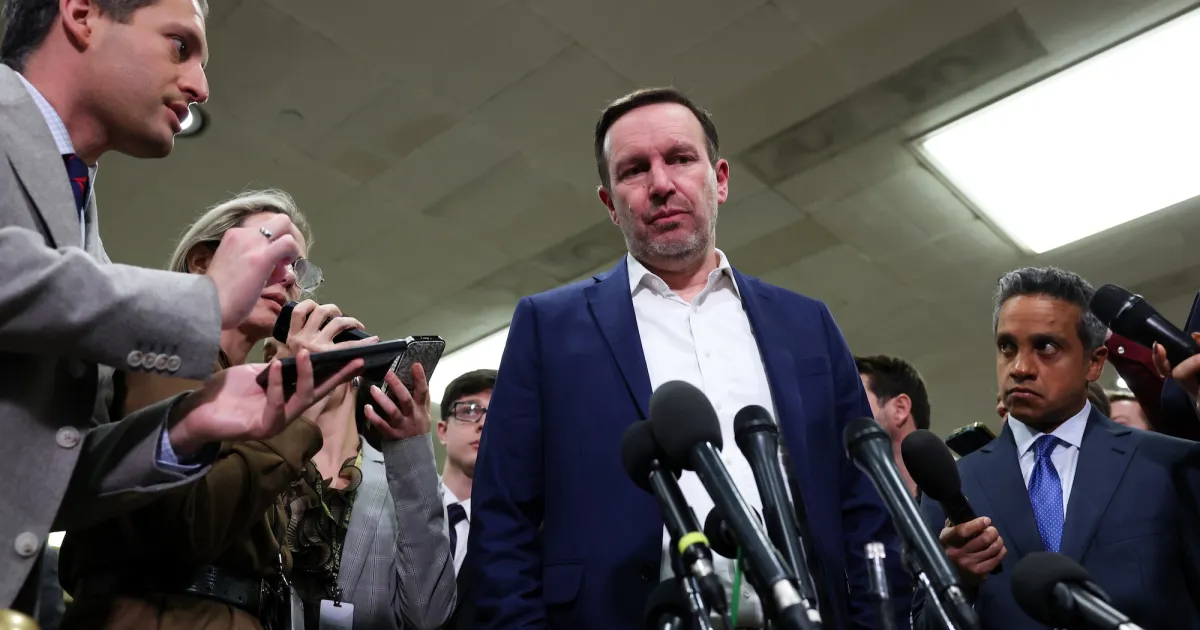
The news arrived like a sudden chill on an otherwise ordinary Sunday: Chris Murphy, the Democratic senator from Connecticut, had been rushed to a hospital after collapsing into a health scare that no family is ever prepared for. It happened not in the halls of the Capitol, not on the campaign trail, but at his son’s hockey game—a place of frozen rinks, bleacher chatter, and the everyday rhythm of parenthood. The senator, 53, began experiencing numbness in his arm during the game, a symptom so alarming that he was immediately taken to a local hospital. There, doctors delivered the diagnosis that no one wants to hear: he had suffered a stroke. In a statement released through his chief of staff, Allison Herwitt, the world learned that Murphy was stable, conscious, and being transferred to Johns Hopkins for further monitoring. For a man who has spent years fighting for the people of Connecticut, the scene was a stark reminder that even the most dedicated public servants are, first and foremost, human—vulnerable to the same sudden storms of health that can upend any family’s life in an instant. His two sons, Owen and Rider, who were presumably at that rink or nearby, suddenly found themselves in the terrifying position of watching their father in medical distress, a moment that no amount of political courage can prepare anyone for.
Murphy’s personal life has lately been marked by significant transitions, and this health crisis arrives at a delicate moment. He shares Owen and Rider with his ex-wife, Catherine Holahan, a relationship that has unfolded in the public eye yet remained largely private in its emotional contours. The couple married in August 2007, sharing nearly two decades of partnership before announcing an amicable separation in November 2024. Their divorce was finalized in July 2026, just months before this stroke, meaning Murphy’s family has already navigated the quiet upheaval of redefining their lives. In times like these, old bonds often resurface, and one can only hope that the boys and their mother have rallied around the senator with the kind of quiet, steady love that transcends legal documents. The statement from Herwitt, though concise, offered a welcome flicker of hope: “Doctors are encouraged” by Murphy’s progress, she said, adding that he is “awake and alert, and we are optimistic he will make a full recovery.” Those words—awake, alert, optimistic—carried the weight of a thousand unspoken anxieties. For anyone who has ever sat in a hospital corridor waiting for news, the simple fact that a loved one can open their eyes and recognize the room is a small miracle. The coming days will bring more tests, more monitoring, and more conversations between doctors and family, but for now, the public has been asked to hold its breath and trust in modern medicine.
What makes this story particularly poignant is the timing. Murphy is not on the ballot in the 2026 midterm elections, which are set for Tuesday, November 3, just two days after his hospitalization. Yet he has spent the final stretch of the campaign season not resting, but crisscrossing his state and the nation, stumping for Democratic nominees in a fiercely contested political landscape. Two days before his stroke, he was doing exactly what he loved: standing before Connecticut residents, urging them to make their voices heard, reminding them that democracy is a participation sport. Connecticut Governor Ned Lamont captured that spirit in a heartfelt statement shared on Sunday, recalling how recently he had been with Murphy on the trail. “There is no stronger advocate for our democracy,” Lamont said. “And no one who fights harder for the people of this state. Chris is a great friend to Connecticut and to me personally.” Lamont’s words, delivered with obvious emotion, also included a prayer for Murphy and his family. In the hyper-partisan air of modern politics, such moments of genuine bipartisan warmth feel almost radical. The governor’s tribute is a reminder that behind the labels, the attack ads, and the ideological divisions, there are human beings who show up for each other in times of crisis. For Murphy, who has built his career on showing up—for town halls, for floor speeches, for the communities that elected him—the support now flows back in his direction.
Murphy’s career has never been short of controversy, and his health scare comes against the backdrop of a long-running feud with former President Donald Trump, a man who rarely misses an opportunity to take aim at his perceived adversaries. Murphy first drew Trump’s ire when he voted to convict the president during the 2020 impeachment trial, and he further cemented his status as a target after delivering a forceful June floor speech in which he argued that Trump should be impeached for a third time amid allegations of systemic corruption. The rhetorical battle between the two men has been as personal as it is political. In August 2025, after Murphy criticized a meeting between Trump and Russian President Vladimir Putin on U.S. soil, Trump took to his social media platform, Truth Social, to mock the senator in characteristically blunt terms. “The very unattractive (both inside and out!) Senator from Connecticut, Chris Murphy, said ‘Putin got everything he wanted.’ Actually, ‘nobody got anything,’ too soon, but getting close,” Trump wrote, before adding that Murphy is “a lightweight” who made it harder to end the war in Ukraine. For Murphy, these attacks have become part of the job, a cost of standing up to a president who views dissent as betrayal. But now, lying in a hospital bed with his family nearby, the venom of political warfare likely seems very distant. The same critics and allies alike are, for the moment, united in a shared hope for his recovery. In a nation so deeply divided, a health emergency has a strange way of leveling the field; partisan lines blur, and all that remains is a person, a father, a senator, fighting to get back on his feet.
This story also resonates because it underscores the fragility of public life. Politicians are often treated as invincible figures, endlessly jetting between rallies, votes, and fundraisers, powered by adrenaline and ambition. But strokes do not check party registration. They do not care about election calendars or Senate schedules. They strike without warning, in the middle of a hockey game, on a Sunday afternoon, when the only thing on the agenda is cheering for a child. Murphy’s sudden hospitalization is a sobering reminder that the most important battles are not always waged in the halls of power, but in the quiet moments of ordinary life—a numbness in the arm, a call to 911, a scramble to find the nearest hospital. For his sons, Owen and Rider, this is not a news story; it is their father’s life flashing before their eyes. For the people of Connecticut, it is a moment of collective anxiety about a senator who has become a fixture of the state’s political identity. For Murphy himself, it is a chance to pause, to reflect, and to fight not for a vote, but for his own health. The coming days will be filled with medical evaluations, rehabilitation decisions, and cautious optimism. If there is any consolation, it is the knowledge that stroke treatment has advanced dramatically in recent years, and the fact that Murphy is awake and alert so soon after the event is a promising sign. The road to full recovery may be long, but it is a road worth walking.
As the nation turns its eyes to the elections on Tuesday, the image of Chris Murphy in a hospital room, monitored by doctors and surrounded by love, will linger in the background. His colleagues in the Senate will cast their votes without him, but his presence will be felt in the speeches and prayers of those who know him. Governor Lamont’s words—“There is no stronger advocate for our democracy”—serve as a fitting summary of Murphy’s career, but they also carry a deeper meaning now. Advocacy, at its core, is about believing in the possibility of a better tomorrow, and no one understands that more than someone who has just been given a second chance at life. The story is still unfolding; no additional information about Murphy’s health status had been publicly released at the time of publication, and his office has remained guarded about the details. But what is known already is enough to inspire hope: a man who spent his career giving voice to the voiceless now asks, silently, for the support of those who believe in him. There will be time later for debates, for political battles, for the endless cycle of outrage and rebuttal. For now, the focus is on a single, simple, human wish—that Chris Murphy will recover fully, that he will return to the causes he loves, and that he will one day stand again in the stands of a hockey rink, cheering for his sons, grateful for the ordinary moments that a stroke could have taken away but did not.