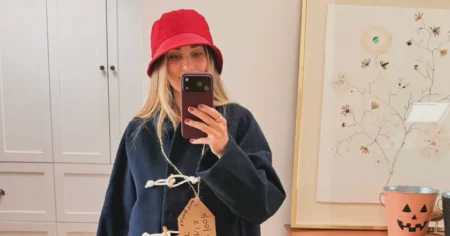




Halloween has always been a night for transformation, for pretending to be someone you’re not. It’s a holiday that rewards cleverness and bold choices, but it also has a way of revealing where a culture draws its lines. In 2026, Jessica Alba learned just how fine those lines can be. The 45-year-old actress and entrepreneur spent her Halloween at Vas J Morgan and Michael Braun’s “Hockey Horror” celebrity party in Los Angeles, and she arrived with a costume that was unmistakably tied to one of the most notorious scandals in American sports history. Alba dressed as Nancy Kerrigan, the celebrated figure skater whose career was almost derailed by a brutal attack in 1994. In the now-deleted Instagram photos, Alba posed with a fake bloodied bandage around her knee, recreating the iconic image of Kerrigan in tears after being struck by a police baton. Next to her, a friend stood in the role of Tonya Harding, holding a baseball bat and playing the part of the woman forever associated with the conspiracy. The caption, “Happy Halloween from Tonya … and Nancy,” was all that needed to be said. For many, it was a clever bit of 1990s nostalgia. For others, it was something else entirely: a reminder that some stories, especially those involving real pain, don’t make great costume material. Alba deleted the post, but not before the internet had plenty to say, and the incident quickly turned into the latest chapter in an ongoing debate about true crime, celebrity, and the ethics of dressing up as tragedy.
To understand the backlash, you need to understand what really happened. The attack on Nancy Kerrigan took place on January 6, 1994, at the U.S. Figure Skating Championships in Detroit. Kerrigan was walking through the concourse after a practice session when a man named Shane Stant rushed up and hit her on the knee with a collapsible police baton. The moment was captured by cameras, and the image of Kerrigan screaming “Why? Why? Why?” became a defining part of the decade’s tabloid culture. Stant had been hired by Jeff Gillooly, Tonya Harding’s ex-husband, and the plan was to injure Kerrigan badly enough to keep her out of the upcoming Winter Olympics in Lillehammer. Harding, who was also a world-class skater and Kerrigan’s main rival, denied any prior knowledge. She later admitted to overhearing the plot, but she was never criminally convicted of participating in it. She did, however, plead guilty to hindering the prosecution, and the U.S. Figure Skating Association banned her for life, effectively ending her competitive career. Kerrigan, meanwhile, recovered, went on to skate in the Olympics, and won a silver medal. But the emotional impact never faded, and neither did the public’s fascination. The story had all the elements of a tabloid epic: glamour, jealousy, working-class grit, an alleged attack, and two women whose lives were forever changed. For years, it has been recycled in documentaries, dramatizations, and jokes. But for the people who lived through it, and for the women at the center, it wasn’t a story. It was their life.
The response to Alba’s costume was immediate and divided. In the comments, people who were uncomfortable with the outfit didn’t hold back. “Immature. We expect better, Jessica,” one user wrote. Another added, “Why would you want to revisit this traumatic moment that ended people’s careers?” The criticism wasn’t just about bad taste; it was about the way a real assault can be flattened into a costume when enough time has passed. Kerrigan was a young athlete who had her Olympic dreams jeopardized by violence, and Harding was a complicated figure whose reputation and career were destroyed in the aftermath. For many, dressing up as both of them and laughing about it felt like kicking two people who were already down. At the same time, there were plenty of defenders who saw the costume as harmless Halloween fun. “Brilliant costumes,” one person wrote, while others responded with clapping hands and laughing crying emojis. Some argued that the 1994 incident had become such a part of pop culture that it was fair game, especially at a party with a hockey horror theme. The fact that Alba later deleted the post only added to the ambiguity. Did she realize it was in poor taste, or was she just trying to avoid the online noise? Representatives for Alba did not respond to requests for comment, so the silence left the question hanging in the air. What’s clear is that the same costume could be read as either clever or cruel depending on who was looking at it, and both readings are understandable when the real-life story is so messy.
In some ways, it’s easy to see how Alba made the choice. The party was literally called “Hockey Horror,” and the venue was an ice rink in Los Angeles, which made the skating reference almost too perfect. Alba was surrounded by celebrities who had also leaned into the night’s playful, unsettling energy. Paul Wesley arrived with his wife Natalie Kuckenburg, wearing a Jason Voorhees costume from the Friday the 13th franchise. Brooks Nadar went as a seductive “fembot” from Austin Powers. Paris Hilton, Machine Gun Kelly, Salma Hayek, and Natasha Lyonne were also part of the crowd, each bringing their own take on the theme. In that context, Alba’s costume probably made sense to her and her friends. The problem is that not every iconic image is fictional. Jason Voorhees is a character; the fembot is a stereotype; Nancy Kerrigan and Tonya Harding are real women, and their story was not a horror film. Kerrigan was injured in an attack that left her sobbing in pain and confusion, and Harding spent decades being vilified in ways that went far beyond what she was ever convicted of. Halloween costumes often work because they take scary things and turn them into something manageable, something we can laugh at. But when the subject is real violence, the laughter can feel like a way of saying that the victim’s pain is not that serious. That’s where the discomfort lives, and why so many people felt the need to speak up even after Alba had already taken the post down.
The irony is that Harding herself is trying to move forward. Just one day before Alba walked into that party pretending to be her, Harding gave an interview to KOIN 6, an Oregon CBS affiliate, in which she explained why she can’t walk away from skating despite her lifetime ban. She has stayed connected to the sport that made her famous and then cast her out, and on December 12, she is scheduled to perform in “Tonya and Friends” at Mountain View Ice Arena in Vancouver, Washington. “I just want people to come out and have fun and be able to enjoy a real skating show,” she said. It was a modest, hopeful statement from a woman who has spent decades trying to reclaim her story. Harding has always been a complicated figure: a gifted athlete from a difficult background in a sport that favored grace and polish, a rebel who never quite fit the figure skating mold, and someone who has carried more than her share of public shame. Seeing her name and her image used as a Halloween prop, complete with a baseball bat, must have felt like another reminder that, in the public imagination, she may never escape the moment that defined her. The timing was especially unfortunate because Harding had just stepped back into the spotlight on her own terms, not as a punchline but as a skater, a performer, and a woman trying to reclaim a love that was taken from her.
Ultimately, the Jessica Alba costume controversy isn’t just about one celebrity’s questionable Halloween choice. It’s about how memory works, and about the line between honoring the past and exploiting it. True crime has become one of our biggest forms of entertainment, with documentaries, podcasts, and dramas turning real tragedies into binge-worthy content. We like to believe that we’re smarter than the tabloid audiences of the past, that we can appreciate these stories with nuance and empathy. But then a party in Los Angeles comes along, and someone dresses up as a woman who was attacked, next to someone dressed as the woman who was blamed, and the whole question opens up again. Who gets to be the joke? Who gets to be the victim? And whose pain becomes a costume for everyone else to wear? Kerrigan and Harding have both had their lives mined for public consumption, and neither of them has fully escaped the weight of what happened in 1994. Alba’s decision to delete the post suggests that she heard the criticism, even if she hasn’t publicly responded. But the larger conversation remains. Halloween is meant to be playful, and sometimes the best costumes are the ones that make us think. But when the reference is to real people and real suffering, the line between clever and careless is razor thin. In the end, what made so many people uncomfortable wasn’t just the image of a bloodied knee and a baseball bat. It was the ease with which complicated, painful history can be reduced to a pair of costumes, a punchline, and a moment on the red carpet. That ease might be the scariest thing of all.