


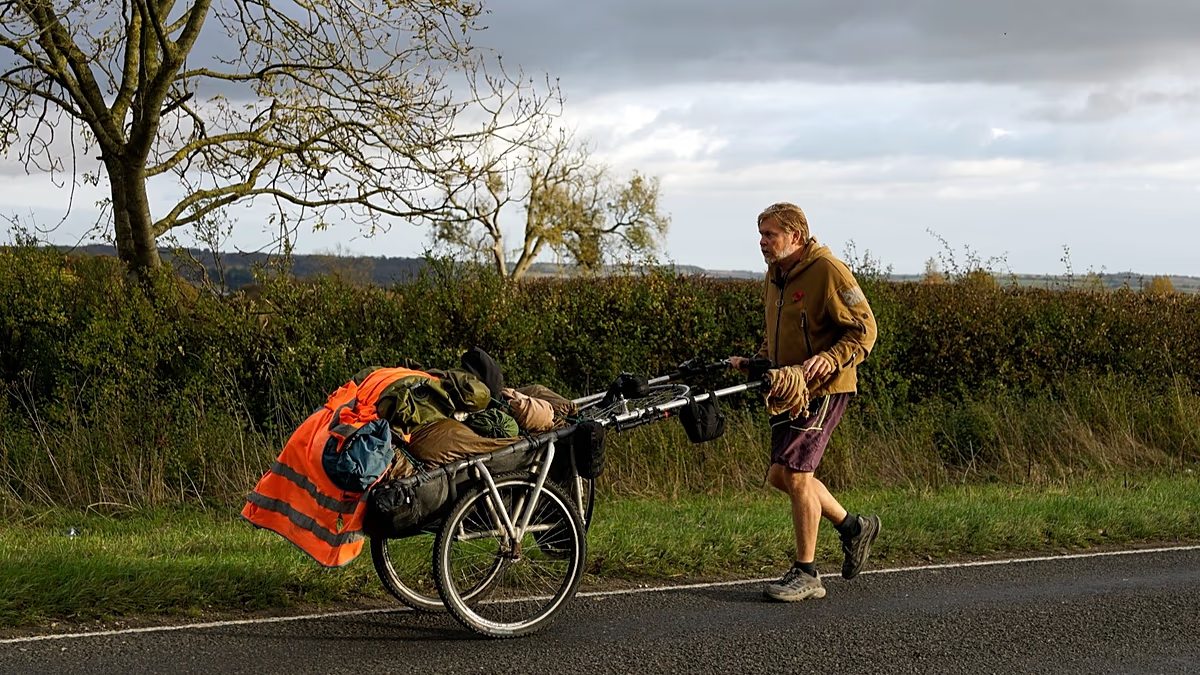
For Karl Bushby, the end of the road was not a dramatic summit or a distant shore, but a damp, grey Monday in the centre of Hull, a city in northeast England that had waited nearly three decades to welcome him home. After 28 years of walking, swimming, and sometimes barely crawling across more than 50,000 kilometres from the southern tip of Chile, the British adventurer finally arrived to the sound of up to a thousand cheering people. He stood among them, visibly moved, and insisted that the monumental journey was never his alone. “I didn’t do this alone,” he said, calling the expedition a “global effort” as Hull’s Mayor Maria Coward looked on with pride. He spoke of governments confronted, impossible obstacles overcome, and an invisible network of strangers who had carried him through the darkest moments. “You wouldn’t believe just how many people have been involved in this, to get us around the kinds of obstacles that we face. We’ve faced down governments, we’ve faced down some of the hardest challenges.” The day before, he had crossed the iconic Humber Bridge through thick, enveloping mist, a suitably quiet and mysterious prelude to the emotional flood of the city-centre reception. Then came the final, ordinary, extraordinary steps to his mother’s home, a place he had dreamed of for nearly a lifetime but could barely remember how to inhabit.
Bushby’s epic, which he named the “Goliath Expedition,” began not with a grand plan but with a birthday card. In the mid-1990s, his father Keith, an Army veteran himself, wrote to him about a bar-room argument among special forces troops over whether it was possible to walk from London to New York across the Bering land bridge, the ancient route that scientists believe once connected Asia to the Americas. The idea lodged itself in Bushby’s imagination like a splinter that could not be removed. He took out a map, drew a continuous line across Europe and Asia, into North America, and then, instead of stopping in New York, kept going all the way down to the tip of Chile. “And that was it,” he recalled. “With that under my skin, there was no going back.” He set out with just $500 and two unbreakable rules: he could never use transportation to move forward, and he had to return home on foot. The rules made an already absurd undertaking almost impossibly difficult. Explorers have circled the planet by boat, plane, balloon, and bicycle, but most walkers have relied on ships to cross oceans. Bushby refused. He fought hurricane-force winds on the desolate Patagonian Steppe, where the land itself seemed determined to push him back. In 2001, he slipped through the Darién Gap, the lawless, roadless, rugged jungle between South and Central America, a place of such danger that even experienced adventurers avoid it. He was jailed for 18 days in Panama after crossing a restricted border zone, and later survived a near-death plunge into freezing waters during a 56-mile Bering Strait crossing with American adventurer Dimitry Kieffer, a crossing so rare and harrowing that after managing it, they were arrested and faced deportation for entering Russia illegally. Every one of these trials could have ended the journey, but each one only seemed to sharpen his stubbornness.
The long middle years of the expedition were an exhausting, grinding battle against bureaucracy more than geography. It took nearly a decade to move through Russia, where visa restrictions and a brutal climate limited travel to a few months each year. When Russian officials denied his visa in 2012, Bushby responded with one of the most absurd and admirable protests imaginable: he walked from Los Angeles to the Russian Embassy in Washington, D.C., a journey of thousands of kilometres, simply to make his case. Eventually, the paperwork came through, but this was only one of many prolonged pauses. During setbacks, he retreated to the United States or Mexico, where living was cheap, and waited for the right moment to return to the exact point where he had stopped. In China, police trailed his every step. The pandemic brought the entire world to a halt, and Bushby with it, for a lengthy, frustrating stretch. Geopolitical closures in Russia and Iran forced him to swim 31 days across the Caspian Sea, a feat made all the more remarkable because he is not a strong swimmer. He floated backward, flapping his arms in a method he called “floatimming,” a hybrid of floating and swimming, kept alive by a flotation vest and wetsuit. Europe, too, imposed its own strange barriers: 90-day visit limits meant he had to travel in three-month chunks, constantly leaving and re-entering to reset the clock. He swam across the English Channel in early October to feel British soil beneath his feet again. “Feels good to have UK soil under my feet after all these years,” he said afterward, adding with considerable understatement that the journey “hadn’t been easy.”
Throughout all this, Bushby was sustained by a shifting constellation of sponsors, many of whom came and went as the years rolled on and financial crises shook the world. For the past sixteen years, he relied mainly on a production company founded by Beau Willimon, the creator of “House of Cards,” and music producer Jordan Tappis, who are backing a documentary about the expedition. The film, directed by legendary German filmmaker Werner Herzog and titled “Walk of Life,” will capture not only the landscapes and dangers but the strange, profound relationships that formed along the way. But if sponsors provided the means, it was the kindness of countless strangers that provided the meaning. Again and again, Bushby was welcomed by people who had almost nothing to give. He slept in shacks assembled from car parts, shivering and grateful. When a severe stomach infection nearly killed him, a Peruvian doctor’s family took him in and nursed him back to health. He was fed endless meals of plain rice and water by impoverished families who refused any payment, simply because he was a traveller in need. “I’ve been welcomed in by the poorest of the poor,” he said, his voice full of awe. “I’ve met 99.9999% of the very best of humanity. Every culture, every country has been the same response.” In an age of borders, conflict, and suspicion, his journey became a quiet counterargument: that humanity, at its core, is generous, curious, and endlessly kind to the stranger who arrives on foot.
The homecoming was not just a public celebration but a deeply personal reckoning. Hull’s mayor had spoken for the whole city when she said, “So many people have followed Karl on his epic journey. We have all felt inspired by his spirit, tenacity and dogged determination,” and she said the city took “pride in his incredible achievement.” But for Bushby, the most important reunions were waiting behind closed doors. Late on Monday, he was to see his mother Angela, the woman who had lived through every anxious year of his absence. He would meet his 36-year-old son Adam, and, for the first time in his life, his 12-year-old granddaughter, a child born during his long years away. Imagine that: to have walked across the world, through deserts and jungles and freezing seas, only to tremble at the sight of a young girl who already knows your name but has never heard your voice. Herzog and his film crew were present to record it all, capturing the strange collision between a man who had conquered the world and a family who had simply had to wait. There was joy in the air, but also a kind of disorientation. After so many years of moving, of sleeping in strange places, of waking up uncertain where the next step would lead, Bushby was about to stop. And stopping, for a man like him, might be the hardest challenge of all.
In an interview from northern France in September, just weeks before his final arrival, Bushby voiced the quiet apprehension that lay beneath his triumph. “I’ve got to try and get established in the grown-up world again,” he said, a honest and vulnerable admission from a man who had faced down governments and survived the world’s most hostile terrain. The expedition had given his life a structure and a purpose; every morning brought a new obstacle, a new distance to cover, a new person to meet. Now, in the ordinary streets of Hull, he faces something far more mundane: settling down, paying bills, perhaps writing a book, perhaps simply learning to be still. The Goliath Expedition is over, but in a sense, the journey of Karl Bushby is only beginning. He spent 28 years walking home, and now he must learn what it means to stay. Yet if his long, impossible trek taught him anything, it is that no obstacle is too great, no red tape too thick, and no ocean too wide when a person is driven by the simple, stubborn desire to return to the people and places they love. The crowd cheered, the mist lifted, and a man who had carried the world in his worn-out boots finally set them down on the ground where his story began. He had drawn a line on a map as a young man, followed it with his body and his will, and somehow, against all odds, made that line into a circle that led all the way back home.