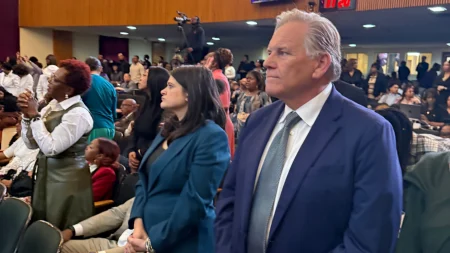



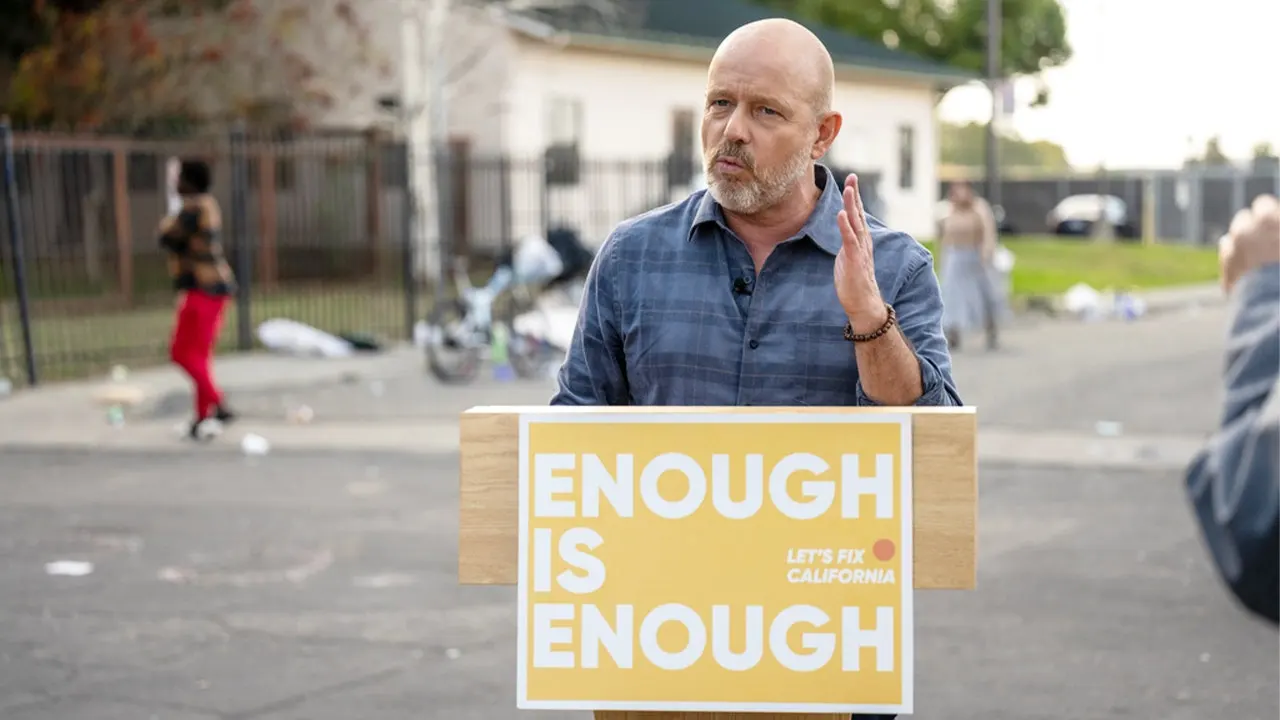
The Pacific Palisades neighborhood of Los Angeles has always been one of those places that seems to live in a different world — a sunlit, postcard-perfect community of winding canyon roads, eucalyptus trees, and expensive homes overlooking the ocean. But on the afternoon Steve Hilton stepped before a crowd of supporters and survivors, that world was barely recognizable. The January 2025 wildfires had turned beautiful hillsides into gray-brown moonscapes, and the people who had come to hear Hilton speak carried the weight of loss in their faces. Some wore jackets dotted with ash residue. Others held photographs of their houses, now reduced to concrete slabs. Hilton stood in front of them not with a standard campaign speech but with something that sounded more like an apology. “I’m so sorry,” he said. “And it’s so sad about what happened because it could and should have been avoided.” He was not only offering sympathy; he was making a political argument. The Palisades Fire tore through more than 23,000 acres, destroyed roughly 6,800 structures, and displaced tens of thousands of residents. It was among the most catastrophic fires in California history, and the trauma of that day was still raw. For Hilton, however, the disaster was not an accident of nature. It was, he told the crowd, “a symbol of 16 years of Democrat failure.” The legal aftermath continued to make headlines, with a jury recently deadlocking in the federal trial of a man accused of starting the deadly blaze, but for Hilton the more important courtroom was the court of public opinion. He wanted residents to understand that their grief was not inevitable, that the fire should have been prevented, and that the slow, painful recovery they were experiencing was itself a kind of policy failure.
Hilton’s message was blunt, and he did not soften it for the grieving audience. The Palisades disaster, he argued, was not an isolated tragedy. “These are not random, disconnected events,” he said. “These are what has gone wrong in the state of California over 16 years of one-party rule.” He ticked through the failures that had accumulated under Democratic governors — from wildfire prevention to emergency response to rebuilding efforts — and he insisted that they all flowed from the same root cause: a political class that had become too comfortable, too ideological, and too disconnected from ordinary people. For sixteen years, Democrats had controlled the governor’s office in California, a period spanning the administrations of Jerry Brown and Gavin Newsom. And in Hilton’s telling, those sixteen years produced a state that could no longer handle the basics: clearing brush, managing forests, building infrastructure, and responding quickly when disaster struck. He wasn’t just talking about the Palisades Fire; he was talking about a pattern of decline that had touched every corner of California, from homelessness in Los Angeles to the cost of living in the Central Valley. The crowd nodded as he spoke, and some wiped their eyes. There was a sense that he was naming something they had felt for years — a frustration with being told everything was fine while the state burned. Hilton’s voice carried an unusual combination of rage and compassion, and when he said that the Palisades had become “a symbol,” it was clear he meant the entire state, not just this one neighborhood.
The heart of Hilton’s critique was not just about who started the fire or how quickly firefighters arrived. It was about the long, slow accumulation of policy choices that made California more vulnerable to catastrophe. He pointed to environmental and land-management policies that, in his view, had left forests and hillsides overgrown and dangerously dry. “The ideology that for years and years and years not just failed to clear the brush that could have prevented these fires here and in Altadena … but deliberately chose not to do that,” he said. These were strong words, and he backed them up with a broader accusation: the state’s leadership had failed at every level, and the people were left to pay the price. He used three words to summarize what he believed was driving the crisis: “incompetence, ideology and corruption.” It was a dark picture, but it was one that many residents in the crowd had already reached on their own. They told stories of applying for permits and waiting weeks for responses. They described debris that sat untouched for months. They talked about friends and neighbors who had moved away because they simply could not imagine rebuilding in a place where the next fire might erase their homes again. Hilton listened to those stories, and he made a point of saying so. “I spent the time, I’ve listened,” he told them. It was a small reassurance, but in a community that felt abandoned by state government, it mattered. He was not offering a slick policy plan; he was offering the most basic thing a leader can give people in a moment of crisis: the feeling that someone is actually paying attention.
That attention, Hilton promised, would translate into action if voters elected him governor. His signature proposal was the appointment of a “recovery CEO” — a single, accountable official whose only job would be to cut through red tape and oversee the rebuilding effort from start to finish. “When I’m governor, I will appoint a recovery CEO to finally get things done, to finally get what you deserve,” he said. The idea was simple, and it spoke directly to the exhaustion of people who had spent months navigating bureaucratic mazes. Hilton understood that language because he had spent his career outside the traditional political establishment. A former Fox News commentator and former adviser to British Prime Minister David Cameron, he was not a career California politician, and he leaned into that identity. He presented himself as an outsider who could not be bought or bullied by the interests that had shaped Sacramento’s culture. His campaign had been built on the idea that the state’s problems were not unsolvable, but that they required a leader willing to break with the orthodoxies of both parties. In the Palisades, that message felt especially powerful. The residents were not asking for a philosophical lecture on governance; they wanted someone who could get their neighborhoods rebuilt before the next fire season. Hilton’s recovery CEO idea was a promise of urgency, and he spoke about it with the conviction of someone who had seen bureaucracies fail up close. He did not deny the scale of the task. He simply insisted that it could be done, if the right person was put in charge. And for the people standing in the ashes of their homes, that was exactly what they needed to hear.
The race to replace Governor Gavin Newsom is one of the most consequential elections in California’s recent history, and Tuesday’s vote will test whether a Republican can break the Democratic Party’s long hold on the state. Hilton’s opponent is Xavier Becerra, a former California attorney general and former Secretary of Health and Human Services under President Joe Biden. Becerra is a deeply experienced politician, but Hilton has tried to turn that experience into a liability. His campaign has run ads mocking Becerra’s “36 years” as a career politician, arguing that Washington and Sacramento insiders are the very people who created the crisis. In Hilton’s telling, the Palisades Fire is the perfect symbol of everything that happens when power goes unchallenged for too long. He argues that California’s Democratic leaders have become experts at managing their own political fortunes but have failed at managing the state. He speaks about the fire not just as a local tragedy but as a referendum on the entire system. “This is not a blue state. It is not a red state. It’s the Golden State,” Hilton said at the rally, his voice rising with emotion. “And we are going to fight with everything we’ve got.” Those words became the emotional climax of the afternoon, a declaration that California’s identity should not be reduced to partisan labels. Hilton was asking voters to imagine something different — not a state that votes one way out of habit, but a state that demands results. Whether that vision will resonate with enough voters remains uncertain. California remains heavily Democratic, and Becerra has deep institutional support. But in the Palisades, where the charred earth is still visible and the recovery is painfully slow, Hilton’s argument carries a visceral power that no poll can fully capture.
In the end, the rally in Pacific Palisades was about more than one election. It was about the relationship between government and the people it is supposed to serve. Hilton stood in front of a community that had been promised help and had waited, often in vain, for that help to arrive. He did not offer easy answers, and he did not pretend that the next governor could magically make the pain disappear. But he did offer something that many residents had not felt in a long time: a sense that their suffering was understood, and that their frustration was justified. The fire exposed not only the fragility of California’s infrastructure but also the limits of its political imagination. For sixteen years, one party has held the governor’s office, and in that time, the state has faced increasingly intense wildfires, housing crises, and economic uncertainty. Hilton’s campaign is built on the conviction that this is not a coincidence. “I’m so sorry,” he had said at the beginning, and those words hung in the air even as he moved on to policy and politics. He was sorry for the houses that burned down, for the memories lost, for the neighbors who would never come back. But he was also sorry that it took a disaster of this magnitude to make plain what had been true for so long: California’s leaders had failed, and ordinary people were the ones who paid the price. As the crowd dispersed, the sun began to set over the blackened hills, and the air grew cold. There was still a long way to go, and the outcome of Tuesday’s election was uncertain. But for a few moments, standing among the ruins, Hilton had given the people of Pacific Palisades a rare thing — a reason to believe that someone was listening, and that maybe, just maybe, the Golden State could rise again.