


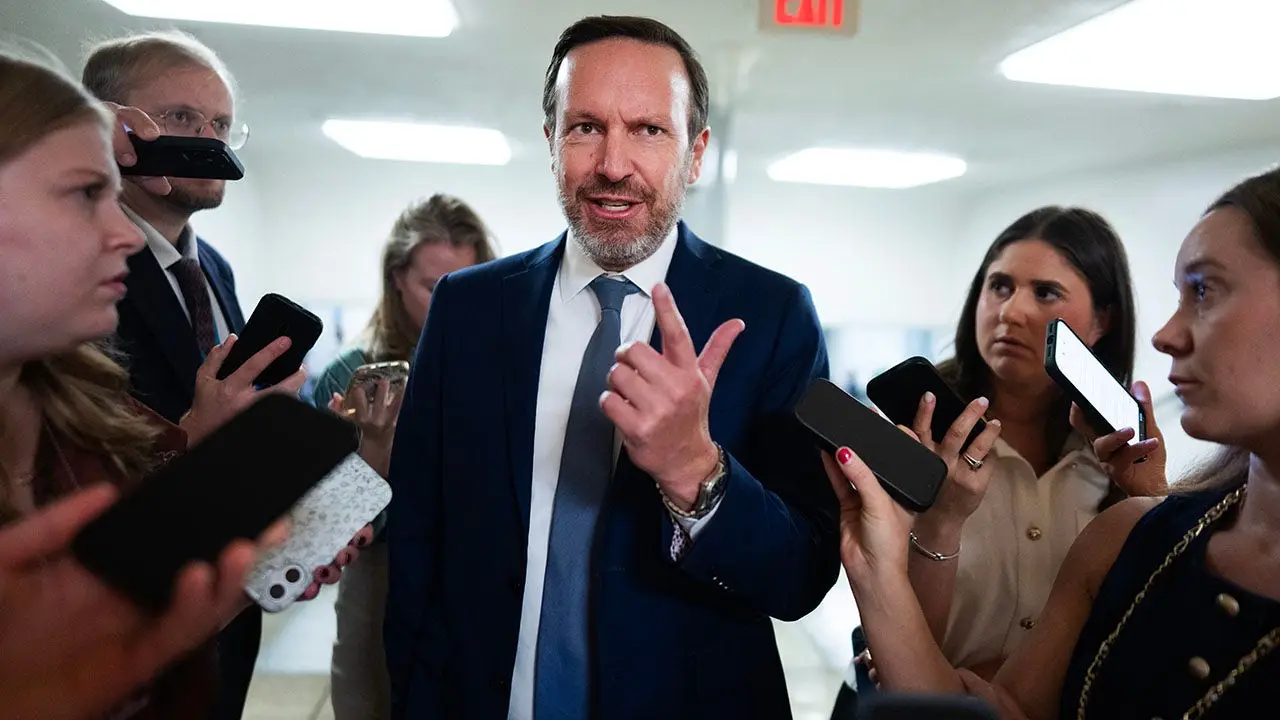
On a quiet Saturday afternoon, in the middle of a hockey rink, ordinary life took a sudden and frightening turn for Senator Chris Murphy. The Connecticut Democrat was doing what countless parents across America do on weekends: sitting in the stands, watching his son play a game, perhaps drinking bad coffee and checking the scoreboard. Then he felt numbness in his arm. In that instant, the day stopped being about hockey or scores or weekend routines. It became about time, about warning signs, about the terrifying possibility that something was deeply wrong. That moment would lead him first to a local hospital, then to the renowned Johns Hopkins Medical Center, and ultimately to a diagnosis that no one ever wants to hear: he had experienced a stroke. His chief of staff, Allison Herwitt, confirmed the news in a statement released on Sunday, offering both the sober medical reality and a careful note of hope. “He was taken to a local hospital, where it was discovered he had experienced a stroke. He was transferred to Johns Hopkins for further monitoring and is responding well to treatment,” she said. “The doctors are encouraged by his progress, he is awake and alert, and we are optimistic he will make a full recovery.” The words brought a collective exhale, but also left a lingering ache. Strokes are sudden, ruthless, and deeply personal. They do not care about titles, popularity, or busy schedules. They happen in the middle of everyday moments, to ordinary people and to U.S. senators alike. The image of Murphy at his son’s hockey game grounded the news in a familiar scene, reminding everyone that behind every public figure is a parent, a partner, a friend, and a patient lying in a hospital bed, fighting for tomorrow.
The details that emerged painted a picture both alarming and, in some ways, reassuring. Murphy first began feeling the numbness on Saturday afternoon, and the symptom was taken seriously enough that he was immediately transported to a local hospital. It was there that doctors discovered he had indeed suffered a stroke. From that local facility, he was transferred to Johns Hopkins for more intensive monitoring, a move that reflected both the seriousness of the event and the value of specialized neurological care. At Johns Hopkins, the news began to shift from fear to cautious optimism. Murphy was awake, alert, and responding well to treatment. Those seemingly simple words carried enormous weight for anyone who has ever waited for information about a loved one during a medical crisis. They meant that he was not unconscious, that his body was cooperating, that his brain was fighting back. They meant that his family could breathe a little easier, and that his medical team had reason to believe that he might come out of this experience intact. The American Heart Association and common medical guidance emphasize that stroke is an emergency in which every minute counts, and the quick recognition of symptoms can mean the difference between life and death. Murphy’s case seemed to show what happens when things go right: a prompt response, a clear diagnosis, and access to exceptional care. But even with all of that, a stroke is never benign. It is an assault on the most essential organ in the human body. It scrambles the core of who we are, sometimes irreversibly. So while the early reports were encouraging, the public’s relief was tempered by the knowledge that recovery can be a long and unpredictable journey. Strokes exact a toll not just on patients, but on whole families, on spouses who sit by hospital beds, on children who must confront the mortality of their parents long before they are ready.
Christopher Scott Murphy was born on August 3, 1973, which made him just 53 years old at the time of this frightening episode. That number is worth pausing over, because strokes are so often associated with older adults, with grandparents, with people who have already lived long lives. But the reality is that strokes can strike at any age, and a growing body of research has highlighted the troubling rise of strokes among younger and middle-aged adults in the United States. Murphy’s age placed him squarely in a group that often believes itself too young for such catastrophic health events. Yet there he was, a man considered a rising star in national politics, suddenly vulnerable in a way that no campaign or debate could prepare him for. Murphy was first elected to the Senate in 2013, completing the term of Joe Lieberman and then establishing himself as one of the most forceful progressive voices in the chamber. He was known for his impassioned speeches on gun control, foreign policy, and the fragility of American democracy. In 2016, he held the Senate floor for nearly fifteen hours in a filibuster demanding action on gun violence, a display of endurance and conviction that became legendary inside the Capitol. That kind of physical and intellectual stamina made the news of his stroke all the more shocking. He seemed like someone who could outlast anyone, a man of relentless energy and restless purpose. He was also a father, and the incidental detail that he was at his son’s hockey game added a deeply human layer to the political story. It reminded people that senators are not abstract figures, but human beings who sit on uncomfortable bleachers, who cheer for their kids, who get cold in the winter and worry about their families like everyone else. As a potential 2028 Democratic presidential primary candidate, Murphy had increasingly become a figure of national attention, but in that alarming hospital room, the future was not about campaigns. It was about survival, recovery, and the simple hope of coming home. His ambitions would have to wait. His body had other plans.
Murphy, who was not himself on the ballot in the midterms, had spent the preceding weeks crisscrossing the country on the campaign trail, lending his voice and energy to Democratic candidates in an effort to secure or retake control of the Senate majority. He was scheduled to campaign for Democrats in New Hampshire on Sunday, the very day after the stroke. That appearance, of course, disappeared in the chaos of the medical emergency. The cancellation was inevitable, but also oddly revealing. It highlighted the relentless demands of American political life, where senators live at a breakneck pace, moving from one rally to another, constantly speaking, constantly traveling, constantly being pulled in a hundred different directions. It is a lifestyle that seems designed to test the limits of the human body. Sleep is sacrificed, healthy meals are replaced with fast food, stress is constant, and rest is treated as a luxury. No one can say with certainty that Murphy’s stroke was caused by overwork, and it would be irresponsible to draw such a direct line. But the timing, in the middle of a grueling election season, inevitably made people wonder about the toll that public service takes on the people who choose it. There is a painful irony in the fact that a man who had been spending his days trying to protect American democracy found himself suddenly fighting to protect his own health. The news from his office did not dwell on political fallout or missed campaign events, and neither should anyone else. There would be plenty of time later to analyze the Senate map, to discuss the electoral implications, to ask what this might mean for his future. But in that moment, all of that seemed trivial. The only thing that mattered was a human being, lying in a hospital bed, with doctors and nurses around him, while the rest of the country watched and waited. It was a powerful reminder that beneath the scorching rhetoric and sharp partisan divisions, public officials are people too. They bleed. They hurt. They get sick. And they need the support, not just of their constituents, but of their fellow citizens and political opponents alike. In a moment like this, compassion should have no party.
Murphy’s experience also served as a public health reminder of enormous importance. Stroke remains the fifth leading cause of death in the United States and a leading cause of serious adult disability. Approximately 800,000 Americans suffer a stroke each year, and the consequences can be devastating. Yet stroke is also a medical emergency in which fast action makes an extraordinary difference. The acronym F.A.S.T. has been drilled into public consciousness for good reason: Face drooping, Arm weakness, Speech difficulty, Time to call emergency services. Murphy’s case was nearly a textbook example of one of those warning signs. The numbness he felt in his arm was exactly the kind of symptom that people are taught to take seriously, and the fact that he was promptly taken to a hospital may have been pivotal in limiting the damage and preserving his prospects for a full recovery. It is all too easy to explain away warning signs. Many people tell themselves that a numb arm is probably just a pinched nerve, that the headache is probably just stress, that the dizziness is probably just exhaustion. Those rationalizations can be deadly. Strokes do not announce themselves with trumpets. They whisper, they confuse, they hide behind ordinary aches and pains. The most human response is denial, because the alternative is too frightening. But the most life-saving response is speed. Murphy’s stroke, so visible in the national news, may encourage countless people to review warning signs with their families, to commit the F.A.S.T. acronym to memory, and to promise themselves that if anything feels wrong, they will not hesitate to get help. There is no better tribute to his ordeal than that kind of renewed awareness. As a lawmaker, Murphy had spent years advocating for policies intended to protect people from gun violence, from sickness, from the many ways a life can be suddenly cut short. Now, unintentionally, he had become a different kind of messenger, one whose own body reminded the nation that health is the most fundamental foundation of everything else. No campaign strategy, no legislative achievement, no political career means anything without the simple ability to open one’s eyes and be alive.
As the news settled into the consciousness of the country, the prevailing emotion was cautiously warmhearted relief. Murphy was awake, alert, and responding well to treatment. His doctors were encouraged. His staff spoke of optimism. His family could begin to imagine a future in which this became a difficult memory rather than an ongoing tragedy. A full recovery seemed possible, perhaps even likely, though the road ahead would require patience, rehabilitation, and careful attention to health. For a man who had built his entire identity around activity, advocacy, and public engagement, stepping back to heal would not be easy. But the same determination that carried him through a fifteen-hour filibuster would surely help him through the slow, patient work of recovery. There is something profoundly human about watching a strong person become vulnerable, and then watching them begin to rebuild. It is a story that plays out in hospitals every day, in every city and town, but it feels uniquely powerful when it happens to someone whose face and voice are familiar. In the hours and days ahead, colleagues across the political spectrum would send their best wishes. Constituents across Connecticut would hold him in their hearts. Strangers who disagreed with him on every policy would still pause to hope for his well-being, because health is universal territory. The news of a senator’s stroke also invited reflection about time, mortality, and priorities. It reminded people to hold their loved ones close, to appreciate the mundane moments, to understand that the stuff of life is not found in headlines or political victories but in the quiet moments between them. For Murphy, the experience might well change the way he approaches his work and his life. It might make the hockey rink feel more sacred, the next sunrise more precious. Whether he ever becomes president or not, he will carry the memory of this moment with him, humbled and strengthened by it. And the country, in turn, would be reminded that behind every public servant is a private soul, vulnerable in exactly the same ways as everyone else. The story of Chris Murphy’s stroke is ultimately a story about resilience, about the fragility of life, and about the remarkable power of hope. It is a story that could have ended much differently. Instead, it continued, moving forward in the careful hands of doctors and the steadfast spirit of a man who had never given up on anything in his life. There will be more tests, more difficult days, more uncertainty. But for now, the word from his hospital room was good, and that was enough. A senator, a father, a person, a survivor in the making. And one day soon, perhaps, he will be back in those stands, watching his son play again, with a deeper appreciation for the blessing of ordinary days.