


XRP Rally Faces a Seven-Month Leverage Test as Ripple’s RLUSD Credit Fund Reshapes the Narrative
Bitcoin’s Breakout Sparks a Broader Crypto Rally
The leverage returned during XRP’s strongest stretch in months, and it arrived just as the broader digital-asset market rediscovered its appetite for risk. The catalyst came last week, when the U.S. Treasury expanded its bond-buyback program, a move that helped pull long-term yields lower and, in turn, set off a powerful rally across risk assets. Bitcoin, the cryptocurrency market’s largest and most liquid entry point, jumped from below $68,000 to nearly $80,000 before taking a breath. The surge rippled outward, and among the tokens that benefited most was XRP. It did not simply follow bitcoin’s lead; it outperformed, climbing faster than the market’s largest cryptocurrency and most other major tokens as the rally broadened. For a digital asset that had spent much of 2026 in a quieter, lower-leverage phase, the shift was striking. Leverage, which had been notably subdued for months, began returning to the XRP derivatives market just as the token found itself at the center of a renewed wave of enthusiasm. The price action was enough to capture the attention of traders, but the more important story was developing underneath the surface. By the time XRP pushed above $1.50 earlier in the week, the market was no longer dealing with the same cautious positioning that had defined most of the year. It was dealing with a market that had rediscovered a taste for borrowed capital, a shift that always brings opportunity and risk in equal measure. The pullback that followed, an almost 5 percent drop over 24 hours to $1.44 on Wednesday, was a reminder that momentum in leveraged markets can reverse just as quickly as it builds.
Ripple’s RLUSD Push and the Rise of Institutional Trading Hours
Yet there was more to XRP’s move than a market-wide tailwind. The token also had its own run of headlines, and those headlines gave the rally a distinctly institutional character. Ripple last week backed a new institutional credit fund that plans to make loans in its RLUSD stablecoin through the XRP Ledger. That is not just another stablecoin announcement. It ties XRP’s underlying ledger to a real-world credit product, giving the network a function that extends beyond trading and speculation. The fund, supported by Ripple, is designed to bring stablecoin-based lending to institutional borrowers, and the decision to run those loans through the XRP Ledger signals that Ripple sees the ledger as more than a settlement layer. It positions XRP’s infrastructure as a home for actual financial activity. Around the same time, separate ledger data showed a growing share of XRP activity taking place during the overlap between London and New York trading hours. That window, when the two largest Western financial centers are both open, is widely watched by market participants because it is when institutional trading desks are most active. A rising share of volume during that period suggests that XRP is attracting the kind of professional involvement that has long been a missing piece for many digital assets. Retail traders can move a market, but institutional participation tends to bring deeper liquidity and a longer-term commitment. The combination of Ripple’s RLUSD credit fund and the shift in trading hours gave XRP a self-generated narrative that did not depend on bitcoin’s coattails. It gave the market a reason to treat the rally as more than just a beta play on the broader crypto cycle.
The Pullback: XRP Slips to $1.44 After a $1.50 Push
For all of the bullish momentum, however, the market hit a pause. XRP fell almost 5 percent over a 24-hour window on Wednesday, dropping to $1.44 after trading above $1.50 earlier in the session. The decline was not dramatic by cryptocurrency standards, but it stood out because it came at a moment when expectations were running so high. A pullback after a sharp rally is common, even healthy, in the crypto market. What matters is how the market handles that pullback, and for XRP, the context is more complicated than a simple case of profit-taking. The token had just moved through its strongest stretch in months, with leverage returning to the market at levels not seen since January. That means the price gains were not solely the result of spot buying. A significant portion of the move was likely fueled by open interest, derivatives positions, and borrowed capital. When a market is built on that kind of structure, a modest price decline can quickly become something larger. The drop from above $1.50 to $1.44 may look like a routine dip, but in a leveraged market, every move is amplified. Exchanges require traders to maintain a certain level of collateral behind their positions. If the price falls enough, those positions are closed automatically. The closing itself adds more selling pressure. That dynamic is what makes leverage so dangerous in a fast-moving market, especially when the majority of positions are on the same side of the trade. For XRP, the question is no longer simply whether the institutional story can push the price higher. It is whether the market can hold its gains without triggering a wave of forced selling.
A Seven-Month Leverage High and the $3.45 Billion Long Position
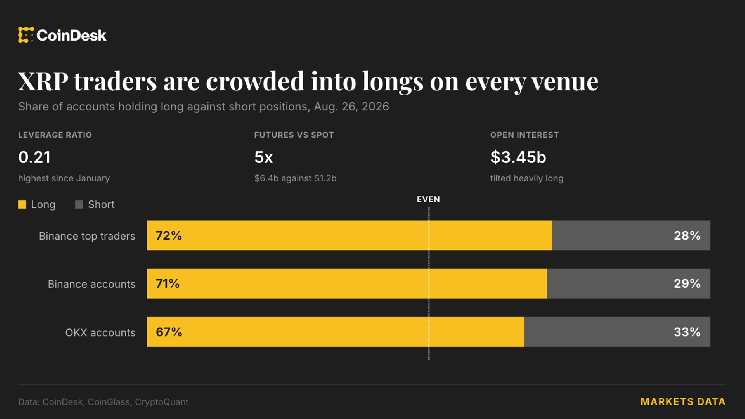
The source of that tension can be measured. Leverage in the XRP market is now at a seven-month high, according to derivatives data. The estimated leverage ratio, a metric that compares the value of open positions in the derivatives market with the size of the underlying spot market, has climbed to a level that traders have not seen since January. At the same time, open interest across XRP futures and options stands at roughly $3.45 billion, and the positioning is tilted heavily toward longs. In simple terms, a large number of traders are betting that the price will continue to rise, and many of them are doing so with borrowed money. That is not inherently a bad sign. Rising open interest alongside rising prices is often a confirmation of a trend. It suggests conviction, not just speculation. But it also creates a specific kind of vulnerability. If the price drops far enough and quickly enough, exchanges will start closing positions that no longer have enough collateral behind them. Those forced sales, known as liquidations, add to the downward pressure. And when enough liquidations happen at the same time, the selling feeds on itself. The lower the price goes, the more positions get caught in the wave, and the more selling is generated. This is sometimes described as a long squeeze, and it is one of the most well-documented patterns in leveraged cryptocurrency markets. The presence of $3.45 billion in open positions, heavily weighted toward longs, means there is plenty of fuel for that kind of move if the price breaks below key support levels. No one can predict whether that will happen, but the risk is real enough that traders will be watching the price, the open interest, and the liquidation levels closely in the coming sessions.
The January Precedent: Same Leverage, Different Price
XRP spent most of 2026 with its estimated leverage ratio at relatively low levels, which is what makes the current spike so noteworthy. The last time the metric sat where it is today was in January, and at that point, XRP was trading above $2. The comparison is not necessarily a warning, but it is important context. In January, leverage was running high while the price was already elevated. The market had become comfortable with XRP at a higher level and was willing to take on risk to push it even further. Now, the situation is different. The price is lower, around $1.44, yet the leverage has returned to the same elevated levels. That means traders are borrowing more to catch the move at a price that is still well below the cycle’s previous peak. There is a certain logic to that. If investors believe XRP is on its way back toward $2 or beyond, they may see the current price as a discount and use leverage to maximize their exposure. But it also means the market is carrying more debt at a lower price, which can be a fragile combination. A leveraged position built during a momentum rally is often less stable than a leveraged position built during a period of sustained confidence. If the price stalls or reverses, those positions are unlikely to be held patiently. They are likely to be unwound quickly. The fact that XRP spent most of 2026 with low leverage suggests that the current spike is a relatively recent development, not a permanent feature of the market. That makes it harder to understand, but also easier to misinterpret. High leverage can extend rallies, but it can also deepen corrections. The January precedent is a reminder that the same leverage levels can mean different things at different prices.
What to Watch Next: Institutional Adoption, Market Structure, and the Risk of a Deeper Drop
The next phase of XRP’s story will be determined by how these forces interact. On one side is a genuine institutional narrative. Ripple’s backing of a credit fund that plans to lend through the RLUSD stablecoin on the XRP Ledger gives the network a utility story that is difficult to ignore. The growing share of XRP trading during the London-New York overlap suggests that this is not just retail speculation. Those are meaningful developments, and they may provide a foundation that earlier rallies simply did not have. On the other side is a derivatives market that has become crowded with leveraged long positions. Open interest of $3.45 billion is a substantial amount, and the fact that it is tilted so heavily toward the long side means there is a structural risk of a cascade. If the price falls far enough to trigger liquidations, those forced sales could overshadow the fundamental story, at least in the short term. The macro backdrop also matters. The U.S. Treasury’s expanded bond-buyback program was the original spark for this rally, and its influence on long-term yields is still being processed by global markets. If yields continue to fall, risk assets could keep climbing, and XRP could resume its upward path. If the bond market shifts or if concerns about inflation or policy re-emerge, the same leveraged market that pushed XRP higher could accelerate its fall. For traders, the practical question is not whether the rally is real, but whether it can be sustained in the face of so much borrowed money. The key level to watch is the recent low near $1.44. If XRP can hold that level and gradually work off the leveraged positioning, the institutional story may eventually carry the day. If not, the correction could run deeper than the fundamentals alone would suggest. The market is at that moment when the next move will say more about the structure of the rally than the rally itself.