



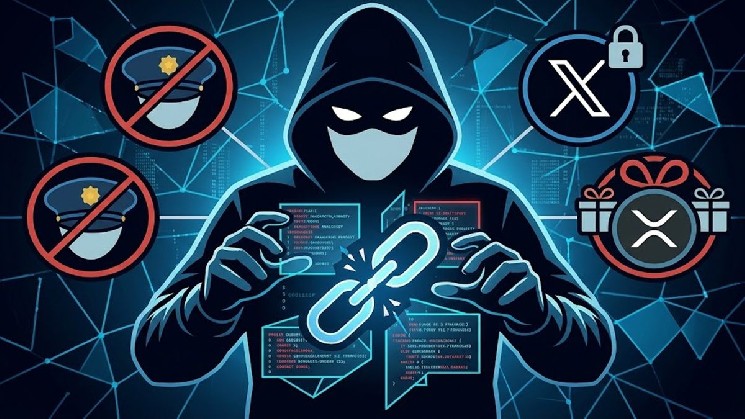
Hackers Breach Irish Police X Accounts to Promote Fraudulent XRP Airdrop Offers
Late-Night Takeover of An Garda Síochána’s Social Media Prompts Urgent Public Warning
It began quietly, in the witching hours of October 14, when most of Ireland was asleep. At approximately 11 p.m. local time, unauthorized actors gained control of the official X accounts belonging to An Garda Síochána, the national police and security service of the Republic of Ireland, and transformed them into instruments of cryptocurrency fraud. Followers scrolling through their feeds were greeted by unexpected posts promising free XRP tokens — supposedly part of an airdrop connected to a digital wallet known as Xaman. By the time the public woke up, the force was already scrambling to contain the damage, confirming the breach the following day and issuing an urgent directive: do not interact with the compromised accounts, and disregard any messages issued during the period of unauthorized access. The Irish police X account hack quickly became a talking point across the cybersecurity community, not only because of the audacity of the attackers, but because of what it revealed about the evolving methods of digital criminals. For a police service that maintains a substantial social media footprint for traffic alerts, community outreach, and public safety announcements, the loss of its verified voice — even briefly — was a serious blow to the integrity of official communications.
The fraudulent posts themselves pointed followers toward links associated with Xaman, a cryptocurrency wallet previously operated under the name Xumm. The wallet provider responded rapidly to the incident, confirming that the advertised XRP allocations were entirely fraudulent and carried no legitimate connection to its services. In the cryptocurrency ecosystem, airdrops — the distribution of free tokens to promote a project — are sometimes used by genuine developers as a way of building community and rewarding early adopters. But in the hands of malicious actors, they become a time-tested trap that continues to snare even veteran crypto users. Victims are invited to connect a digital wallet, complete what looks like a simple transaction, or register with a fraudulent website, ostensibly to receive their promised tokens. Beneath the surface, however, a more sinister sequence is set in motion: scammers harvest sensitive information, engineer approval of destructive blockchain transactions, or gain the access necessary to drain accounts completely. For those who take the bait, the cost is often the loss of digital assets that took years to accumulate. In the case of the Irish police hacker incident, the use of a reputable wallet branding gave the campaign an added veneer of credibility, making it all the more dangerous before Xaman and the Garda publicly cut ties with the promotion.
What made this particular episode especially alarming was the platform on which it unfolded. Security analysts observing the incident noted that a growing number of criminal operations now prefer to compromise established institutional accounts rather than spend time impersonating cryptocurrency projects from scratch. Constructing a fake brand profile requires substantial investment, effort, and time; building a convincing front with an engaged audience is not easily manufactured. Hacking a verified police account, by contrast, provides immediate access to a broad public following and the kind of trust that would take years to earn organically. The coveted blue checkmark that once signified authenticity becomes, in the hands of a fraudster, a weapon of deception. The authority of a law enforcement institution is repurposed to validate a criminal enterprise. This was not the first time official governmental or corporate accounts have been hijacked for crypto giveaway scams — similar incidents have struck global brands, celebrities, and even other national institutions in recent years — but each new occurrence reveals how thoroughly trust itself has become commodified in the modern digital landscape. When scammers exploit Irish police accounts, the message is clear: no account, no matter how official, is immune.
To their credit, An Garda Síochána responded with what appears to be commendable transparency. In the wake of the breach, the force issued a formal statement clarifying that the compromise was confined entirely to the X platform. Authorities reported no evidence that internal police systems, operational databases, or sensitive law-enforcement data had been accessed without proper authorization. The distinction is critical: a social media account takeover does not automatically imply a deeper intrusion into an organization’s technological backbone. Still, the incident carried significant risks for the public. Official police channels are relied upon for vital safety information, and their corruption can expose ordinary citizens to financial ruin while sowing confusion about which communications can be trusted. The Garda also warned about potential impersonator accounts that could emerge in the aftermath of the hack, seeking to exploit the confusion by imitating the very institution that had just been victimized. Followers were urged to rely strictly on official sources and to exercise caution when encountering police-branded messaging elsewhere on the platform. For a force that established its reputation on dependability and public service, the need to warn citizens against its own social media presence was a uniquely uncomfortable position.
The investigation is continuing, with X cooperating closely with Irish authorities as they work to determine precisely how the attackers obtained control of the accounts. While investigators have not publicly disclosed the method of intrusion, cybersecurity experts point to a familiar roster of possibilities: targeted phishing attacks against the social media team, reused credentials exposed in prior data breaches, sideloaded session tokens, or accounts lacking robust two-factor authentication. For all its sophistication, the attack was not an extraordinary technological feat in the broader landscape of cybercrime; rather, it represents a masterclass in social engineering. The same platform that has struggled, since its rebranding from Twitter, with questions about verification, moderation, and user safety has now become the stage on which the legitimacy of a national police force was borrowed, however briefly, by fraudsters. The incident also highlights the broader problem of official social media account security in the public sector, where budget constraints and outdated protocols often leave organizations vulnerable. As law enforcement agencies worldwide continue to expand their digital outreach, the security of the accounts they use to communicate becomes a matter of public safety, not merely administrative concern.
For ordinary users, the lesson from this XRP airdrop scam is familiar but worth repeating with renewed urgency: pause before you click, and question the generosity of strangers — even those wearing a verified badge. No legitimate airdrop will ever ask you to connect a wallet to an unfamiliar website, approve a suspicious blockchain transaction, or share a seed phrase. Official communications from police and other authorities should be verified through independent channels whenever they appear out of the ordinary. And for organizations entrusted with public safety, this incident underscores an uncomfortable new responsibility: in an age where trust is the ultimate currency, safeguarding the accounts used to communicate is every bit as important as safeguarding the systems used to serve. As cybercriminals evolve and begin trading on the reputations of the most venerated institutions, the only defense is skepticism, vigilance, and a hardened approach to account security. The hackers who seized the Garda’s X accounts may have been looking for quick victims; what they ultimately demonstrated is that no profile, however authoritative, is beyond the reach of a well-crafted scam. The breach may be over, but the warning it carries will echo long after the fraudulent posts have been deleted.