


Bitcoin Miner Hut 8’s Texas Campus Emerges as Powerhouse Behind Anthropic’s $35 Billion AI Deal
A new chapter in the symbiotic relationship between cryptocurrency mining and artificial intelligence is being written in South Texas, where a sprawling industrial site originally built to secure the Bitcoin network is now providing the computational muscle for one of the most anticipated AI models in the world.
AUSTIN, Texas – In a significant development that underscores the rapid convergence of the digital asset and artificial intelligence sectors, Hut 8 Corp, a prominent Bitcoin mining firm, has been confirmed as a key infrastructure provider in a monumental $35 billion AI computing agreement. The deal, orchestrated between AI safety and research company Anthropic and Nvidia-backed cloud provider Lambda, will see a significant portion of its high-performance computing operations hosted at Hut 8’s Beacon Point campus in Nueces County, Texas. This arrangement marks a pivotal shift for the mining industry, which is increasingly being recognized not just for its role in securing blockchain networks, but as a vital landlord and power broker for the next generation of computing.
The Anatomy of a $35 Billion Cloud Computing Agreement
Anthropic, the developer of the Claude AI assistant, has committed to spending a staggering $35 billion to secure computing capacity from Lambda, a specialized AI cloud services firm that boasts hardware manufacturer Nvidia as a strategic investor. Reports from the Wall Street Journal on Monday night revealed the scale of this transaction, which represents one of the largest private cloud computing commitments in the industry’s history. The financial firepower behind the deal reflects Anthropic’s aggressive push to scale its AI models, which require vast arrays of graphic processing units (GPUs) to train and operate. Crucially, the physical infrastructure where this digital intelligence will be processed is not a new, purpose-built data center in a tech hub like Silicon Valley or Northern Virginia, but rather a facility initially engineered to solve Bitcoin’s massive cryptographic puzzles.
Hut 8’s Strategic Pivot to High-Performance Computing
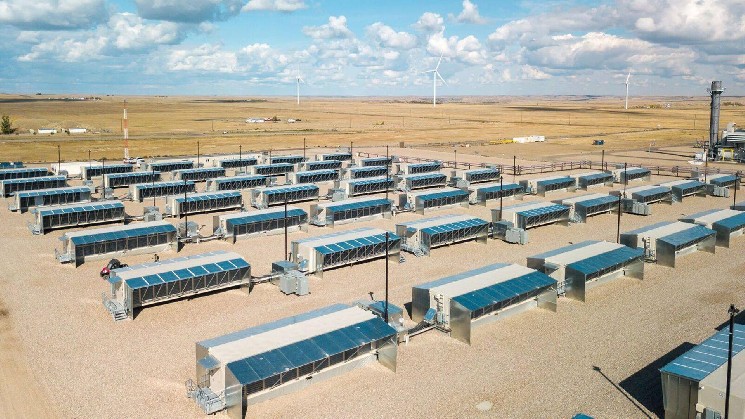
The revelation has cast a spotlight on Hut 8’s business strategy, which has evolved significantly from its roots as a pure-play Bitcoin miner. According to details emerging from the deal, Nvidia holds the master lease on the Hut 8 Beacon Point facility. Lambda, in turn, will deploy Nvidia’s latest generation of AI chips within that space to power Anthropic’s workloads. This three-way arrangement creates a powerful synergy: Nvidia provides the hardware, Lambda manages the cloud infrastructure, and Hut 8 supplies the land, shell, and, most importantly, the power. The Beacon Point campus is a massive undertaking, encompassing 525 acres with access to up to 1 gigawatt of electricity and a pre-existing connection to the Texas power grid. This access to abundant, reliable energy is the linchpin of the entire operation.
The 704-Megawatt Mystery and the Nvidia Lease
While the market reacted positively to the initial news on Monday evening—with HUT shares surging in after-hours trading before gaining marginally in pre-market sessions—the full scope of Hut 8’s involvement is only now becoming clear. The company had previously disclosed two 15-year lease agreements at Beacon Point covering a total of 704 megawatts of IT capacity, but had notably declined to name the tenant. Those leases are valued at a combined $19.6 billion in contracted revenue over their initial terms, a figure that instantly transformed Hut 8’s financial outlook from a speculative mining venture into a stable, utility-grade real estate investment trust. The agreement with Lambda and Anthropic raises a central question: is Nvidia the mystery tenant behind both leases, and does the 704-megawatt capacity represent the entire Lambda deal, or just a portion? CoinDesk has sought confirmation from Hut 8 regarding the precise allocation of its leased capacity to Lambda and whether Nvidia is indeed the counterparty for the full footprint.
Why Wall Street Views Bitcoin Miners as AI’s New Landlords
This landmark agreement is symptomatic of a broader industrial synthesis that has been gathering momentum over the past two years. AI companies face a herculean challenge in their quest for scale: they require colossal amounts of electricity—often hundreds of megawatts—to power their data centers. For a traditional data center developer, connecting that kind of load to the grid can take over a decade due to permitting delays, supply chain bottlenecks for transformers, and the general strain on utility infrastructure. Bitcoin miners, however, have already cleared these hurdles. Over the past several years, firms like Hut 8, Core Scientific, and Riot Platforms have strategically acquired distressed power assets, locked in long-term electricity contracts at fixed rates, and established strong relationships with grid operators. They possess exactly what AI developers are scrambling to find: shovel-ready sites with existing grid connections, high-voltage substations, and massive cooling capabilities.
Navigating Energy Markets and the AI Infrastructure Boom
The Texas location of Beacon Point is particularly strategic. The Lone Star State operates its own independent power grid, overseen by ERCOT, which has proven to be highly accommodating to large-scale industrial loads. The region offers a unique market structure that allows large consumers to curtail their power usage during peak demand spikes in exchange for financial incentives. This setup provides a hedge against high energy prices, ensuring that the facility can offer competitive power rates to AI giants like Anthropic. Hut 8 has been at the forefront of this “demand response” strategy, utilizing its Bitcoin mining rigs as a flexible load that can be switched off instantly to sell power back to the grid during summer heat waves. Now, with GPUs running AI workloads, the financial calculus changes slightly, but the fundamental grid relationship remains advantageous.
A Synergy of Shoulders and Circuits
The tech world’s sudden interest in crypto mining infrastructure has breathed new life into an industry that suffered a brutal bear market in 2022 and a mining difficulty surge following the Bitcoin halving event. For investors, the Hut 8 announcement is a validation that these mining assets possess a “dual purpose” utility. They are no longer just cost centers for securing a blockchain; they are scarce, hard-to-reproduce infrastructure that serves as the physical foundation for the AI revolution. This realization has led to a reevaluation of mining companies’ stock valuations, with many analysts now pushing for a “sum-of-the-parts” approach that values their power portfolios independently of their Bitcoin treasuries. The narrative has flipped from “wasteful energy consumers” to “essential energy enablers.”
What the Lambda-Anthropic Contestation Means for the Future
As the market digests the specifics of the Anthropic-Lambda deal, the implications for other Bitcoin miners are clear. We can expect to see a continued flood of deals where AI companies effectively “rent” the energy infrastructure of crypto miners, retrofitting their power halls with GPU racks instead of ASIC miners. For companies like Hut 8, this allows them to diversify revenue, reduce their exposure to volatile Bitcoin prices, and secure massive, long-term cash flows. The company’s partnership with Nvidia—a key player in the AI hardware space—is particularly telling, suggesting that Hut 8 is being viewed as a preferred partner for high-density computing projects, a far cry from its old image as a scrappy digital-asset miner.
The Road Ahead for Beacon Point and the HUT Stock Story
Looking forward, the Beacon Point campus stands as a testament to the evolving landscape of data ownership. The campus’ ability to scale up to 1 gigawatt provides significant headroom for further expansion beyond the current 704 megawatts. If Lambda requires more capacity to fulfill its $35 billion contract, Hut 8 is in a prime position to expand the facility’s footprint. However, analysts note that execution risk remains. Building out the infrastructure to house Nvidia’s latest-generation AI systems is a complex engineering challenge. Hut 8 must ensure that the power delivery, cooling systems, and network connectivity meet the stringent uptime requirements of AI workloads, which are less forgiving than Bitcoin mining operations.
Yet, after years of proving its operational mettle in one of the most competitive mining landscapes in the world, Hut 8 appears well-positioned to transition from a Bitcoin market leader to a broad-based digital infrastructure titan. The $35 billion commitment from Anthropic to Lambda, powered by Hut 8, is not just a commercial transaction; it is a declaration that the digital frontier of 2025 is being built on the back of the crypto boom of the past decade. It is a powerful reminder that in the world of high-stakes technology, the most valuable commodity is not just the chip itself, but the land, power, and infrastructure that allows it to come alive.