

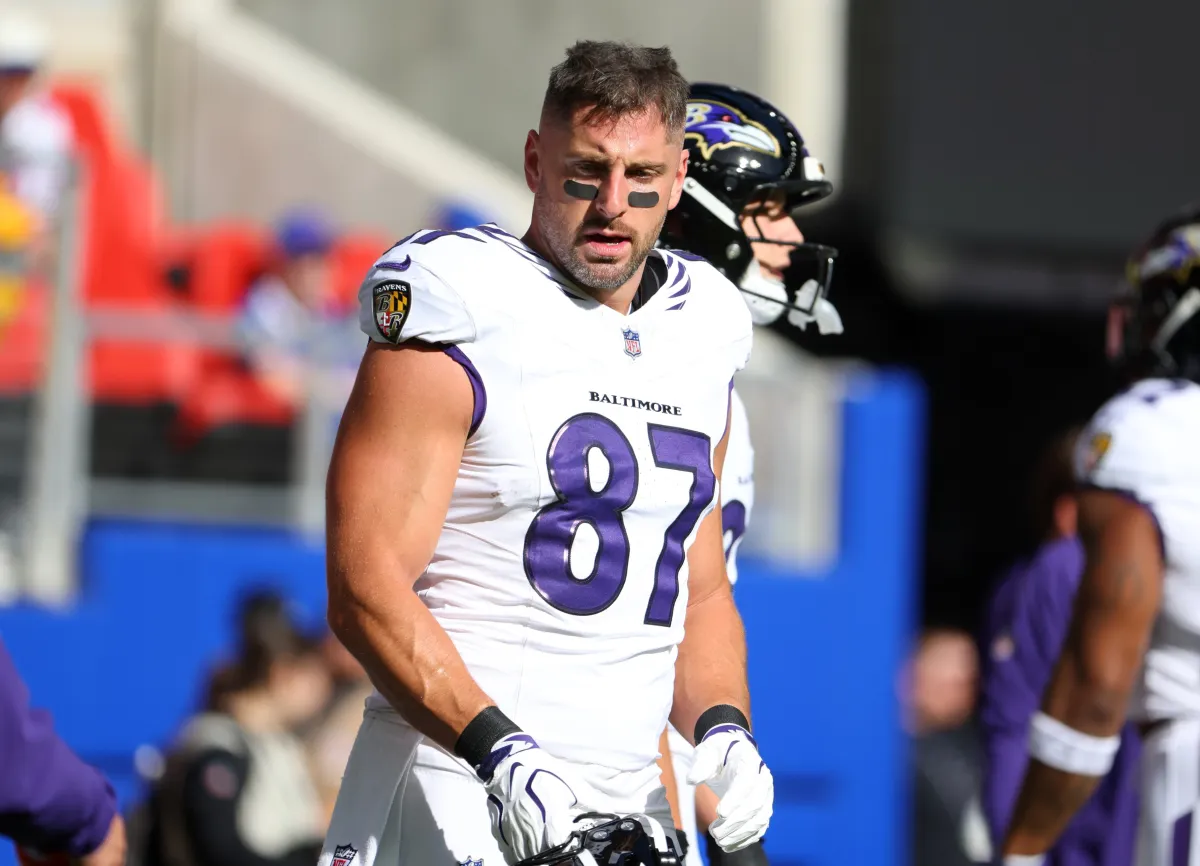
The Baltimore Ravens were among the most active teams as this year’s NFL trade deadline came and went, and while the headline news centered on the acquisition of Atlanta Falcons starting center Ryan Neuzil, the quieter moves made by the franchise told a far more human story. On Tuesday, the Ravens announced a series of roster decisions, including the release of veteran tight end Nick Vannett. In the transaction wire, that release is just a cold line of text: a player’s name, a date, a team. But for Vannett, it was the latest twist in a career that has never followed the easy path. At 33 years old, he had already been through this exact moment many times before. He had been cut, traded, and released so often that the routine was almost familiar: the phone call from the front office, the quiet conversation with the coach, the box in the locker room, the last walk through the facility. The Ravens needed roster space after their deadline moves, and Vannett, a tight end who had not recorded a single statistic during his time in Baltimore, was the cost. Yet the statistics do not measure what a player like Vannett brings to a locker room. They do not measure the extra work in the film room, the mentorship of younger players, or the willingness to do the unglamorous jobs that never appear in a box score.
Vannett’s time with the Ravens began with cautious hope. He first joined the team in September after being released by the Seattle Seahawks as part of their final roster cuts, a familiar blow for a player entering his tenth professional season. Instead of sulking, he packed his things and reported to Baltimore, where he worked to earn a spot on the team’s practice squad. Then, on October 7, the Ravens promoted him to the active roster. It was a small victory, but for a journeyman tight end it felt enormous. He was no longer just a practice body; he was an NFL player again, eligible to dress on Sundays and contribute to a team with serious postseason ambitions. He attended every meeting, took every rep, and stood ready whenever his number was called. But the call never came. Vannett failed to record a statistic in Baltimore. There were no catches, no targets, no tackles on special teams. He simply existed in the margins of a roster built to win now. In a league that prizes production, lack of production can be fatal. With the acquisition of Neuzil and other moves designed to strengthen the team’s offensive line, the Ravens had to make a corresponding move. Vannett became that move. It may have been the right football decision, and it may have been necessary for the team’s championship hopes. But that does not make it any easier for a man who has spent his entire adult life trying to prove that he belongs.
To understand what this release truly means, one must understand where Vannett came from. He began his career as a third-round pick in the 2016 NFL Draft out of Ohio State, a program known for producing NFL-ready players. At Ohio State, Vannett was not the star of the offense, but he was a dependable target, recording 91 catches for 877 yards and six touchdowns over his college career. Those numbers did not scream superstar, but they suggested a reliable tight end who could block, catch, and do whatever was asked of him. The Seattle Seahawks saw enough to select him in the third round, and Vannett spent the first three years of his professional career in the Pacific Northwest. He learned behind veterans, carved out a role on special teams, and absorbed the physical demands of the NFL. But the business side of football is always lurking. In 2019, Seattle traded Vannett to the Pittsburgh Steelers in exchange for a 2020 fifth-round pick. He finished that season with 17 catches for 166 yards, a modest output that did little to convince the Steelers that he was part of their long-term future. The next year, Vannett joined the Denver Broncos for the 2020 season, but the results were similarly underwhelming: 14 catches for 95 yards and one touchdown in 15 games. Across three different teams in three years, Vannett had gone from a promising draft pick to a nomadic backup. Yet he kept showing up. He kept learning new playbooks, new coaches, and new quarterbacks. He never stopped believing that the right opportunity was just around the corner.
The middle years of Vannett’s career were defined by instability and quiet resilience. In 2021, he signed a three-year contract with the New Orleans Saints, a deal that seemed to offer the security he had been seeking. But halfway through the 2022 season, the Saints released him. The timing was brutal, as midseason cuts often are. With no team willing to pick him up immediately, Vannett landed on the New York Giants practice squad, where he spent the remainder of the year. A practice squad is a strange purgatory for a veteran. He practiced all week, helped the defense prepare, and waited for a chance that might never come. He was on the payroll, but he was not truly part of the team in the way that active roster players were. Still, he kept working. The following year, Vannett signed with the Houston Texans and later moved to the Los Angeles Chargers. In eight games across that 2023 season, he caught exactly one pass for three yards. It would have been reasonable for anyone to walk away at that point. He had been in the league for seven seasons, had played for six different teams, and had spent more time packing boxes than celebrating touchdowns. But Vannett could not let go of the game that had defined his life. He still believed there was football left in his body. He still believed that one good year could change everything.
That good year finally arrived in 2024 with the Tennessee Titans. Vannett recorded 17 catches for 135 yards and three touchdowns, tying his career-best mark for scoring in a single season. It was not a dominant season by any measure, but it was proof that he could still contribute in a meaningful way. It earned him another chance the following year when he signed with the Minnesota Vikings ahead of the 2025 season. But the Vikings cut him during the roster battles, and he was eventually signed off Minnesota’s practice squad by the Los Angeles Rams, where he finished the season. After that, he found his way back to Seattle for a brief stint before the Seahawks released him as part of their final cuts. That release led him to Baltimore. In many ways, the last several seasons have been a blur of airports and hotel rooms, short-term contracts and uncertain futures. Vannett’s career totals now stand at 108 receptions for 1,012 yards and nine touchdowns. Those numbers will never earn him a place in the Hall of Fame, and they will not make him a multi-million-dollar commentator. But they represent a decade of survival in a league that discards thousands of players every year. They represent a man from Westerville, Ohio, who refused to give up on his dream even when the dream kept moving him from city to city.
Now, as the Ravens turn their attention to the stretch run and their pursuit of a Super Bowl, Nick Vannett finds himself in an all-too-familiar place. The team released him, but the door was not entirely closed. There is a chance he could return to the practice squad, which would mean more waiting, more uncertainty, and more resilience. For a native of Westerville, Ohio, the journey from Ohio State to the NFL was supposed to be a fairytale. In many ways, it has been, but not the polished, glamorous version that fans imagine on draft night. It has been a grind filled with injury scares, contract disputes, late-night moves, and the constant fear of being replaced by someone younger and cheaper. Yet Vannett is still here, still refusing to walk away, still believing that his best football might be ahead of him. The Ravens’ decision to release him was a football move, plain and simple, but the human story behind that move is anything but plain. In a league filled with superstars, Vannett has been a supporting actor, a reliable presence, a man who showed up day after day and did the work without complaint. No statistic will ever capture that kind of dedication. No transaction wire will ever explain the emotional weight of another goodbye. But Nick Vannett’s story is not over. Whether he lands on a practice squad, signs with another team, or finally decides to hang up his cleats, he has already proven something far more important than any number on a stat sheet: he has proven that persistence matters, that resilience is a kind of greatness, and that there is dignity in every single attempt to get back up again.