

1. A New Kind of Grant, Announced With Baseball Mascots and a Sense of Relief
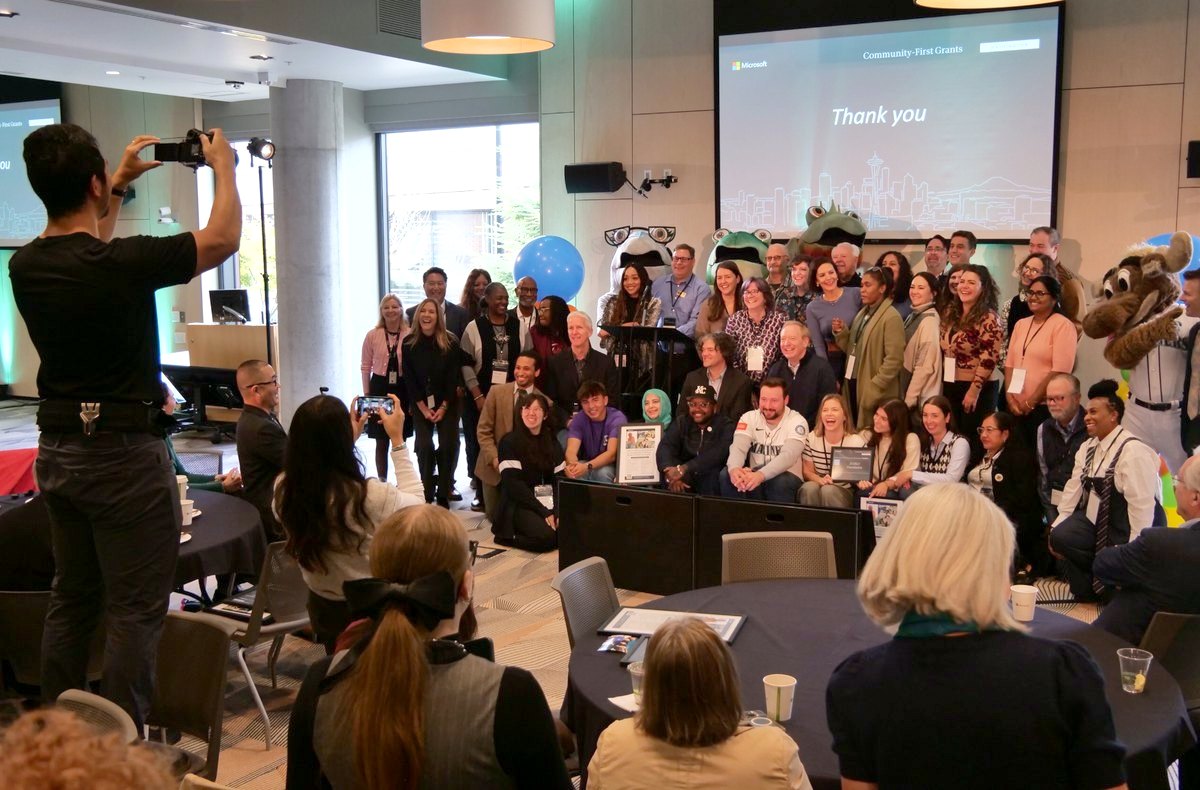
On a crisp Monday afternoon in Redmond, Washington, a collection of unlikely guests gathered on Microsoft’s campus: nonprofit leaders, company executives, a Seattle Mariners catcher, and two oversized salmon mascots. The occasion was the announcement of Microsoft’s first-ever Community-First Grants, a program designed to do something deceptively simple yet profoundly impactful—give money directly to local organizations for the things they desperately need right now. Twenty-five nonprofits from King County each received $20,000, drawn from a $1 million fund the company launched in September. The money isn’t for flashy pilot programs or long-term strategic planning. It’s for the unglamorous, essential stuff that keeps an organization alive: replacing a broken-down van, repairing a failed freezer, buying uniforms that don’t smell like a time capsule from the Reagan administration. The response was overwhelming. Microsoft said it received 813 applications for just 25 slots, a number that surprised even those inside the company. “Boy, I think we hit a nerve,” said Jane Broom, Microsoft’s senior director of Community Affairs, as she stood onstage with the grantees and the Mariners’ mascots. For the people in that room, the checks represented more than a bank deposit. They were a signal that someone saw the work they do, understood the strain they were under, and trusted them enough to give without a mountain of red tape. The grants are deliberately restricted to organizations that weren’t already receiving Microsoft corporate funding in 2026, meaning this money flows to groups that might otherwise be overlooked. In a region dominated by tech billionaires and soaring salaries, the event was a reminder that just a few miles from the company’s gleaming headquarters, there are food banks serving more people than ever, hatcheries trying to educate kids who can’t afford field trips, and school bands making do with equipment older than the students wearing it.
2. Nonprofits Are Stretched Thin, and the Funding Landscape Is Shaky
The timing of the grants is no accident. Across Washington State, nonprofits are navigating a brutal combination of rising costs, stagnant funding, and skyrocketing demand. Their single largest source of support is the state government, but that support is far from reliable. In Olympia, lawmakers and business leaders are locked in an ongoing, contentious debate over taxes, spending, and economic competitiveness, all while the state wrestles with a serious budget crunch. Microsoft is among the companies that have publicly argued that current and proposed taxes are harming the business climate, a position that puts the company in an awkward position: simultaneously a critic of state fiscal policy and one of the most important private funders of the nonprofit sector. Brad Smith, Microsoft’s president and vice chair, acknowledged the tension in an interview after the event. He noted that Microsoft is the second-largest funder of the state’s nonprofits, behind only the government itself. But he also cautioned against relying too heavily on any one source of money. “In my view, a healthy nonprofit community actually has aspects of support from more than one source,” Smith said. That’s not just abstract philosophy. When a recession hits, state grants are often among the first things cut. The Community-First Grants are designed to be a complement, not a substitute—a flexible cushion that helps organizations weather the unexpected. But the underlying fragility remains. For many of the grantees, the $20,000 check is a lifeline in a storm. They are seeing things fall apart—not because of mismanagement, but because the needs around them are growing faster than their budgets. A food program that served a few hundred people a month a few years ago is now serving twice that. A diaper bank that thought it had a handle on demand is watching the list double year after year. The economy has recovered in many ways, but for the people on the margins, it hasn’t. And for the organizations that serve them, every dollar counts more than ever. Microsoft’s grants are a small but meaningful acknowledgment that these groups shouldn’t have to choose between fixing the freezer and feeding the line that forms outside the door.
3. The Money Meets Real, Growing Needs: Food, Diapers, and Salmon
The stories behind the grants illustrate just how varied the needs are. At Community Lunch on Capitol Hill, where free hot meals are served to anyone who walks in, demand is up 40 percent this year. That’s not a short-term spike; it’s a reflection of how many people are struggling to afford groceries in one of the most expensive cities in the country. Meanwhile, at Byrd Barr Place, a nonprofit that provides services to underserved communities, the diaper bank has grown from 720 families in 2021 to 1,600 today. Diapers are an expense that many policymakers overlook, but for parents juggling rent, utilities, and transportation, they can be the difference between making ends meet and falling behind. The new grant money will help these organizations keep up with the surge. But not every need is a basic necessity. Some are educational, cultural, and even whimsical. Friends of the Issaquah Salmon Hatchery, known by the delightfully fitting acronym FISH, gives over 700 tours during the salmon season and works to connect people with the region’s natural heritage. But many of the schools that would benefit most from those tours can’t afford to bring their students to the hatchery. So FISH is flipping the model. It will use its grant to take lessons directly into classrooms, focusing on Title I schools, which serve large numbers of low-income students. “If they can’t bring the school to the hatchery, we will go out to the school,” said Mark Clemens, the group’s executive director. Clemens has an unusual background for a salmon educator: he’s a former art director for Scientific American and served as creative director on the massive, multi-volume Modernist Cuisine cookbook project before taking over FISH in 2023. But his passion for the salmon and the watersheds they depend on is unmistakable. At the Microsoft event, his group got a bonus moment when the Mariners’ salmon mascots bounded onstage to join them for a photo. It was a lighthearted moment in a room full of serious purpose—proof that even the most earnest work can have a little joy attached to it.
4. Technology for the Blind, and Marching Band Capes From 1981
One of the most striking grant uses is coming at The Lighthouse for the Blind, a Seattle-based nonprofit that employs blind and visually impaired people in manufacturing, retail, and other jobs. The organization is upgrading its computer training lab with new Windows 11 PCs, braille displays, and wireless keyboards. Antonio Rozier, the nonprofit’s IT director, explained that the goal is to keep employees current on screen readers and other assistive technologies so they can work effectively alongside sighted colleagues. It’s easy to take for granted how quickly technology changes. For a blind worker, a new version of a screen reader can mean the difference between being able to use a database and being locked out of it. The Lighthouse also maintains computer labs at its three manufacturing plants, and employees are encouraged to use them for personal tasks—paying bills, writing emails, searching for housing—since many don’t have that equipment at home. Rozier called the upgraded lab “a game changer for the future.” It’s a phrase that captures the essential optimism of the grant program: a relatively modest investment now can open doors for years to come. Across the region, in a very different corner of the nonprofit world, the Lake Washington High School Band and Jazz Boosters are using their grant for something more nostalgic. Their marching band returned in 2025 after a 40-year absence, and the students have been performing in capes that date back to 1981—the era of MS-DOS, shoulder pads, and a very different kind of marching music. The grant will buy 150 new uniforms, replacing those ancient capes with something the students can be proud to wear. It may seem like a small thing compared to feeding the hungry or equipping a computer lab, but anyone who has ever marched in a too-heavy, too-warm, outdated uniform knows how much it matters. It’s about dignity, school spirit, and giving kids a reason to show up and belong. The program’s return after four decades is itself a statement: communities don’t give up on their institutions, even when the band has been silent for a generation.
5. Employee-Led Giving in a Time of Corporate Uncertainty
The Community-First Grants are just one slice of a much larger philanthropic engine at Microsoft. Most of the company’s local giving is directed not by executives, but by employees themselves. Microsoft matches their donations and adds $25 for every hour they volunteer, up to a combined $15,000 a year per person. Brad Smith said that program accounts for the bulk of the $1.9 billion Microsoft and its employees have funneled into roughly 13,000 Washington nonprofits over the past 30 years. “We let our people decide where the money goes,” Smith said. That decentralized approach is a powerful form of community engagement, but it’s happening against a backdrop of significant change inside the company. Microsoft has gone through layoffs in July and September, and in October it offered voluntary buyouts to about 60,000 people—roughly a quarter of its global workforce. The New York Times has painted a picture of employees grappling with stagnant pay, mounting pressure to embrace AI, and a growing sense of job insecurity. Asked about the buyouts, Smith struck a note of cautious optimism, saying it’s a good time for Microsoft to keep investing in the employee experience. He described the giving program as part of that investment. He acknowledged that Silicon Valley companies might lure workers with free food and other perks, but argued that Microsoft’s matching-gift program offers something different: a way for employees, many of whom move to the region from somewhere else, to put down roots and feel connected to their new home. When an employee donates to a local food bank or volunteers at a school, they aren’t just doing good—they’re becoming part of the community. That’s a form of retention and morale-building that no free lunch can replicate. Still, the disconnect is hard to ignore. At the same time the company is celebrating its giving, it is also shrinking its workforce. The grants are real, and they’re helpful, but they coexist with a sense of unease among the very employees whose generosity makes the program possible. Smith’s message was that the giving culture is resilient, and that even in times of change, the company remains committed to civic life.
6. Looking Ahead: A Second Round, and a Deeper Promise
Microsoft’s annual Give campaign in October—the company’s biggest month for employee donations—was, by all accounts, a success again this year. “Employee participation and employee giving is alive and well,” Smith said. That’s a reassuring statement, but the proof will be in the next round of Community-First Grants. Microsoft has announced plans to open a second round of applications in the spring of 2027. The gap between now and then gives nonprofits time to use the current funds, track their impact, and prepare for the next opportunity. It also gives Microsoft time to reflect on what the overwhelming response to the first round says about the state of the sector. The 813 applications were a signal that needs are acute, and that the nonprofit community is hungry for flexible, accessible funding. The grants are small in the grand scheme of Microsoft’s philanthropy, but their design is unusually thoughtful: they target immediate needs, they go to organizations outside the usual corporate grant orbit, and they come with minimal strings attached. That last part matters more than you might think. Nonprofits often spend so much time reporting to funders and applying for grants that they have little energy left for the actual work. The Community-First Grants cut through that bureaucracy. They treat local leaders as experts in their own communities, trusting them to know whether a new freezer, a set of braille displays, or two dozen marching band uniforms is the most pressing need. The image from the event—nonprofit staffers in casual clothes standing beside a baseball star in full uniform, flanked by mascots on a corporate campus—captured something essential about public-private partnerships. They’re a little awkward, sometimes a little silly, and full of mismatched energy. But they’re also where the real work happens. For the 25 nonprofits that walked away with $20,000, the money will mean tangible things: meals served, diapers distributed, salmon lessons delivered, jobs made more accessible, and a marching band that finally looks like it belongs in this century. It won’t solve every problem, and no one pretends it will. But it’s a start, and it’s a promise that Microsoft intends to be part of the community for the long haul. As the event wound down and the mascots handed out one last round of high-fives, the message was clear: help is here, more is coming, and the best way to support a community is to listen to what it says it needs.