


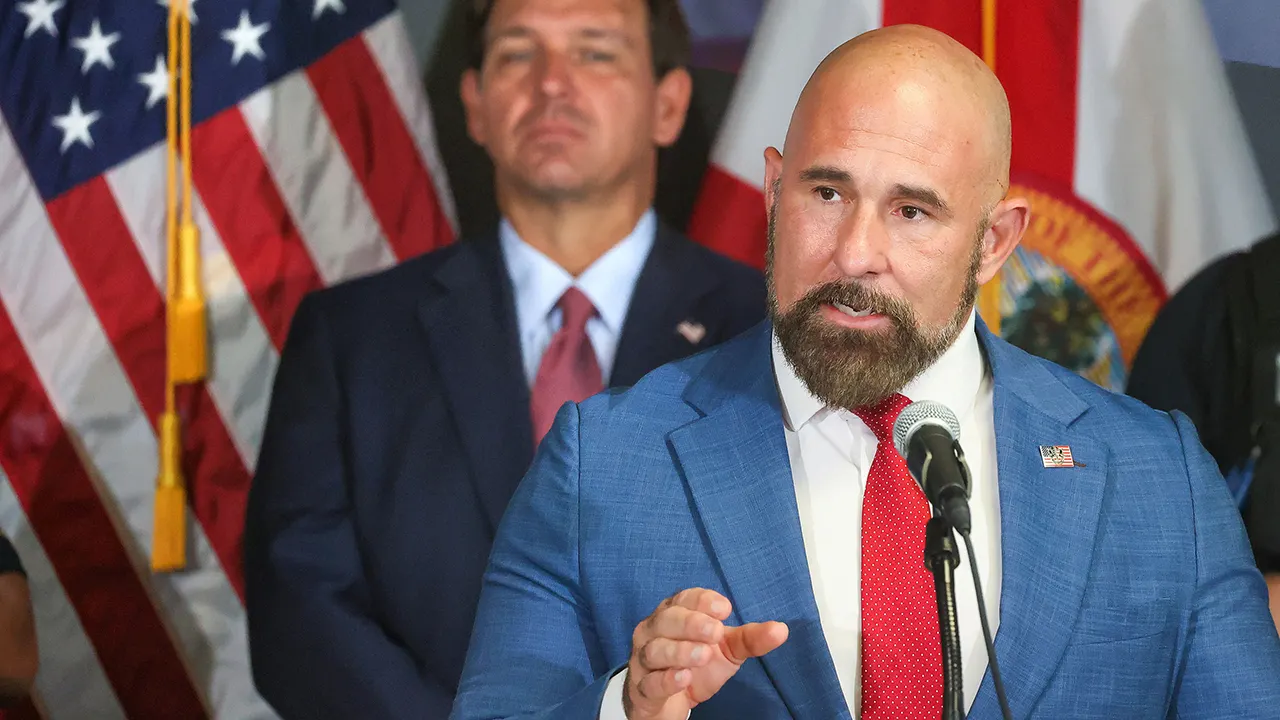
When an insurgent’s bullet shattered his arm in combat, Republican Florida Lt. Gov. Jay Collins did not wait for an evacuation team. A Green Beret, he performed emergency surgery on himself to save the limb. That image—a wounded warrior refusing to lie down and die—is the one Collins wants his party to keep in mind after the midterms. Gov. Ron DeSantis called the results a “near extinction-level” event for Republicans, and Collins sees a national GOP lying bloodied on the field. His advice is not complicated: show the same refusal to die, get up like a warrior, and fight. In an interview with Fox News Digital just days after what he called the midterm “bloodbath,” Collins said, “Where we go from here is up to us as a Republican Party.” He added: “This can be a definitive death blow if we allow it to be, but I believe in what we stand for. I believe in our Constitution. I believe in our founding fathers’ vision. I believe that God blessed this nation. I think we have to knuckle down, learn, apply this, and we have come out with a relentless dedication and fury to focus on what matters: To lead our state, to lead our country, and be what we need to be for the American people. That is what we should choose to do.” His message is blunt but human: “Hard times happen. Warriors, leaders get up and fight. That’s what we have to do now.” DeSantis has dubbed Collins the “Chuck Norris of Florida politics,” and the metaphor is not subtle. It is meant to be a road map.
That road map, Collins argues, is Florida itself. Under DeSantis, Florida shed its long-held “purple” swing-state identity and became the nation’s largest, most disciplined red bastion. Collins served as DeSantis’ No. 2 during the governor’s second term, and he points to Florida’s recent history as an example the rest of the country can follow. “Florida’s been the road map,” he said. “I think we’ve been what I call the conservative proving grounds. I think that it’s time for many here in Florida to use our voice and to be out there and help our party get back on their feet. Be resilient. Yeah, man, you got popped. You got hurt. Get back up, dust it off, and let’s go lead. Let’s learn.” The contrast is striking. While congressional Republicans scramble to assign blame for a devastating cycle of national losses—including, in the article’s telling, the loss of Texas to Democrats—Florida has positioned itself as the country’s preeminent conservative fortress and now the largest red state on the 2028 map. Collins does not pretend losing is fun. “Losing sucks, winning is awesome: Let’s get back to more winning,” he said. “We’ve just got to figure out how we’re going to do that, and that’s achievable. I think Florida is a blueprint. I think we have a responsibility to lead.” The point is not that Florida is perfect or that its formula can be copied without thought. The point is that Collins believes the party has a working model close at hand—one built on discipline, communication, and a refusal to accept decline as inevitable.
For Collins, that model depends heavily on a group that is easy to overlook in partisan warfare: no party affiliated voters, or NPAs—the valued middle that can flip races and states. Before being tapped to serve under DeSantis, Collins ran for the state Senate in a Tampa-area district that he describes as “not a conservative juggernaut in terms of Florida.” He was running against the Tampa mayor’s mother-in-law. It was his very first race. “We didn’t talk to a single Republican out there. We only knocked NPAs and light D’s, and we won by 10,” he recalled. “What does that tell you? In a community like Tampa, I didn’t hide from my views. I told people I’m conservative, I’m a Republican.” The lesson was not that ideology does not matter. The lesson was that honesty and conversation matter. “What I realized is if you’re honest with people, you agree on more than you don’t, but you have got to be willing to step in there and have that conversation,” he said. “And we did that over and over and again. And we built a base of people who trust us, because I don’t play games.” Looking back at the midterms, Collins said Republicans showed up, but NPAs showed up too—and they overwhelmingly did not align with Republicans. Even Florida’s heavy Republican registered-voter edge led to slim margins in a tough national environment. “What does that tell us? Well, the biggest gap we had was that we didn’t spend enough time communicating to our NPAs,” he said. His conclusion is that the party needs to go back to being a party that welcomes people in—a little bit more of a big tent—while still standing on conservative values. That is a human message: don’t hide who you are, but don’t treat voters you need as enemies either.
Collins is termed out of office alongside DeSantis in January, so his own political future is an open question. He says he will evaluate whether to serve in the state or the national party apparatus. For now, he is committing to nothing and merely saying, “Stay tuned.” That uncertainty fits the moment. The party is searching for a direction, and Collins is not pretending to have every answer. But he does return again and again to his military background—to having risked his life and literally sacrificed a limb for unity. “I wore a flag on my shoulder every single day that I served in uniform,” he said. “I wore the flag on my suit, really every single day that I was out there, serving in our state or serving our nation in any way that I could. We’re the American people; we are blessed.” Once the party picks its 2028 candidate, Collins says Republicans need to be all-in against the opposition. “We have to row the boat,” he said. “Sept. 11 was a big day in our life. Sept. 12 was incredible because we saw the power and the might of what America can be. When we rowed the boat, our enemy was fearful. They were on their heels because they saw an absolute juggernaut standing righteously to defend our people and our way of life. What our enemy fears, what other nations fear is Americans coming together.” That is the emotional core of his argument: unity is not a slogan; it is a source of strength that adversaries notice and respect.
Collins’ appeal to unity comes with a warning and a task. “We have to come together and realize that our nation is blessed,” he said. “It will fall if we don’t come together. But it won’t happen if we don’t start uniting and remind ourselves that this is America, we’re allies, internal in our country, and we’re going to make sure that it’s the greatest country moving forward. America’s worth fighting for.” He wants Republicans to focus on getting through the aftermath of the cycle, wrap it up, transition, and make sure they understand exactly what happened. Here his military experience becomes a parable. “You know, when we started the war on terror, and I was a young soldier, we spent two years trying to fight the last war. It wasn’t very great, to be honest with you,” he said. “Let’s not fight the last war. Let’s understand the operational environment. Let’s under our gaps. Our weaknesses and how we can clearly address those. And then we’re going to have to move with a righteous fury.” In plain terms, Collins is saying: study the battlefield, admit where you are weak, stop replaying old fights, and then move with purpose. That is not a call for mindless anger. It is a call for clear eyes, hard lessons, and disciplined action—the kind of thing a soldier learns when survival depends on honest assessment.
The overall picture is of a party that is wounded but not dead, and of a leader who thinks the difference between those two outcomes is a choice. Collins does not minimize the midterm damage. He does not pretend that Florida’s success automatically translates everywhere. But he does offer a human, practical message: be resilient, communicate with people you need, tell them the truth about who you are, welcome them in, stand on your values, and stop fighting the last war. He sees Florida as a conservative proving ground and a blueprint, not because it has all the answers, but because it shows that Republicans can win when they do the slow, unglamorous work of persuasion and trust-building. His own story—a Green Beret who saved his own arm and now urges his party to save itself—gives the metaphor real weight. The midterms may have left the GOP bloodied, but Collins’ advice is to dust off, learn from the wounds, and get back up. “Warriors, leaders get up and fight,” he said. “That’s what we have to do now.” For Collins, that means understanding the operational environment, addressing gaps, and then moving forward with righteous fury—not as a death blow, but as a comeback.