

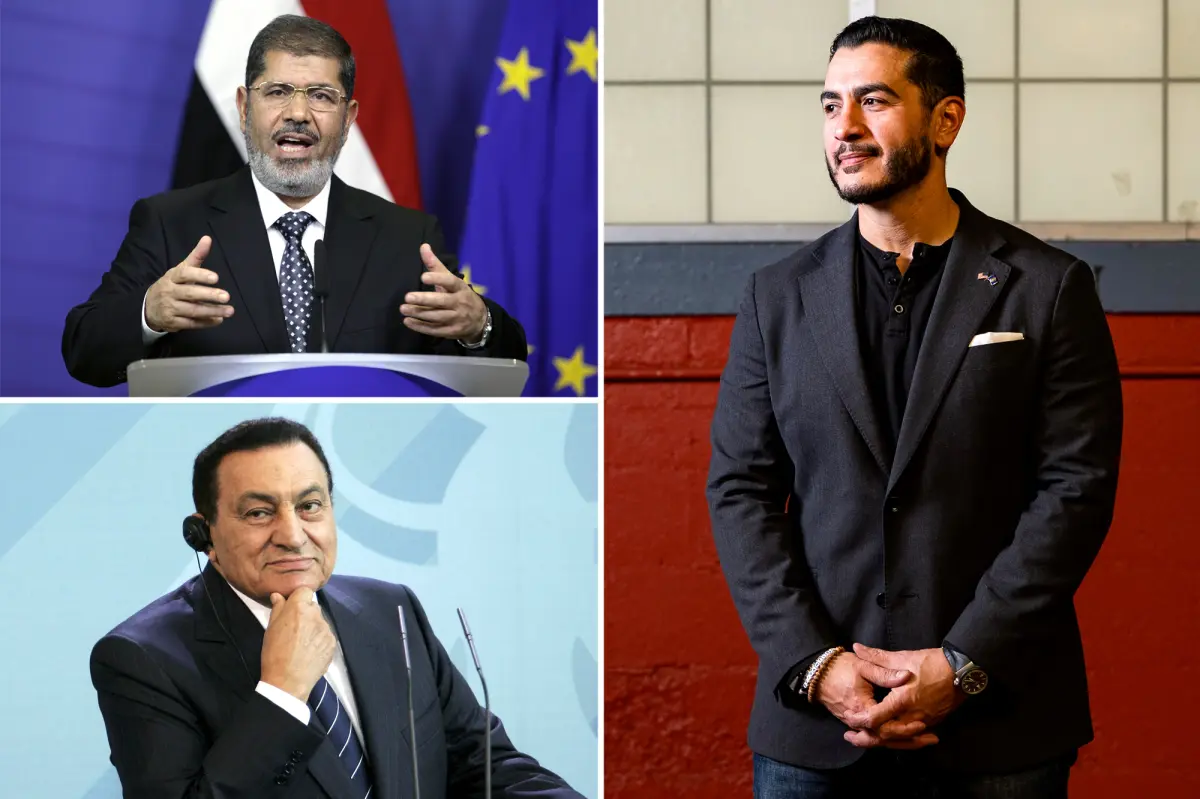
When Abdul El-Sayed walks into the U.S. Senate for the first time, he will carry more than a policy agenda. He will carry a paper trail—a collection of old articles, opinion pieces, and letters written years ago, long before he became Michigan’s senator-elect. And in the glare of national politics, those words have resurfaced with a vengeance. They reveal a young, passionate, often contradictory thinker: a progressive Egyptian-American who fiercely condemned Barack Obama’s drone strikes as extrajudicial killings, yet also warned Islamist parties in post-revolution Egypt against sliding into radical socialism. They show a man who once urged an American president to stand with street protesters in Cairo, but who later signed a letter pressing Egypt’s new Islamist president to purge the media and police. The incoming senator has spent part of his campaign laughing off the scrutiny, making jokes about having a “Muslim brotherhood” with his own brother. But the writings are not jokes. They are snapshots of a man trying to navigate the messy intersections of human rights, national security, revolution, and governance—and they are now part of the public record he must answer for.
The sharpest criticism came in 2011, when El-Sayed wrote a HuffPost piece about proposed budget cuts. He was angry that lawmakers seemed more eager to protect the Pentagon than to safeguard social programs, and he connected that anger to the human toll of America’s endless wars. “Beyond the decade-long slog that’s claimed hundreds of thousands of lives — Afghan and American — in Afghanistan, our military carries out daily drone strikes in Pakistan and Yemen,” he wrote. Then he went further, calling out a specific operation that still haunts American civil liberties debates. Earlier that year, President Obama had authorized a drone strike that killed Anwar al-Awlaki, a U.S.-born cleric and senior al-Qaeda organizer. Al-Awlaki was the first American citizen deliberately killed by a U.S. drone strike. El-Sayed described it in stark moral terms: “Most recently, in fact, one of these drone strikes perpetrated the extrajudicial assassination of an American citizen. Soon after, another was ordered to murder his son, 16, also an American. Not to mention our misguided, unfounded, and tremendously damaging war in Iraq.” Those were searing words from a future lawmaker. They placed El-Sayed squarely in the anti-war left’s corner, willing to criticize a Democratic president and to frame counterterrorism as a matter of constitutional principle and human dignity. For many progressives, that kind of critique was exactly what they wanted to hear. For his future opponents, it became ammunition—proof that he was dangerously radical, naive about national security, or both. But the piece was not simply an attack on Obama. It was an argument about values, about which lives the government treats as worthy of protection and which lives it treats as disposable. El-Sayed was saying that an American citizen killed by his own government without trial should matter to everyone. That conviction, whatever one thinks of the policy, is hard to dismiss as mere political posturing.
Around the same time, El-Sayed was turning his attention to Egypt, where the Arab Spring was upending decades of authoritarian rule. When Hosni Mubarak fell in 2011, El-Sayed—who has deep family roots in Egypt—responded with both celebration and concern. In a February 2012 Al Jazeera piece co-written with Jisung Park, then a Harvard economics doctoral student, he examined what the revolution meant for Egypt’s future. The Muslim Brotherhood and the Salafist Al-Nour party had won impressively in parliamentary elections: the Brotherhood took roughly 47 percent of seats, and Al-Nour took about 24 percent. Many observers assumed that meant Egyptians had embraced Islamic ideology. El-Sayed and Park disagreed. “Impressive showings at the polls by both the Muslim Brotherhood and the Al-Nour Salafist party – both of Egypt’s Islamic parties – was likely more a product of their domestic platforms and their histories of social justice than voter resonance with Islamic ideologies,” they wrote. In other words, Egyptians were not voting for theocracy; they were voting for people who had actually shown up to help them. But then came the twist that makes this so complicated. El-Sayed, who during his Senate bid was known for his left-of-center economic views, teamed up with his co-author to warn Egypt against pursuing radical redistributionist policies. He understood the temptation. Mubarak’s economy was rotten with corruption, and the new Islamist parties had won partly on promises of social justice. “In light of the business corruption that has [characterized] Egypt’s economy throughout the Mubarak years, it may be tempting for these parties to enact radical redistribution policies from the get-go,” the pair acknowledged. Yet they urged caution: “But the ruling coalition must resist the temptation to close off the Egyptian economy and redistribute its shrinking spoils by [nationalizing] private industries or raising tariff barriers.” To make their case, they invoked the painful history of the Korean Peninsula. North Korea’s centralized economy, they noted, “led to faster economic growth in the short-run (during the early 1950s),” but eventually Pyongyang “stagnated.” The lesson, as El-Sayed saw it, was that revolutionary governments should not let the euphoria of the moment lead them into economic suicide. It was a strikingly pragmatic argument from a man often painted as a doctrinaire leftist.
But El-Sayed’s engagement with Egypt was not only analytical; it was deeply personal. In a 2011 piece for the Guardian, he directly appealed to Barack Obama to support the Egyptian protesters. “As an American, I ask you to support these freedom fighters because not only is it in our American self-interest to promote democracy in the Middle East, but this is the only avenue our ideals will allow us,” he wrote. Then he added, with the weight of family memory: “As an Egyptian, I ask you to support them because I know, firsthand, the injustice that the Mubarak regime has inflicted.” That dual identity—American and Egyptian—runs through everything El-Sayed has written about the region. He is not a distant observer offering geopolitics from an ivory tower. He is someone whose own relatives lived under Mubarak’s rule, and who felt the fall of the regime as a personal liberation. Yet those family ties also became a political liability. During his Senate campaign, his half-sister publicly claimed that his family was very supportive of the Muslim Brotherhood. Opponents noted that some of his relatives had worked for organizations linked to the Brotherhood. The Brotherhood itself is a notoriously complex and controversial movement: it has democratic elements and charitable networks, but it is also associated with radical offshoots such as Hamas, and it has been designated a terrorist organization in several Middle Eastern countries, though not in the United States. El-Sayed denied having any ties to the Brotherhood. But his own writing complicated the story. At one point, after Mohamed Morsi—a leading Brotherhood figure—became Egypt’s president, El-Sayed signed a letter urging Morsi to “purge” the media and police. Morsi later did exactly that, in an infamous crackdown on journalists and protesters that helped provoke the military coup against him. It is hard to read that letter today without cringing, especially for someone running as a champion of democracy and civil liberties. The letter suggests that El-Sayed, like many observers at the time, was willing to give Morsi the benefit of the doubt—and that gamble failed catastrophically. It also shows a young intellectual trying to have it both ways: celebrating revolutionary energy while warning against revolutionary excess; defending the Brotherhood’s electoral mandate while cautioning against its economic instincts; urging democratic accountability while calling for purges of institutions. Those contradictions do not make El-Sayed a sinister figure. They make him human. But in politics, old words are rarely read generously.
By the time El-Sayed ran for the Senate, his past had caught up with him. Adversaries dug up the drone critique, the Egypt columns, the letter to Morsi, and the family connections, and turned them into a scandal narrative. The implication was clear: El-Sayed was too radical for the Democratic Party, or worse, somehow sympathetic to Islamist extremism. He responded with a mixture of defiance, clarification, and humor. He insisted that he disavows the Muslim Brotherhood and has no ties to it. He mocked the controversy during a session at Crooked Con, a progressive conference, saying: “I have a brother. He’s Muslim. He and I have a Muslim brotherhood.” The joke was clever, a way to defuse the phrase by making it literal, ordinary, almost silly. It may have worked with friendly audiences, but it did not erase the deeper questions. Why did he sign that letter to Morsi? What exactly did he think when al-Awlaki was killed? Does he still believe the drone strike was murder? These are not questions about slogans; they are questions about judgment and principle. The incoming senator will face them again in Washington, where every vote and every statement is scrutinized. His past writings will follow him like a shadow. But in another sense, they should also be read as the record of a thoughtful person engaging with the world’s hardest problems. El-Sayed was writing during a period of enormous uncertainty. The Arab Spring was still young. Obama was conducting a little-discussed drone war. Young American idealists, especially those with ties to the Muslim world, were wrestling with impossible questions: How do you condemn terrorism without condemning entire peoples? How do you support revolutions without endorsing whatever comes next? How do you hold a president accountable for killing an American citizen without a trial, while still wanting to protect that president’s broader agenda? Those are not contradictions that belong to El-Sayed alone. They are tensions at the heart of modern progressive politics.
As El-Sayed prepares to take office, the resurfaced articles offer a portrait that defies easy labels. He is at once a left-wing critic of American militarism and a cautious voice against revolutionary economics. He is a Muslim-American leader who feels the sting of injustice in his bones, yet who warned Islamist parties that they would fail if they nationalized industries and raised tariffs. He is a man who once called the killing of an American citizen “extrajudicial assassination” in one breath, and in another breath asked that same president to intervene in Egypt’s revolution. Some voters will see these writings as evidence of a sharp, independent mind—someone willing to criticize his own party, think unsentimentally about economic development, and speak honestly about the messy realities of the Middle East. Other voters will see them as red flags, signs of an erratic worldview and a troubling judgment. The truth, as always, is more complex. El-Sayed is not a villain in this story, nor is he a hero. He is a politician with a past made of paper—old columns, old arguments, old calculations, old hopes. What matters now is not just what he wrote then, but what he does next. The Senate will give him chances to show whether he has learned from the past, whether he can reconcile his ideals with governance, and whether the man who once called out presidents and revolutionaries with equal bluntness can now turn that honesty on himself. Washington may not remember every sentence he wrote as a young activist. But his opponents will remember. And so will the people who believed in him. The words have already resurfaced, once and for all. What he does with them from here is up to him.