

The midterms are over, but the political hangover is just beginning. What remains is not simply a war between Democrats and Republicans, but a quieter, more personal set of battles—inside party caucuses, in closed-door conference rooms, over who gets to lead and what that leadership means. House Speaker Mike Johnson has already made one of the most telling decisions of this post-election season by declining to pursue the post of minority leader. It is a decision that says a lot about the thankless nature of leading a minority in a chamber where your own members can make your life miserable. President Trump, meanwhile, has apparently decided not to demand a change at the top of the Senate, even though he and Senate Majority Leader John Thune have never been particularly close. That may reflect a practical calculation: Thune is there, he is institutionally useful, and fighting over his position would distract from the bigger losses the party just absorbed. But on the Democratic side, the celebration is already complicated. They just won a stunning midterm night—a sweeping victory that should have produced pure joy and relief. Instead, there are murmurs of discontent. Some incoming House and Senate progressives are openly raising questions about House Minority Leader Hakeem Jeffries and Senate Minority Leader Chuck Schumer. It is a strange feeling to win and still feel restless, but that is exactly what is happening. The new wave of Democrats did not run to preserve the status quo. They ran on bold promises: to get money out of politics, to put money in people’s pockets, to pass Medicare for All, to hold the Trump administration accountable. And they are not entirely sure that the leaders who guided the party through years of minority status are the right people to guide it through the heady days of majority power. The old guard may see a mandate; the new guard sees an opportunity and a responsibility to be bolder. And so the questions—if not the knives—are already out, not against the other party, but against their own.
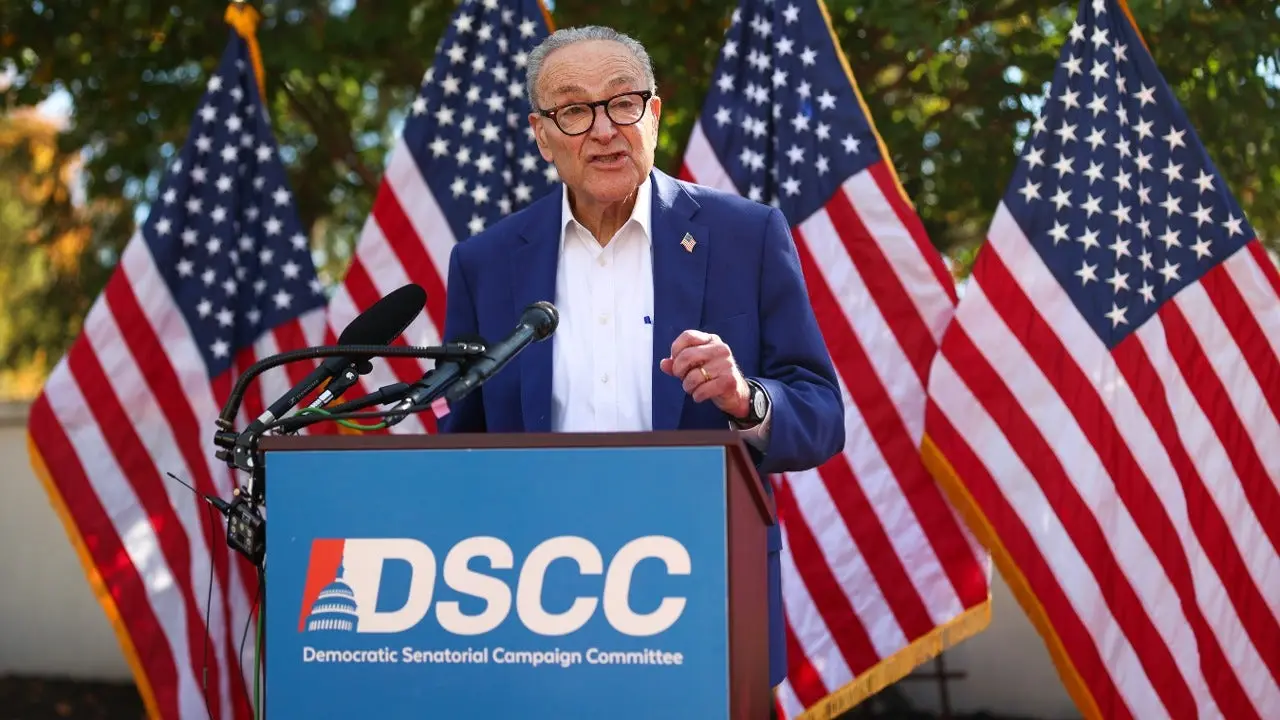
Nowhere is this tension more visible than in the Senate, where Chuck Schumer’s path to another term as majority leader looks, on paper, almost absurdly secure. The arithmetic is simple: with Democrats guaranteed at least 54 seats and possibly more once Mississippi and Alaska are decided, Schumer only needs a majority of his own caucus to be re-elected leader in the secret ballot. That works out to roughly 29 votes out of the Senate Democratic conference—a majority that should be easy to assemble for an incumbent with Schumer’s fundraising network and institutional power. But this is not a typical challenge. Sen.-elect Abdul El-Sayed of Michigan has been warning for months that he might not support Schumer, and since winning his seat, he has made good on that promise—or at least he has refused to hide it. In late June, he told anyone who would listen, “If you’re Chuck Schumer, I’m dangerous.” After the election, he dodged a direct question about whether he’d support the leader, saying he was interested in seeing what options the caucus had. Then he went on CNN and praised Maryland’s Sen. Chris Van Hollen, who hasn’t even announced that he’s running for anything, as “an amazing Senate majority leader.” That kind of public praise for a rival is not an accident; it is a signal. And El-Sayed is not alone. Sen.-elect Adam Hamilton of Kansas was blunt before the election: “No, I will not support Schumer,” he said, adding that he’d already told the leader he wouldn’t vote for him. Sen.-elect Annie Andrews of South Carolina told Bret Baier that both parties are clearly ready for a new generation of leadership. Sen.-elect Troy Jackson of Maine said he had informed Schumer personally that he was supporting someone else. These are not obscure fringe figures. They are newly elected Democrats, many of whom rode a wave of grassroots energy that is suspicious of the carefully calibrated, donor-friendly approach that has defined Schumer’s tenure. They feel they owe their victories not to the old machinery but to voters who are desperate for structural change. Schumer, for his part, is handling it with practiced political nonchalance. “I’ll be re-elected as majority leader,” he told reporters on Wednesday. “But the issue is focusing on the American people and what they want.” That calm confidence may be warranted, or it may be the kind of complacency that encourages challengers to look for an opening. The vote is secret, after all. People can say one thing and do another. But if Schumer is truly as safe as he claims, why are so many of his new colleagues already going out of their way to say they won’t vote for him?
Over in the House, Hakeem Jeffries is facing a different kind of challenge. Jeffries is on the verge of making history as the first Black speaker of the House, a deeply symbolic victory that should be a moment of celebration for the Democratic Party. But a group of incoming members affiliated with the Democratic Socialists of America are withholding their support, demanding commitments on a transformative progressive agenda before they will pledge their votes. The math here is more forgiving than it might appear. To become speaker, a candidate needs an outright majority of the entire House—218 votes out of 435, assuming every member-elect shows up to vote on Jan. 3. But House Democrats are expected to end up with more than 260 seats once every race is finally counted. That means Jeffries can afford multiple defections and still have the votes to take the gavel. The cushion is real, and it gives him room to tolerate a protest vote. But it also creates a political problem: he doesn’t want to begin his speakership with a visible, public rebellion, especially from the party’s most energetic base. The DSA members know this, and they are using their leverage to push for commitments on issues like Medicare for All, ending the war in Iran, reining in corporate money, and taking on the rising threat of artificial intelligence to American jobs. Jeffries is walking a careful line, trying to keep them in the coalition without making promises that could come back to haunt him. It is the oldest story in political life: the movement wants purity, the leader wants flexibility, and the grass roots wants proof that their votes matter. Meanwhile, Mike Johnson’s decision to step aside as Republican leader has a human poignancy to it. Last month, Johnson told a colleague that if God moved on his heart, he might return to his hometown of Shreveport and start a lawn business. It sounded like a joke—a tired man dreaming of an easier life, away from the endless meetings, the competing egos, the impossible task of herding cats. But now it seems less like a joke and more like a glimpse of what he actually wanted. Being minority leader in the House is arguably the worst job in politics. You have no power to set the agenda, no ability to demand loyalty, and all the responsibility for speaking for a party that may not even be listening. Maybe Johnson looked at the math, looked at the fractures in his conference, and decided that the grass really is greener back in Louisiana. It is hard to blame him.
The Republican leadership contest in the House is more crowded, but no less uncertain. House Majority Leader Steve Scalise and Rep. Jim Jordan are both running to become the top Republican in the House, the man who will lead the opposition against Jeffries. House Majority Whip Tom Emmer is trying to keep his job as minority whip, but he is facing a challenge from Rep. August Pfluger of Texas. At first glance, this is just the usual game of musical chairs. But underneath the titles and the posturing lies a fundamental question about the future of the Republican Party. Scalise and Jordan are both aligned with President Trump, but they represent two very different ideas of how to be a Trump Republican. Scalise is the institutionalist, the guy who knows the rules, counts the votes, and has the relationships to make the machinery work. Jordan is the firebrand, the fighter who turned committee hearings into political theater and would rather go down swinging than negotiate. Both have strong supporters in the conference, but neither has universal trust. There are Republicans who believe, after the midterm shellacking, that the party needs to move past Trump’s style, even if it doesn’t move past his policies. They want a leader who can talk to suburban voters, who can respond to the cost-of-living crisis with something other than “tariffs and tax cuts.” And there are Republicans who believe the answer is to double down, to embrace Trump’s energy and his willingness to challenge the establishment. The leadership election is the first test of which faction is stronger. But there is a deeper problem: whoever wins will have to hold together a coalition that is deeply suspicious of the other side. That was hard enough when Republicans were in the majority and had a common enemy. In the minority, with little power and plenty of internal rivalry, it will be even harder. The tension is visible in the candidates themselves. Scalise and Jordan are both touting their Trump connections, but they are also trying to project a sense of authority and competence that the party lacked in the campaign. Emmer, meanwhile, is trying to hold off Pfluger, who represents a more aggressive, Trump-first faction. The outcome will say a lot about what kind of opposition party Republicans want to be. Some are already nostalgic for the days when the Republican agenda was simple and the messaging was unified. But those days may be gone for good. The party is in for a long, messy argument with itself, and the leadership vote is just the opening round.
Democrats, for their part, have won the chance to govern, but they are still deciding what that means. They campaigned on the cost of living and on holding the Trump administration accountable, two themes that resonate deeply with frustrated voters. But those themes are not a legislative agenda. Unlike 1994, when Newt Gingrich famously crafted the Contract with America and gave Republicans a ten-point checklist that voters could understand, the Democrats have no single document, no unified manifesto. They have a collection of ideas, some of them old promises and some of them new anxieties. There is talk of rolling back “the cuts from the one big ugly bill,” as Sen.-elect Juliana Stratton of Illinois put it. There are promises to revive the expired Obamacare subsidies, the very fight that produced last year’s record-breaking 43-day government shutdown. Schumer believes that shutdown ultimately helped Democrats, because it forced voters to see the difference between a party that wanted to protect healthcare and a party that was willing to shut down the government over it. So there will almost certainly be votes on that. There is also growing concern about artificial intelligence and data centers. Rep. Greg Casar of Texas, who chairs the Progressive Caucus, has warned that the revolt against data centers is just the first tremor of an earthquake. He worries that AI will upend American jobs, and he wants Democrats to be on the right side of the issue before the country is caught off guard. Then there is the war in Iran. Democrats plan to force votes to cut off funding for the conflict, revisiting the earlier war powers resolutions that split the Republican caucus and exposed the limits of presidential authority. They believe that ending the war will bring down gas prices, and that lower gas prices will ease the cost of groceries, and that all of it will make voters feel the difference in their daily lives. They are also ready to tackle tariffs. President Trump has used them as a weapon, but Democrats see them as “irrational and self-defeating,” as Rep. Greg Stanton of Arizona puts it. They are daring Republicans to break with the president and show what they would do differently. Some Republicans are tempted. Others, like Rep. Chris Smith of New Jersey, still think the tax cuts and the “Big, Beautiful Bill” were underappreciated. The Democratic agenda, then, is a hodgepodge of revenge, opportunity, and experimentation. It is designed to put Republicans on the record, to force hard votes, and to prove to voters that Democrats understand their pain. Whether it adds up to a coherent vision remains to be seen. But it will be exciting, messy, and unpredictable.
At the center of all this is a stubborn, unavoidable piece of arithmetic: the math of overriding a veto. President Trump has said he is willing to work with Democrats on some things, but he has also made clear that he will not hesitate to use his veto pen. To override a veto, Democrats would need two-thirds of both chambers—290 votes in the House and 67 in the Senate. When all the races are settled, House Democrats may control more than 260 seats. That is a remarkable number, and it puts them within striking distance of 290, particularly if they can find a handful of Republicans who are ready to defy the president. In the Senate, the path is steeper. Democrats are guaranteed at least 54 seats, with Mississippi and Alaska still too close to call. If they end up with 56 seats, they would need 11 Republicans to reach the 67-vote threshold. That is a lot, and it is made even more difficult by the departure of some of the most independent-minded Republican senators—Mitch McConnell, John Cornyn, Bill Cassidy, and Thom Tillis—who might have been willing to cross the aisle on matters of principle. Losing them narrows the pool of possible GOP defections. And yet, even 11 is not impossible. The Republican Party is not a monolith, and the political incentive to break with a president who just lost a midterm cycle may grow stronger by the day. It will all depend on what Democrats can actually pass, and on whether the president wants to sign bills or fight them. If Trump chooses to veto everything, the next two years will be a war of attrition, with each side trying to wear down the other. But there is another possibility: that the two parties find a way to blunder into agreement on the things that voters actually care about, like the cost of living, or border security, or some new version of antitrust reform. The midterms were a devastating verdict on the Republican majority, but they were also a demand that government start working. Voters didn’t send Democrats to Washington to relitigate the past. They sent them to make a difference. The leadership battles now underway are about more than who holds the title. They are about what the party will do with its new power, and whether it can learn the lessons of the campaign. The political landscape is shifting beneath everyone’s feet. The leaders who survive will be the ones who understand that the old ways of doing business are no longer enough. The ones who don’t will be swept aside, politely or not, by the very people who are now whispering and organizing in the halls of a Congress that is about to be turned upside down. The midterms were just the opening act. The real show is only beginning.