

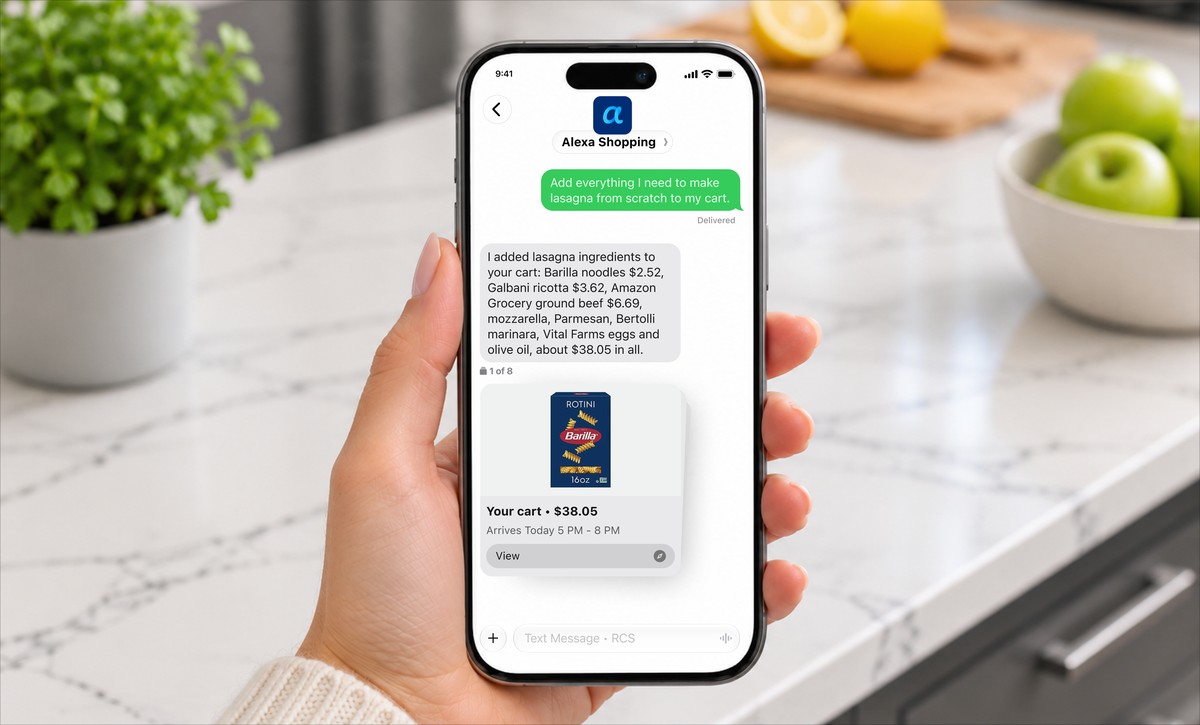
Imagine this: you’re sitting on your couch, realize you’re completely out of dog food, and instead of opening an app, typing in a search, scrolling through dozens of listings, comparing prices, reading reviews, and then checking out, you just send a quick text. “Hey, I need dog food.” That’s it. A few moments later, a reply comes back with a couple of good options. You tap one, and the order is on its way. This is the kind of everyday magic Amazon is betting on with its latest move. The company is rolling out a new feature that lets customers shop by text message through its Alexa for Shopping AI agent. It’s like having a personal assistant who lives in your text messages, someone who can search for products, compare options, and even place orders on your behalf. You don’t need to browse, you don’t need to compare endlessly, you just ask, and the agent handles the heavy lifting. It feels equal parts old-school and futuristic, a throwback to the days when texting was the most personal way to communicate, wrapped around one of the most advanced artificial intelligence tools we’ve ever had in our pockets.
The way it works is simple, at least from the outside. Customers who opt in get a contact in their phone called “Alexa Shopping.” You can send that contact a text message, or even a photo, and the AI agent takes it from there. If you text that you’re out of dog food, it searches for options and texts back with recommendations. If you send a photo of a recipe you’d like to make for dinner, it can turn that into a grocery order. The agent works quietly in the background after receiving your request, and then reaches out again when the task is done. You get to approve the purchase before anything is finalized, so there’s a sense of control. But there’s also an option to turn on auto-buy, which lets the agent automatically purchase an item when the price hits a target you’ve set. That means you could tell it to buy a new coffee maker if it ever drops below a certain price, and then just let it go. Beyond that, the agent can watch for price drops on things you’ve been eyeing, reorder past purchases with a quick text, and check on package deliveries. And because Amazon is weaving this into its entire ecosystem, a conversation that starts as a text can continue seamlessly in the Amazon app, on the website, or on Alexa-enabled devices around your home. It’s a level of convenience that feels less like shopping and more like delegating.
This launch isn’t happening in a vacuum, and it’s part of a much larger shift in how tech companies are thinking about artificial intelligence. Amazon’s text-based shopping agent is arriving at a moment when AI agents are becoming the new frontier for everyday digital tasks. OpenAI, for example, recently added texting to its personal AI agent, Dot, and DoorDash introduced text ordering back in September. The idea of messaging a service instead of navigating an interface is catching on, partly because it feels so natural. We already text our friends, our family, our partners, so why not text our shopping assistant? But there’s a deeper battle going on here, one that’s about who gets to control online shopping as AI agents become the ones doing the buying. Amazon has been aggressive about protecting its turf. The company has reportedly moved to block outside AI agents from Meta, Perplexity, Google, and OpenAI from shopping on its site, while at the same time building out its own powerful agent. This is a strategic chess match. If AI agents become the primary way people shop, then whoever owns the agent owns the customer relationship. Amazon clearly wants to make sure that when you ask an AI to buy something, that AI is Amazon’s own, and that it stays inside Amazon’s walls.
There’s also a commercial side to this that can’t be ignored. The text thread is more than just a convenience, it’s a new place for Amazon to sell. The company has said that order updates, delivery notifications, and deals will eventually land in the same conversation where you’re doing your shopping. That means the chat will become a kind of personalized storefront, a space where Amazon can gently nudge you toward products you might not have thought about. According to a report from Digiday, sponsored products can appear among the options the agent texts back to you. For now, those placements are free to advertisers, which suggests Amazon is still trying to figure out exactly how to turn this new channel into a revenue stream. Interestingly, purchases that the agent completes entirely on its own, without any back-and-forth approval, will stay ad-free for now. That’s a careful balance. Amazon doesn’t want to annoy people who are using the agent for pure convenience, but it also clearly sees an opportunity. The stakes are enormous. Amazon reported a staggering $68.6 billion in advertising sales in 2025, and the company is always looking for new surfaces where ads can live. A text conversation with a shopping assistant is about as intimate as advertising gets. It’s not a billboard or a banner; it’s a chat between you and a service you’re trusting with your money.
The rollout itself is being handled in a characteristically cautious way. Amazon started rolling out the feature on a Friday to a small group of U.S. customers by invitation, and the company says millions more will get access in the coming weeks. It’s the kind of slow, deliberate launch that lets Amazon test the experience, fix bugs, and see how real people actually use it before opening the floodgates. This new text feature builds on the broader evolution of Alexa for Shopping, which Amazon originally launched back in May. That launch merged its Rufus shopping chatbot with Alexa+, the generative AI version of its voice assistant. So this isn’t a completely new system; it’s the next step in a journey that has been underway for a while. What’s new is the interface, the fact that it lives in your text messages, right next to conversations with your mom and your best friend. There’s something almost intimate about that. It makes the AI feel less like a tool and more like a person you can rely on. And the invitation-only approach adds a little bit of mystery and exclusivity, like being part of a secret club. But for everyone else, it’s also a reminder that the future is arriving in stages, and this particular future is just a few weeks away for millions of people.
Looking at the bigger picture, this is a glimpse into a world where shopping becomes entirely conversational. The days of browsing through infinite product pages may not be over, but they’re certainly becoming less central to the experience. Instead of hunting for what you want, you’ll simply ask for it, and an AI will bring you exactly what you need, or at least a few close options. It’s the kind of convenience that feels almost lazy in the best way, like having a personal shopper who never sleeps, never gets tired, and never judges you for ordering snacks at midnight. But it also raises questions. How much trust are we willing to put in these agents? When an AI is making decisions about what to buy, whose interests is it really serving? Amazon has a clear incentive to push its own products, its own advertisers, and its own bottom line. The line between helpful assistant and clever salesperson is going to blur, and it will be up to consumers to stay aware of that. There’s also the question of competition. If Amazon becomes the default way to shop through AI, it could make it even harder for smaller retailers and independent brands to get noticed. The text thread might feel personal, but it’s still a corporate ecosystem. For now, though, the promise is genuinely exciting. Shopping by text message feels like a natural evolution, a way to make the mundane act of buying things feel a little more human, a little more like asking someone you trust for help. And as the technology improves, it’s easy to imagine a future where we all have a friendly assistant in our pocket, ready to handle the shopping so we can focus on living. Whether that future is truly helpful or just another way to sell us more stuff will depend on the choices Amazon makes in the years ahead. But for now, the message is clear: the next big thing in shopping is just a text away.