

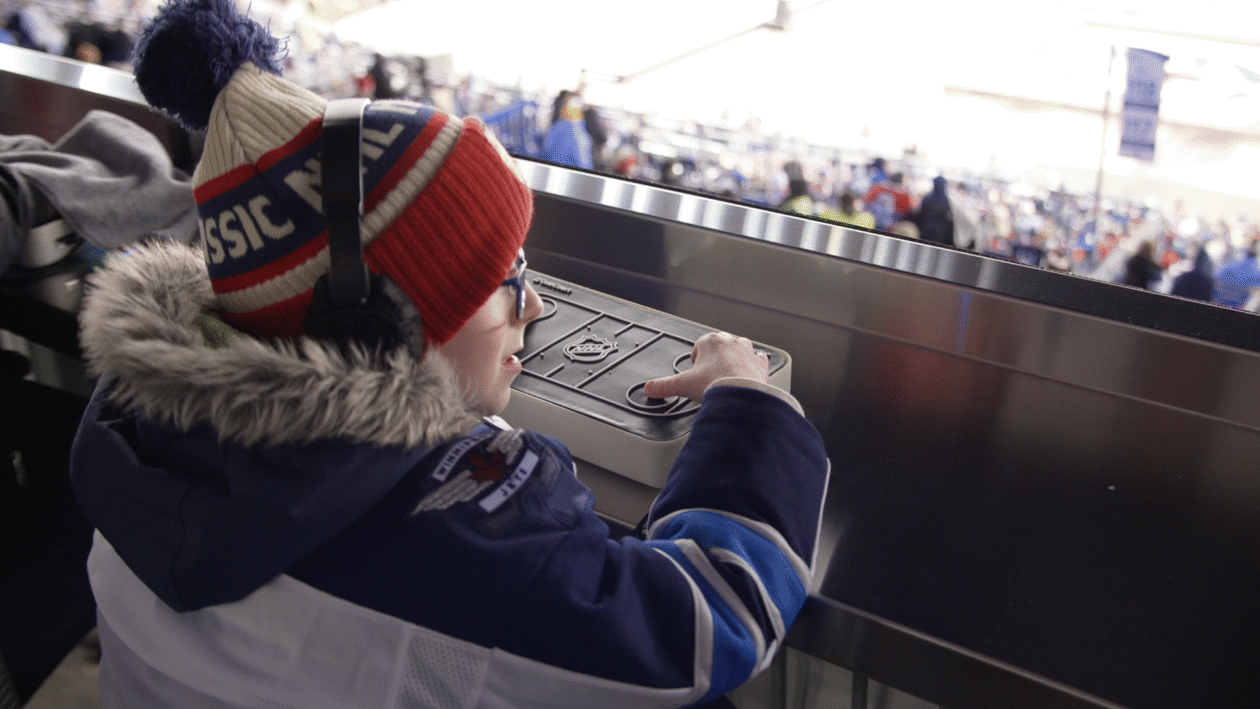
Imagine standing in a packed hockey arena, the air sharp with the smell of cold ice and popcorn, the crowd’s roar rolling over you like a wave. You hear the slap of sticks, the thud of bodies against the boards, the frantic scraping of skates as the puck moves from one end of the rink to the other. But if you are blind or have low vision, all of these sounds remain a mystery, disconnected voices and collisions without a visual map. For decades, attending a live hockey game meant accepting that the most important part of the action — the lightning-fast movement of a small black disc — would be invisible to you. That is why the moment OneCourt’s haptic tablet appeared at the NHL Heritage Classic in Winnipeg on Oct. 25 felt so revolutionary. The game between the Montreal Canadiens and the Winnipeg Jets, played outdoors at Princess Auto Stadium, was more than just a marquee event. It was the stage for a new kind of access. With their fingertips on the tablet’s smooth surface, blind and low-vision fans could feel the shape of the game: the puck sliding across a digital ice surface, a player’s presence as a vibration, the acceleration of a breakout, and the unmistakable, heart-pounding pulse of a goal. For the first time, hockey was something they could touch.
The technology behind OneCourt is elegant in its simplicity and powerful in its execution. The device is a tablet-like hardware unit that uses real-time game data to create a tactile representation of the action on the field, court, or ice. For hockey, OneCourt taps into the NHL’s EDGE puck and player tracking system, a sophisticated infrastructure that collects precise positional data hundreds of times per second. The tablet then translates that data into a living, breathing map that users can follow with their hands. Imagine a miniature replica of the rink under your fingers, with each player represented by a distinctive buzz, the puck by a constant, subtle hum that moves as the real puck moves. When the play is in the offensive zone, you feel it shift beneath your fingertips. When a defenseman winds up for a slap shot, the vibration intensifies. When the puck crosses the goal line, the entire device seems to erupt with a strong, unmistakable pulse. The experience is not quite like being able to see the game, but it is something just as extraordinary: being able to feel it in real time. It takes a little practice to interpret the subtle signals, but the intuitive design means many fans begin to understand the flow of the game within minutes. The tablet does not replace sight; it creates a new sense of participation.
OneCourt’s official arrival in hockey marks a significant milestone in the company’s mission to bring live sports to everyone. At the Heritage Classic, the tablets were offered free of charge to fans, a partnership between OneCourt, the NHL, and Ticketmaster. The positive reception at that outdoor game has already translated into a larger rollout. The Washington Capitals, Colorado Avalanche, Chicago Blackhawks, and Detroit Red Wings are the first NHL clubs to offer the devices at every home game this season. That commitment matters because it means the technology is not a one-time novelty or a special-event experiment. It is becoming a permanent part of the game-day experience for fans who need it. “Our community has been asking us for hockey since day one, and launching it with Ticketmaster and the NHL is a milestone for OneCourt,” said Jerred Mace, OneCourt’s CEO. The feeling behind that comment is important. This was not a product invented in a vacuum and pushed onto an unsuspecting audience. It was a solution demanded by the very people it serves. The hockey community — including blind and low-vision fans who never stopped loving the game — saw the potential of OneCourt’s work in other sports and wanted the same access to the sport they loved most. Their voices helped shape the launch.
OneCourt’s journey to this moment began not in a boardroom, but in a classroom. Mace started developing the idea as a student at the University of Washington, studying industrial and product design. What began as a school project quickly became a personal mission, driven by the realization that live sports are one of the great shared experiences of modern life, and that too many people are excluded from that experience. Mace’s co-founders are three fellow University of Washington graduates: COO Antyush Bollini, CTO Andrew Buckingham, and CIO Nick Durand. Together, they have built OneCourt into a recognizable name in accessible technology. The path to hockey was paved by earlier work in other leagues. OneCourt first made its mark with the NBA’s Portland Trail Blazers, a partnership that proved the concept in a fast-paced, high-scoring environment. Since 2025, Ticketmaster has made the tablets available at every home game for nine NBA teams. The company also ran an NFL pilot during the 2025 season with four clubs, including the Seattle Seahawks, and brought the technology to Super Bowl LX. Each league presented its own challenges and opportunities, but the core mission remained the same. Whether it is basketball, football, or hockey, the device transforms live action into an accessible, tactile language. The Seattle startup’s homegrown roots and its repeated success with major leagues are a testament to the power of thoughtful, inclusive design.
The recognition for OneCourt’s work has grown along with its reach. Last month, Time named OneCourt’s tablet to its list of Best Inventions of 2026, in the accessibility category. It was one of several Seattle-area innovations honored, but its significance extends beyond awards and headlines. For the people who use it, the tablet is not merely a piece of technology; it is a ticket to a shared emotional experience. There is a particular joy in going to a game with friends or family, and until now, that joy was incomplete for blind fans. They could hear the crowd, but not understand why the crowd was cheering. They could feel the energy, but not the details that produced it. OneCourt’s tablet changes the dynamic. A blind fan can sit beside a sighted friend and follow the game on their own, feeling the tension of a breakaway, the disappointment of a missed shot, the celebration of a goal — all at the same moment as everyone else in the arena. The device allows them to react with the crowd rather than after it. That may sound small, but it is everything. The fact that hockey fans have been asking for OneCourt since day one shows how hungry this community is for inclusion. For many, going to a game is not just about seeing; it is about belonging. OneCourt gives blind and low-vision fans a way to belong.
Looking ahead, OneCourt’s hockey launch feels like a beginning rather than an endpoint. The partnership with the NHL and Ticketmaster brings mainstream credibility and financial accessibility — the devices are provided free at participating venues, removing cost as a barrier for fans who want to try them. As more teams see the impact, the program is likely to expand. The same could happen in other sports and other countries. But the deeper significance of OneCourt’s work is the message it sends about the value of inclusive design. Accessibility is too often treated as an afterthought, an add-on, or a compliance requirement. OneCourt treats it as the foundation. The company’s growth shows that building for people who are often overlooked is not just the right thing to do; it is also a smart, sustainable way to innovate. Jerred Mace and his co-founders have built something rare: a startup that combines technical ambition with deep human empathy. Their device does not try to mimic sight, and it does not claim to be a cure. It simply offers another way to experience the world — a way to feel the electric energy of live sports, to participate in the collective drama of a game, and to be part of a community that has always been there, waiting to be included. On a cold October evening in Winnipeg, with the wind blowing across the outdoor rink, a fan ran a hand across a tablet and felt hockey for the first time. That moment, multiplied across arenas and seasons, is the true measure of OneCourt’s success.