

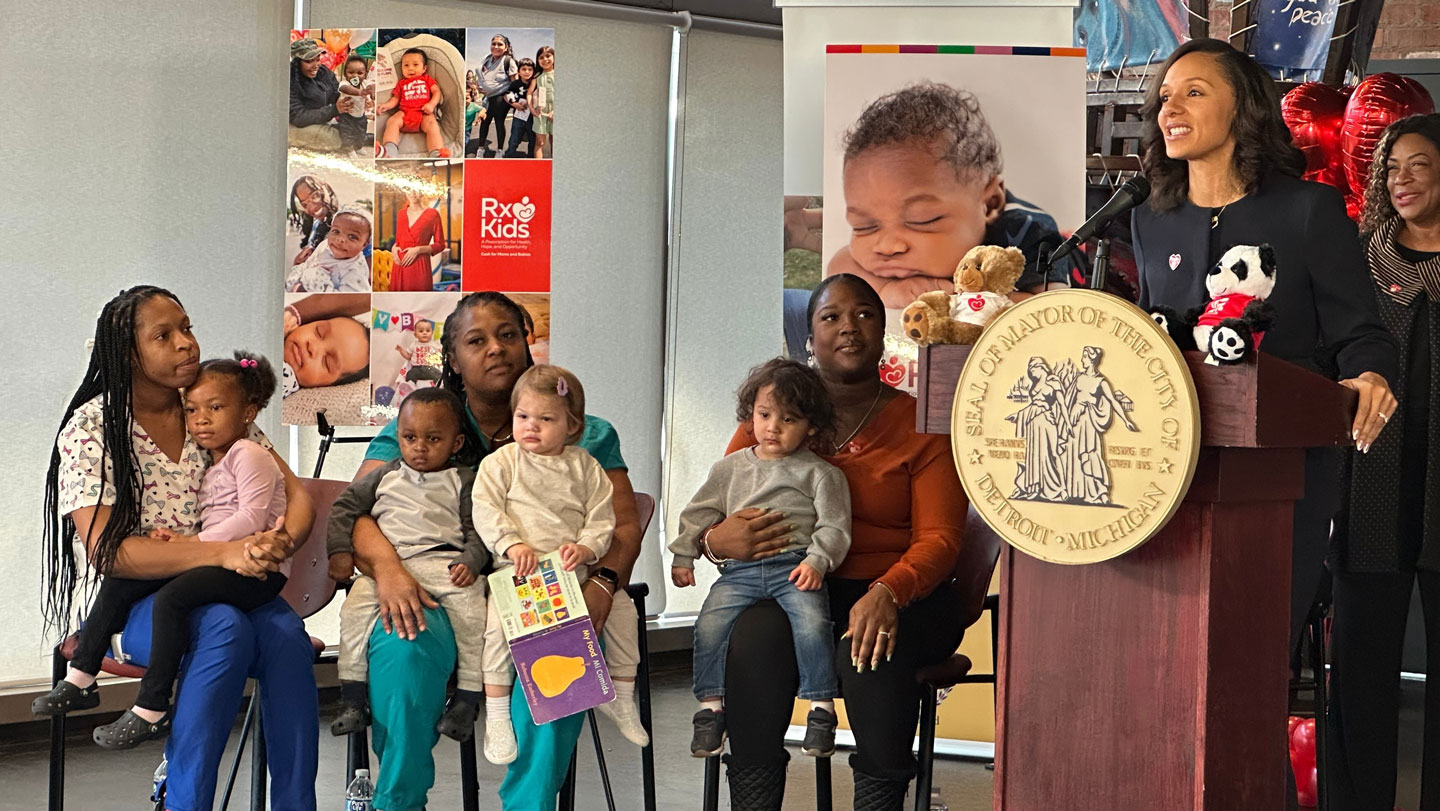
Bringing a new life into the world is often described as one of life’s most profound and joyful moments, but for many families it is also a time of silent crisis. The months leading up to birth and the weeks that follow are filled with new costs: medical bills, baby supplies, time away from work, and the pressure to find a safe and stable home. Income often drops just as expenses climb, and for families already living close to the edge, that squeeze can become a source of constant stress. The result is that the very period when a baby is most vulnerable is also the period when family finances are often most fragile. In Flint, Michigan, a program launched in January 2024 is trying to change that with a straightforward tool: cash. Rx Kids gives no-strings-attached payments to pregnant residents and families with new babies. There is no means test, no behavioral requirement, no list of approved purchases. If you live in Flint and you are at least 16 weeks pregnant, or you have a newborn up to six months old, you can enroll. Families receive $1,500 once during pregnancy and then $500 each month for the first year of the child’s life. It is not a reward for good behavior, and it is not a loan. It is a public expression of the idea that parents in this community are entitled to basic financial stability—not because they have proven themselves, but because they are raising children. The program stands out because it is universal within its community and unconditional in its design. It treats economic support as part of what a healthy start requires, just like prenatal vitamins or a safe crib. Early data suggest this quiet, respectful intervention may be saving babies’ lives. The city has known more than its share of hardship, including a water crisis that eroded trust and exposed children to lead. Yet the response here is not just more clinical services; it is an investment in the purchasing power of parents. If economic security is a health issue, then the check is medicine.
Researchers have already begun to measure the impact, and the findings are striking. The study, published November 2 in JAMA Pediatrics, compared neonatal deaths in Flint in 2025 with the years 2021 through 2024, a period before the program had fully taken hold. Neonatal mortality—the death of a baby within the first four weeks of life—dropped by half, from 10 deaths per 1,000 live births to 5 per 1,000. Early neonatal mortality, which counts only deaths within the first week, fell even more dramatically, from 8 per 1,000 to 2 per 1,000. During the same period, the rest of Michigan saw no similar improvement; those rates remained stable. The contrast is important because it reduces the possibility that the good news in Flint is simply part of a broader statewide trend. Something in Flint was changing, and the most visible change was Rx Kids. The study’s authors are careful not to claim absolute proof; no single city program can be isolated from all other factors. But the magnitude of the decline, combined with a stable comparison group, makes the results hard to ignore. For Dr. Mona Hanna, a pediatrician at Michigan State University College of Human Medicine and the founder and director of Rx Kids, the outcome is exactly what she hoped to see. “As a pediatrician, there is no outcome more important than babies surviving,” she said. “These early findings suggest that something as simple as providing families with financial support during pregnancy and infancy may help save babies’ lives.” The word “simple” is revealing. The intervention is not a fancy piece of medical technology. It is a check, delivered to a parent’s bank account, with no judgment attached. And it is being associated with the kind of result that every hospital, clinic, and public health department longs to achieve. Every one of those avoided deaths represents a family that did not have to plan a funeral instead of a first birthday. It represents a mother who got to hear her baby cry, a father who got to hold a warm body, and a set of grandparents who got to visit a healthy infant. Statistics cannot capture the relief, but the reduction is large enough to deserve attention.
To understand why cash could make such a difference, it is necessary to understand how fragile life becomes when money is scarce. Income tends to drop around pregnancy and birth, often because one parent stops working or reduces hours. Expenses, meanwhile, climb steeply: there are medical co-pays, prenatal appointments, baby clothes, formula or breastfeeding supplies, diapers, and the cost of heating, electricity, and water that all rise with a new baby in the home. This mismatch is sometimes called the income squeeze, and it hits families at exactly the moment when they need stability the most. Economic precarity can have direct health effects. Housing instability and homelessness are associated with preterm birth and low birth weight, both of which are leading drivers of neonatal death. When a pregnant person does not know where she will be sleeping next week, her body produces stress hormones that can influence fetal development. When a family cannot afford reliable transportation, they miss checkups. When a mother is constantly worried about money, she has less bandwidth to notice warning signs, follow medical advice, or simply rest. Poverty does not just stay in the bank account; it gets under the skin. In Flint, these conditions are layered on top of a long history of hardship. The water crisis that exposed thousands of children to lead was a profound betrayal, and it left behind a population that has every reason to be skeptical of institutions. It also left many families with deeper debts and greater struggles. Child poverty in Flint is high, and many parents work hard but still cannot stretch their paychecks to cover the basics. Rx Kids was designed, in part, as a way to begin repairing that damage—not by blaming families or instructing them, but by giving them resources and trusting them. It is an acknowledgment that the health of a newborn is shaped by the health of the ecosystem around them: stable housing, reliable food, affordable transport, and a sense of hope.
Rx Kids is rooted in practical realities, not ideology. The program is supported by a mix of public and private funds, and it has achieved near-universal participation: nearly 100 percent of eligible community members take part. That level of engagement suggests that the program has avoided the bureaucratic hurdles that often make assistance feel humiliating or inaccessible. There is no lengthy application process with paperwork designed to prove worthiness. Anyone who is a Flint resident and either at least 16 weeks pregnant or the parent of a newborn up to six months old can sign up. The support is substantial enough to matter but structured in a way that respects autonomy. The $1,500 pregnancy payment can cover overdue bills, a deposit on a new apartment, or a car repair that would otherwise derail a mother’s ability to get to work. The $500 monthly payments during the first year can be used for the relentless small expenses that parenthood brings. Hanna says families have used the money for diapers, transportation, housing, and safe places for their babies to sleep. That last item deserves special attention. Safe sleep is recommended by pediatricians to reduce the risk of sudden infant death and accidental suffocation, but it can be difficult to achieve if a family cannot afford a crib or lives in overcrowded housing. Cash allows families to create a space where babies can sleep safely, and that may be one way the program helps lower mortality. The flexibility is not a weakness; it is the whole point. A family facing eviction needs different help than a family struggling with transportation. No one at a central office can anticipate every situation. Rx Kids assumes that parents are the best experts on their own lives, and it gives them the means to act on that knowledge. The near-total participation suggests this approach feels good to families—not like a handout, but like a right.
Behind the data are stories that make the numbers come alive. “Every day, we hear from moms who tell us, ‘I can breathe’ or ‘A weight has been lifted off my shoulders,’” Hanna says. “They tell us they feel less stressed, more hopeful, more supported and more loved.” These words are not just emotional testimonials; they point to the physiological pathways by which money can influence health. Chronic stress raises cortisol, which can affect fetal growth and timing of birth. When a sudden check removes the threat of eviction or makes it possible to fill a prescription, the body’s alarm system begins to quiet down. A mother who can breathe is more likely to sleep, to eat well, to seek prenatal care, and to bond with her baby. The program’s effects on other health indicators are consistent with that story. Studies linked to Rx Kids have found increased access to prenatal care, a decline in the preterm birth rate, fewer babies born at low birth weight, and fewer admissions to neonatal intensive care units. Each of those outcomes is connected to the others. Prenatal care helps clinicians manage high blood pressure or diabetes before they become emergencies. Avoiding preterm birth gives babies crucial weeks for brain and lung development. A healthy birth weight reduces the likelihood of infections and feeding difficulties. And fewer NICU admissions means fewer children are exposed to the medical intensity and trauma of a hospital stay, while parents are spared the terror and expense of watching their infant struggle. The savings to health systems are real, but the human savings are immeasurable. Every avoided NICU night is also a night that a mother can hold her baby in her own arms. Every prevented preterm birth is a child who may reach milestones a little more easily. The money does not change everything, but it changes enough. It gives families a buffer, a plan, and a sense of being held by a society that is not waiting to judge them.
What happens in Flint does not have to stay in Flint. Rx Kids has already expanded to dozens of communities in Michigan and Ohio, and the new findings will likely accelerate that momentum. The model speaks to a growing political and scientific consensus that poverty is a health hazard, especially for pregnant people and infants. Programs that provide cash with no strings attached are not a new idea, but they are increasingly being tested as serious public health interventions. The early results from Flint are the kind of evidence that can turn an idea into a movement. Still, it is important to be honest about what remains unknown. The study compares one city with a relatively small population to its own recent past, and many factors can influence infant mortality rates. The researchers will need longer follow-up and larger numbers to understand whether the gains are durable. They will also need to examine whether the program works equally well in communities with different demographics, housing markets, and health systems. But the finding that neonatal mortality fell by half in Flint while the rest of Michigan remained unchanged is too striking to dismiss. It reinforces the message that ensuring a healthy start for children is not only a task for doctors and hospitals. It is also a task for employers, landlords, utility companies, and government budgets. The months during pregnancy and the first year of a baby’s life are a narrow window in which the right support can shape a lifetime. If $500 a month can help a family keep the heat on, afford a crib, and make it to appointments, that is not merely social policy; it is preventive medicine. The babies born in Flint under Rx Kids are too young to know that a community decided to invest in them. But their parents know. They know what it feels like to get the help they needed without being made to feel small. And the continued expansion of the program suggests that many other communities are willing to trust parents in the same way. For families who have long been told they need to do better, this is a chance to be believed. For babies, it is a chance to live.