


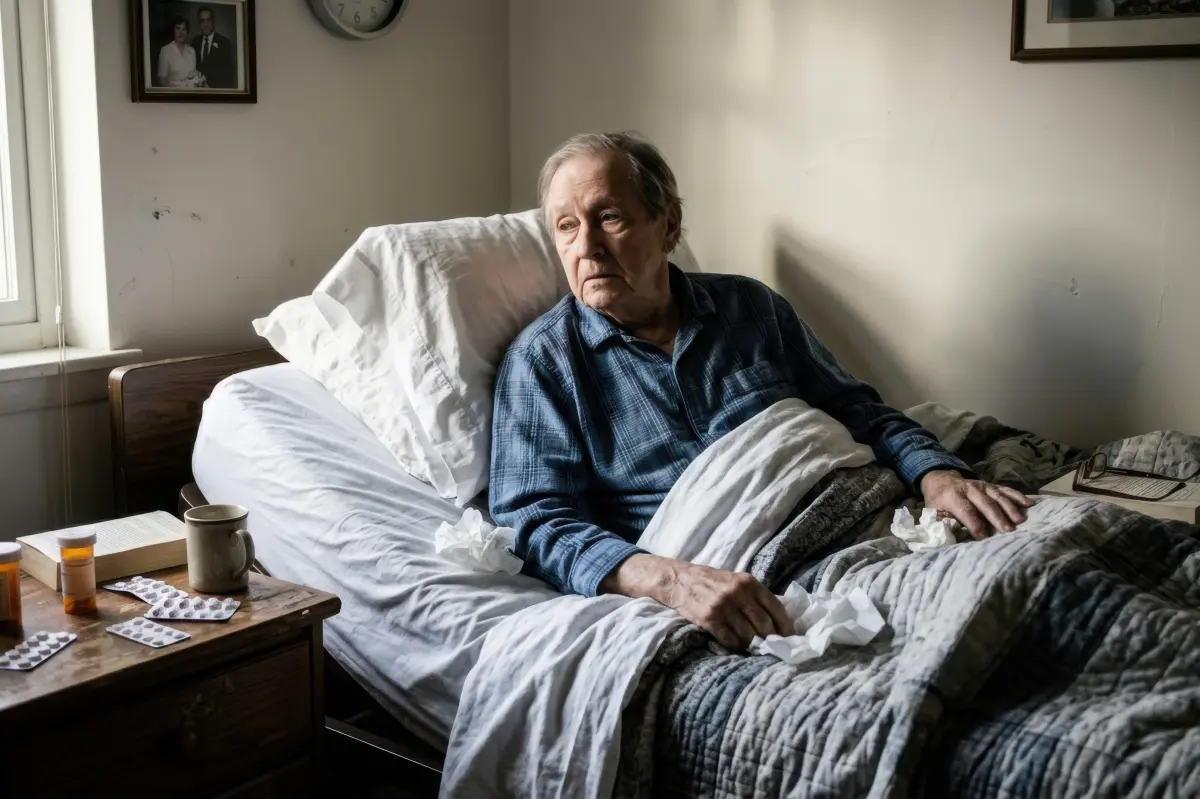
Sometimes a single letter can be a quiet alarm in the middle of the night. That is what happened when a reader known only as Frustrated Neighbor wrote to Dear Abby about the man next door. This man is 94 years old and completely bedridden. A woman who claims to be his caregiver also holds his power of attorney, which means she has legal authority to manage his money and make decisions for him. Yet for about eighteen hours each day, the neighbor reported, this elderly man is completely alone. The letter was not sensational or cruel; it was worried and uncertain. The neighbor seems to have wondered what one person can do when they suspect that a vulnerable human being is being neglected. The answer, it turned out, came from many people. The mailbox was bursting with responses. Readers were angry, sad, and determined. One reader, signing as Red Flags, wrote that the situation was dangerous. A caregiver who holds power of attorney has control over the older person’s finances. If she is supposed to be caring for him, she has a financial interest in keeping him exactly where he is, even if that means leaving him alone and helpless. That reader called the situation elder abuse and possible fraud. Another reader, using the name Unnerved, put it even more bluntly: if a bedbound man is ignored for eighteen hours or more, he almost certainly has bedsores or worse. The thought is painful to hold onto. It is painful to imagine a man lying in bed, staring at the ceiling, unable to change his own position, perhaps unable to call for help. The readers’ responses were not just warnings. They were expressions of something deeper—a refusal to accept that an old person can simply be set aside and forgotten. In a culture that often prefers not to look at aging and frailty, these readers were willing to look.
Several readers went beyond their initial shock and offered practical, legal advice. One reader, who identified as On Watch and is both an attorney and a volunteer member of a county Adult Protective Services Multidisciplinary Team, urged the worried neighbor to contact Adult Protective Services without delay. The point of that phone call is not to make dramatic accusations or to punish anyone. It is to bring a trained, unbiased professional into the situation, someone who can look at the facts, talk to everyone involved, and determine what the elderly man actually needs. This attorney said that her team sees this kind of situation all the time, and that is not reassuring. It means that the story of a bedridden older person being left alone for long stretches of time is not rare. It also means that there are systems in place to respond, and that those systems depend on ordinary people paying attention. The most powerful sentence in that response was simple: one phone call is all it should take if the person explains the situation. That may be optimistic, but it is also a call to action. Many people hesitate to report suspected abuse because they are afraid of being wrong. They worry about interfering in someone else’s private life, or about making the situation worse. But the readers who wrote in reminded us that helpless people cannot always speak for themselves. A 94-year-old bedridden man may not be able to tell anyone that he is thirsty, or that his body hurts, or that he has been alone in the dark for hours. If no one else is watching out for him, his silence becomes a wall between him and the rest of the world. An investigation is not an act of cruelty; it is an act of care. It is a way to make sure that the man’s own wishes are respected, that his legal rights are protected, and that his caregiver is actually fulfilling the responsibilities she accepted when she took his power of attorney. At its best, this kind of intervention restores dignity rather than destroying it.
The same column also carried a letter of a very different kind, though it touched on a similar theme: the danger of being forgotten. Dr. T. Richard Parenteau, a physician in the Division of Geriatrics at the University of California, San Francisco, wrote to describe his work with Alzheimer’s disease. He is the principal investigator at a new clinical trials site in Oakland, California, and he spoke not only as a scientist but as someone who has spent years watching what this disease does. Alzheimer’s, he wrote, affects not only the people who live with it but also the families and caregivers who love them. There is no way to fully prepare for that experience. It begins with a misplaced set of keys, a forgotten name, a familiar route that suddenly looks strange. Then, slowly, it becomes more serious. The disease steals memories, language, and eventually the ability to recognize the people closest to you. It asks families to grieve a person while that person is still alive. And for too long, there were very few treatment options that offered real hope. Dr. Parenteau’s letter was about a new approach to that old problem. He is helping to build a clinical trial site that is not just about testing a drug, but about making research more accessible to the communities that have often been left out of clinical studies. This matters because medical advances only help everyone if they are tested in a diverse range of people. When trials include only a narrow slice of the population, the results may not apply to people of different races, backgrounds, or life experiences. By opening a site in Oakland and actively seeking volunteers from underrepresented communities, Dr. Parenteau is trying to make sure that the future of Alzheimer’s treatment is fairer and more inclusive.
The study he is working on is called the SPRING Trial, and it is exploring a surprising connection. For people ages 55 to 80 who have been diagnosed with mild to moderate Alzheimer’s disease, the trial is looking at a bacterium called P. gingivalis, which is commonly associated with gum disease. It turns out that this bacterium can travel beyond the mouth and make its way into the brain. Once there, it produces toxic enzymes that may play a role in damaging the brain and contributing to the progression of Alzheimer’s disease. The experimental drug LHP588 is designed to inactivate those enzymes, with the goal of stopping or slowing the disease’s advance. There is something almost hopeful in that idea, something beautiful and strange. The same kind of bacteria that can cause bleeding gums might also be involved in one of the most devastating diseases we know. It suggests that the answer might be hidden in unlikely places, and that our bodies are more connected than we realize. But a clinical trial cannot succeed without volunteers. Dr. Parenteau repeated this message clearly because it is the foundation of all medical progress. Researchers need participants who are willing to step into the unknown, to share their time, their bodies, and their stories. And he is especially asking families affected by Alzheimer’s to consider whether the SPRING Trial might be right for them. More information, including where the study is being conducted across the United States, can be found at springclinicaltrial.com. That website may seem like a small thing, but for a family desperately searching for hope, it could be a doorway to something new.
Abby’s response to Dr. Parenteau was warm and direct. She said that she was happy to help spread the word that volunteers are needed for this important study, and she urged readers to visit the website if someone they know might be a candidate. It was a small moment, but it made a difference. An advice column has a strange kind of intimacy. People read it at breakfast tables, in waiting rooms, on their phones in quiet moments. They may not think of themselves as participants in medical research, but when they see a letter from a doctor explained in simple language, it becomes possible to imagine. Maybe their father is in the early stages of Alzheimer’s. Maybe their wife has been losing pieces of herself for years. Maybe they have been diagnosed themselves and are looking for something, anything, that might change the direction of the road ahead. For those people, the SPRING Trial is more than a clinical option. It is an invitation to turn helplessness into purpose. Joining a study is not an easy decision. It requires time, travel, paperwork, and the willingness to accept uncertainty. But for many families, the uncertainty of a clinical trial is preferable to the certainty of watching the disease take everything. Every person who enrolls in a study becomes a partner in discovery. Their experience helps scientists learn what works and what does not, and their contribution lasts long after the trial ends. That is quiet heroism. It will not make headlines, but it will make a difference in the lives of millions of people who are not yet born.
Taken together, the two parts of this column are not as different as they might seem. One is about a forgotten old man in a bed, and the other is about millions of people navigating the fog of Alzheimer’s disease. But both are stories about vulnerability, and about the people who refuse to look away. The neighbor who wrote to Dear Abby noticed something wrong and asked for guidance. The readers who responded were willing to speak uncomfortable truths and to recommend action. The physician in Oakland sees the faces of Alzheimer’s patients and their families and is trying to build a bridge between their suffering and scientific possibility. In every case, the common thread is attention. We cannot solve every problem alone, but we can notice the people around us. We can make a phone call when something feels wrong. We can share a website with someone who might benefit from it. We can ask questions instead of assuming that someone else will step in. The elderly are not a separate group. They are our future selves, and the way we treat them is the way we prepare for our own old age. Perhaps the most powerful message in all of these letters is that caring is not a grand gesture. It is a series of small, deliberate choices. It is the choice to keep watching, to keep asking, to keep offering what we can. Whether that means contacting Adult Protective Services, enrolling in a clinical trial, or simply sitting with an older person and listening to their stories, the impact is real. That is the heart of this column. It is also the heart of what it means to be human.