


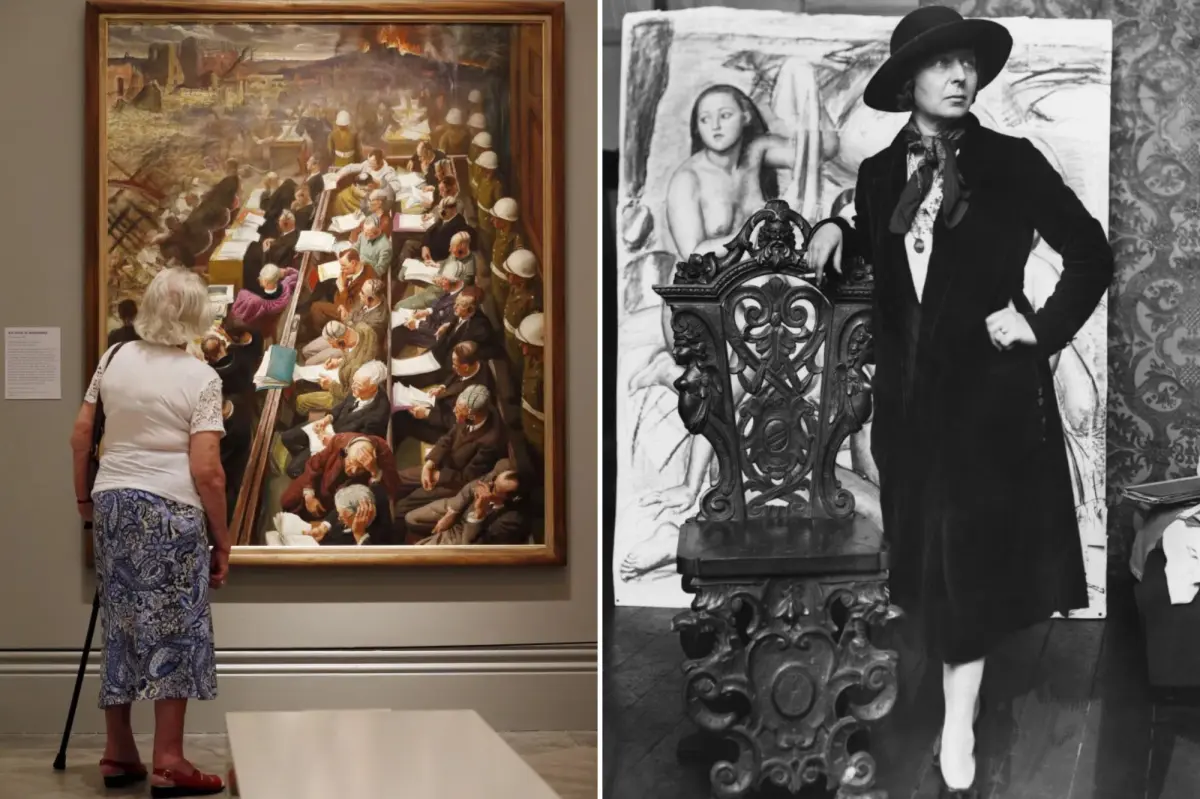
Natalie Livingstone grew up with the past breathing down her neck. As the granddaughter of Hungarian Holocaust survivors, she was not content to treat World War II as a distant chapter in a textbook; she felt its weight in her bones and wanted to understand who had been allowed to tell its story. That instinct led her one day to London’s Imperial War Museum, where she found herself standing in front of a six-foot oil painting simply called “The Nuremberg Trial.” It was an arresting image: the desolate dock of Courtroom 600 inside the Palace of Justice, the ruined city of Nuremberg looming in the background, the spiritual home of the Third Reich reduced to rubble. Everywhere she looked she saw men—stern Nazi defendants, grim-faced soldiers, stern lawyers, solemn officials. The trial of the century appeared to be a wholly male affair. But then she noticed a tiny signature in the corner: Laura Knight. Knight was a celebrated 68-year-old British female artist who had painted the scene from life. For Livingstone, that signature set off a quiet explosion. Here was the great reckoning for history’s worst crimes, and yet the picture contained not a single woman. “There is not a single woman in the picture,” she later said. “It’s a picture of the bloodiest catastrophe in human history with half of humanity painted out.” That moment became the spark for a four-year obsession, one that would eventually produce her book “The Nuremberg Women: The Untold Story of the Eight Women Who Brought the Nazis to Justice.” It is not just a work of historical excavation; it is an act of restoration, an effort to put back into frame the women who were there, who shaped the trial, and who were almost entirely forgotten.
The book’s central argument is that Nuremberg cannot be understood only through its famous male judges, prosecutors, and defendants. As Livingstone put it, “In order to really understand Nuremberg, in order to really appreciate it from these women’s perspectives, you’ve got to see it as an ecosystem.” That ecosystem was crowded and messy, full of ambition, fear, desire, hope, and trauma. It included a brilliant American prosecutor who had the legal firepower to go after notorious Nazi leaders; three hungry journalists chasing the story with competing motivations; a besotted artist who found herself strangely drawn to the trappings of Nazi power; a glamorous refugee aristocrat with deep misgivings; an indefatigable Auschwitz survivor who gave voice to the voiceless; and a conflicted young Russian translator who slowly pieced together a geopolitical puzzle that foreshadowed the Cold War. They came to Nuremberg for wildly different reasons: to see justice done, to build reputations, to escape the wreckage of war, to postpone deportation, or simply to survive. The trial began in November 1945, months after the end of World War II, when the world was still only beginning to grasp the scale of Nazi atrocities. Hitler, Goebbels, and Himmler had already killed themselves. The names Auschwitz and Belsen were not yet synonymous with absolute horror. That would change, in large part because one woman refused to stay silent. Marie-Claude Vaillant-Couturier, a 33-year-old French resistance fighter, had survived three years in the camps. When she took the stand, she transported the courtroom to the gates of hell. For two hours, in a steady voice, she described the immediate drowning of Jewish newborns, the gassing of Jewish women “for practically no reason at all,” the wholesale murder of a “scabies block” that could have been cured with a simple remedy, and the fifty of five hundred typhus patients who were sent to the gas chamber. Her testimony, delivered for those who could no longer speak, brought the room to its knees. As she left, she walked deliberately along the front of the dock, fixing her gaze on each indicted Nazi, one after another: a final act of defiance. She spent less than twenty-four hours in Nuremberg, unable to bear another minute in the city that had once been the Nazi party’s favorite stage.
The same city that broke Vaillant-Couturier’s heart proved irresistible to Laura Knight, the artist whose hidden signature had first set Livingstone’s imagination on fire. Knight was a woman of enormous talent and enormous contradictions. She wrote to her husband Harold that she longed to be home with him in England, but she kept postponing her return. Nuremberg, with its strange mix of horror and gaiety, had cast a spell on her. She stayed at the Grand Hotel in a suite that she believed Hitler had once occupied. “My suite was built for Hitler,” she gushed in a letter to Harold, confusing the Grand with the now-destroyed Deutscher Hof. “I often wonder if Hitler himself slept in my room.” She exulted in sleeping soundly after days spent listening to horrors brought about by his “overweening ambition,” and she relished the VIP dining room in the Palace of Justice, where she lunched on “lots of good vegetables” and “more meat than I can eat.” At night, she drank White Lady cocktails, flirting with young soldiers, hosting cocktail parties in judicial villas, and, by some accounts, hanging from chandeliers. Livingstone describes Knight as a renowned artist who “both desired and admired status,” and there is something unsettling about her enchantment with Nuremberg’s high life. But her presence is also a reminder that the trial was not simply a solemn judicial proceeding. It was a strange, feverish interlude in a ruined city, filled with gossip, scandal, romance, and the “full panoply of human life,” as Livingstone says. Knight’s famous painting, with all its sweeping grandeur, was itself born of that complicated atmosphere—the work of a woman who saw the tragedy from the inside, even if she could not always resist the seduction of her surroundings.
Other women were caught up in Nuremberg’s emotional currents. Rebecca West, the celebrated British journalist, arrived with a sharp eye and an even sharper tongue. She famously described the International Military Tribunal as a “citadel of boredom,” yet she was anything but bored. During a feverish summer, she began an affair with Francis Biddle, an American judge who was very much married. Livingstone writes of West’s “great blossoming at the age of 53,” as if Nuremberg woke something in her that the war had suppressed. West eventually left the city, but she found her way back in the fall, both to cover the October 1, 1946 verdict and to rekindle her passionate relationship with the judge. For West, Nuremberg was not just a story; it was a place where she could feel alive again. Then there was Tatiana Stupnikova, a 22-year-old Soviet interpreter whose experiences at Nuremberg were more troubling. She was the “conflicted young Russian translator” who haltingly pieced together a disturbing geopolitical puzzle, watching the alliance between the Soviets and the Western powers begin to fray in real time. Yet even in the shadow of the coming Cold War, she found love. Livingstone describes her meeting with her future husband as “perhaps the most romantic love story of any of the women of Nuremberg.” The city, for all its darkness, could still make room for human connection. So could the courtroom itself. Harriet Zetterberg, a 36-year-old American prosecutor with a Yale-trained legal mind, was one of the women working behind the scenes to convict the Nazis. During the trial’s winter break, she conceived her first child with her fellow lawyer husband. She helped secure the conviction of Hans Frank, the “Butcher of Poland,” who was responsible for more than four million deaths. But she never got to speak in court. As a woman, she was barred from the very forum where she had helped build the case. The glass ceiling at Nuremberg had been cracked—women testified, painted, reported, translated, and strategized—but it was far from shattered.
That painful contradiction is central to Livingstone’s book. Nuremberg gave these women a sense of purpose, importance, and power that many of them would never find again. It was, in the author’s words, “a bubble, this moment in time, that afforded some women levels of power and influence that they were denied after they left the trial.” Zetterberg is the most heartbreaking example. She was sent home from Nuremberg while pregnant, and once she returned to the United States, she was unable to find meaningful work. The brilliant legal mind who had helped bring down one of history’s most monstrous criminals was reduced to working as a legal aide at a secretary’s hourly wage of $2.50. She never attained professional fulfillment again. Her story exposes the limits of the postwar moment: even after the near-collapse of civilization, even after women had proven themselves indispensable in the courtroom, they were expected to step back into the shadows. But Livingstone also wants to show that Nuremberg transformed the women who were there, not only by giving them a stage but by forcing them to reckon with the worst of humanity. For some, the experience was destructive; for others, it was liberating. The lessons they learned were painful and poignant, but also surprisingly hopeful. They had witnessed the unthinkable, and yet they had shown up, done their work, and refused to look away. They had loved and laughed and even, in some cases, partied in the ruins, because that is what human beings do: they find a way to go on.
What remains most powerful in Livingstone’s telling is the idea that power can exist even without position. None of the eight women at the center of her book was a head of state or a lead prosecutor or a commanding general. They were witnesses, translators, journalists, artists, and behind-the-scenes lawyers. They had no formal authority at the tribunal, and in some cases they were actively discouraged, marginalized, or silenced. And yet they changed the way the world understood Nuremberg. Marie-Claude Vaillant-Couturier’s testimony forced the courtroom to confront the reality of the Holocaust. Laura Knight’s painting preserved the enormity of the moment for future generations. Rebecca West’s journalism captured the strange texture of a trial that mixed high ideals with human weakness. The women, Livingstone writes, reveal “a much more diverse, more haphazard, more human and intimate” Nuremberg than the one found in official records. They were not merely present; they were essential. And their stories, once hidden beneath the imposing male gaze of history, are now finally being told. Livingstone’s book is a reminder that history is not a single painting, no matter how large it might hang in a museum. It is a collection of overlapping lives, each with its own fears and hopes. At the end of her journey, the author arrived at a kind of quiet faith. “Even after witnessing the near collapse of civilization,” she says, “it was still possible to live, to love, to create and to believe in humanity again. And to believe in the idea that even though these women were not in a position of power, they still were able to be powerful.” In that sense, the half of humanity once painted out of the picture has finally been restored—not just to the canvas, but to history itself.