


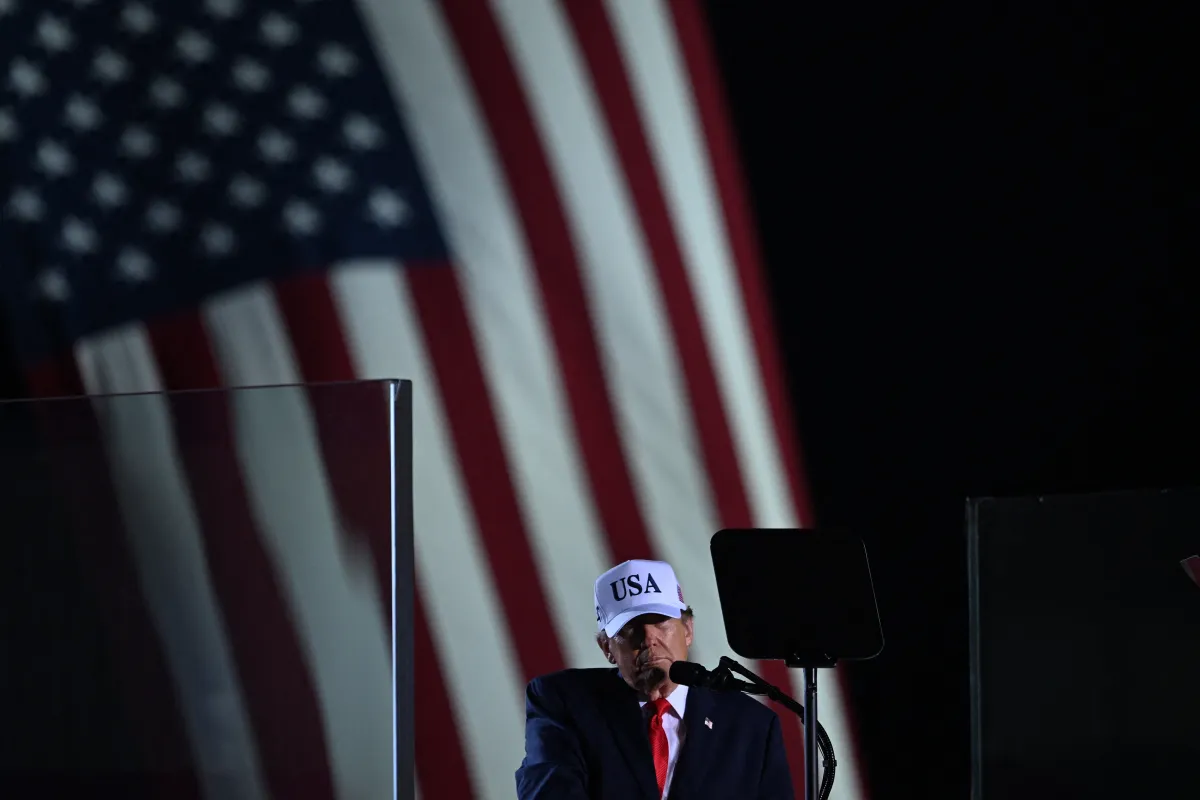
There was something almost confessional about the way President Donald Trump opened his final rally of a grueling 32-day stretch, standing before a crowd in Salina, Kansas, on a Sunday night that most people would have spent on the couch. “I could have been home watching television, or some crappy thing; I’d rather be with you,” he told the crowd, with the weariness of a man who had been on the road for over a month and the urgency of one who was not entirely sure victory would come easily. This was his 30th rally, and he was closing his pre-election tour in a state he had won comfortably in 2024, not because it felt safe, but because it no longer did. He had come, he said, to make sure Roger Marshall got elected. “I didn’t want to take a chance,” Trump admitted, and those words hung in the air with more meaning than perhaps he intended. A president who can win Kansas by double digits should not need to spend his final night in Salina coaxing voters to save a Republican Senate seat. But the ground has shifted beneath the GOP, and Trump’s presence was both an act of loyalty and a recognition of fear. The crowd cheered, but the anxiety beneath the surface was hard to miss. This was not a victory lap; it was a fire drill.
The anxiety was justified by numbers. A New York Times/Siena College poll released Sunday, surveying 5,708 likely voters across battleground states from October 23 to November 1, showed Democrats leading in all seven Senate races considered competitive this cycle. For anyone watching from inside the Republican bubble, that was a jarring headline. But the truly remarkable part was where those Democratic leads were showing up. Kansas, a state that has not elected a Democrat to the Senate since 1932, had suddenly become a genuine toss-up, with Democrat Adam Hamilton leading Republican Senator Roger Marshall 49 percent to 44 percent among 736 likely voters. In September, the two were tied at 45 percent. Now the Democrat had opened a five-point gap in a state Trump had carried by comfortable margins. Iowa, another state that should be deep red, was even tighter, with Democrat Josh Turek leading Republican Representative Ashley Hinson by a single point, 48 to 47. Texas, long thought to be safely Republican, showed Democrat James Talarico leading Republican Attorney General Ken Paxton by seven points, 50 to 43. In Michigan, Democrat Abdul El-Sayed held an eleven-point lead over Republican Mike Rogers. These were not just polls; they were warning signals flashing across the map, telling Republicans that the political weather had turned, and that even the safest-looking territory was suddenly exposed.
Trump’s response, as always, was to lean into the theater of it all. In Iowa earlier Sunday, he had spoken for just over two hours, spending only about twenty-three minutes on issues that mattered to the state and its candidates. The rest was a meandering performance that mixed genuine policy talk with the kind of asides that have become his signature. In Kansas, he attacked Hamilton as unworthy of the seat, renewed his suggestion that the Strait of Hormuz be renamed the Trump Strait, proposed renaming New Mexico “New America,” and even appealed to ranchers to produce more beef in the face of high prices. It was classic Trump: equal parts grievance, spectacle, and odd nostalgia for a kind of power that names oceans and states after himself. At both rallies, his closing messages were nearly identical, focusing on his own achievements and warning that Democratic control of Congress would bring disaster. He repeated familiar false claims that Democrats would provide gender-affirming care to all children in schools without parental permission, and that they would reopen the southwest border. The warnings were sharp, but the tone was less triumphant than defensive. In Iowa, he declared, “We’ve never been stronger. We’re the most respected nation anywhere in the world.” But the fact that he needed to say it so forcefully, in states he should not have had to fight for, told a different story. The golden era he spoke of did not appear to be calming voters’ nerves.
Nowhere was that disconnect more visible than on the issue voters said mattered most: the cost of living. Working families in Kansas and Iowa are still feeling the squeeze of high grocery bills, expensive rent, and the creeping sense that the American dream is slipping further out of reach. Trump blamed President Joe Biden, saying he had inherited high prices and that they were now coming down, even though economic data largely showed otherwise. But voters were not buying it. In the same Times/Siena poll, Democratic Senate candidates held a nine-point advantage over Republicans in Kansas when voters were asked which party would do a better job addressing the cost of living, and a four-point advantage in Iowa. That is a devastating number for an incumbent party. It meant that all the rallies, all the attacks, all the talk of tariffs and energy dominance had not broken through the most basic anxiety in American life: the fear that the next generation will be worse off than the last. Trump’s speech in Kansas tried to address that fear head-on, but in his own unusual way. “Today I’m also announcing that Fannie Mae and Freddie Mac will be investing $4.3 billion in Kansas mortgages next year to help 15,000 Kansas homebuyers achieve their American dream,” he said, pausing in the middle of a speech that had been interrupted by hecklers, as his recent speeches often have been. The housing announcement was intended as a concrete answer to a real problem, but it also illustrated how much of the Republican closing argument has become about defending the margins, offering small reliefs in places where voters were once certain.
The hecklers were a side note, but their presence was meaningful. In previous years, Trump could stand in Kansas and speak uninterrupted, buoyed by a hometown crowd that never doubted him. Now even that had changed. The interruptions forced him to stop, respond, and recalibrate, a visual reminder that the political atmosphere has grown more contentious and less forgiving. The president’s schedule reflected the same pressure. To spend his final 32 days on the road, to hold his 30th rally in a state that should have been safe, to make a late-night trip to Salina, Kansas, of all places, was an acknowledgment that the Republican majority in the Senate was genuinely in jeopardy. The Times/Siena poll did not just show Democrats leading in seven states; it showed a national mood that had soured on the party in power. After two years of Republican control of Congress and the White House, voters were looking for someone to blame, and many had decided the blame belonged at the top. Trump’s presence in Kansas and Iowa was meant to reassure, but it also betrayed a basic truth: when you have to campaign in states you used to take for granted, your coalition is not as strong as it once seemed.
In the end, whether Democrats actually capture Iowa or Kansas may matter less than what the competitiveness of those races reveals. For decades, a Democrat winning a Senate seat in Kansas would have been unthinkable, a political impossibility so remote it was not even discussed. Now it is a real possibility, with a five-point lead in the polling average and a candidate who seems to be gaining momentum. Similarly, Iowa should not be a place where a Democrat leads by one point in a Senate race, but there it is. Trump carried both states comfortably in 2024, but that was then. The 2026 environment, shaped by inflation, fatigue, and the natural swing of history, is different. The Republican Party has been forced to spend its final days defending territory it once had no reason to fear losing, and Trump has become the fireman rushing from one blaze to another, trying to save seats that should never have been in danger. He told the crowd in Kansas that he could have stayed home and watched television, but he chose to be there. That may have been intended as a compliment to the voters, but it was also a confession. The president of the United States, in the final stretch of a critical election, could not afford to take a single state for granted. And that, more than any poll, is the real story of this election night.