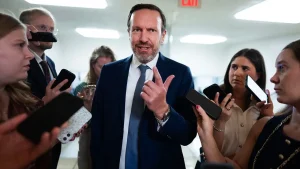



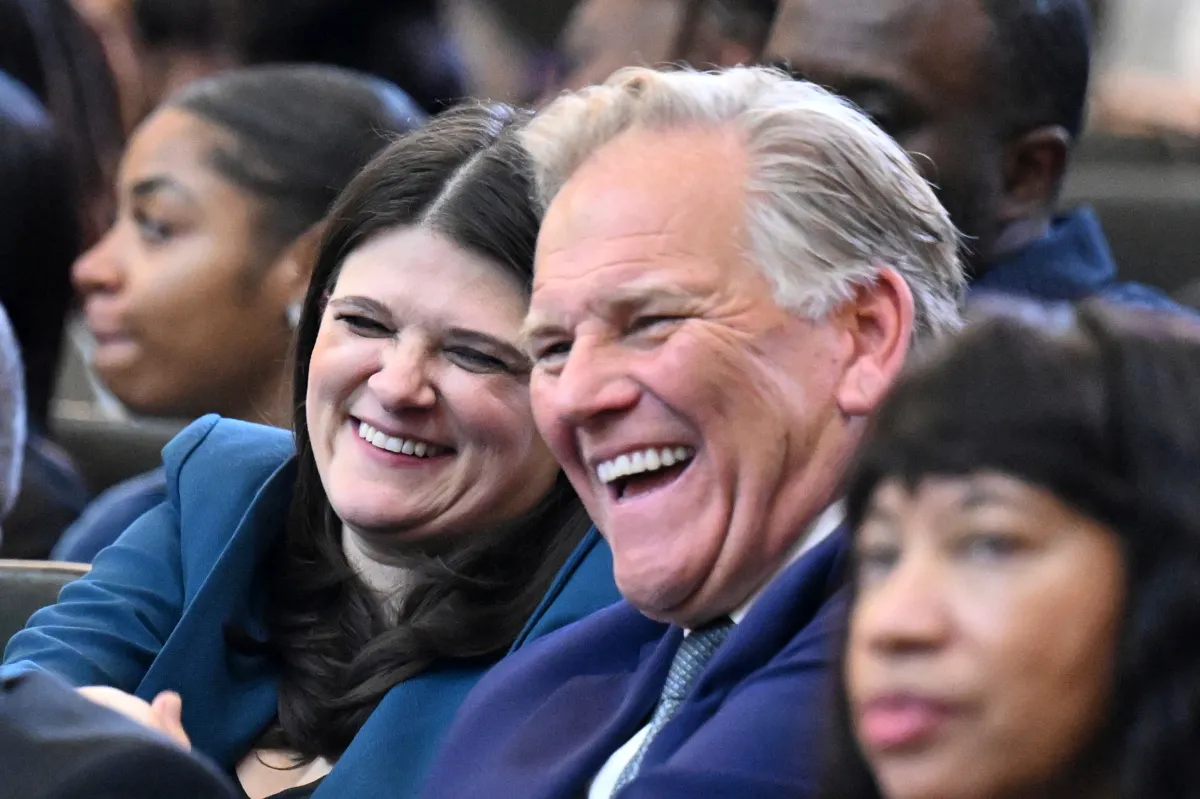
On a Sunday morning in Detroit, inside a church called Perfecting, a political moment unfolded that many thought could never happen. Representative Haley Stevens, a Democrat who had spent months fighting to keep Michigan’s Senate seat in her party’s hands, stood beside Mike Rogers, the Republican hoping to take that seat away. The image alone was striking, but the words that followed were even more stunning. In a video announcing her decision, Stevens said that Abdul El-Sayed, the Democrat who narrowly defeated her in the primary, had made it clear she was no longer welcome in his campaign. “And he’s right,” she said, “and that’s why I am endorsing Mike Rogers for the United States Senate today.” It was a blunt, deeply personal declaration, delivered just days before an election that could help determine control of the Senate. For voters watching in Michigan and across the country, it felt like the final break in a relationship that had been crumbling in public for months. This was not the usual closing-day show of party unity. It was a very visible, very painful fracture, one that left Democrats reeling and handed Republicans a moment of unexpected momentum.
The political stakes could hardly be higher. Michigan is considered by many strategists to be one of the Senate seats Democrats likely cannot afford to lose if they hope to take control of the chamber. Republicans hold a 53-47 majority and are defending 22 of the 35 seats being contested this year, which already creates a difficult map for Democrats. Their most straightforward path to power requires holding every single Democratic-held seat on the ballot, including Michigan, Georgia, and New Hampshire, and then flipping four Republican-held seats. The seat in Michigan is currently held by retiring Democratic Senator Gary Peters, which makes it an open seat and a delicate defensive fight for Democrats. A Rogers victory would not only leave Democrats in the same place they started; it would hand Republicans a Democratic-held seat and force Democrats to compensate with an additional pickup elsewhere. The broader context makes Stevens’ decision even more consequential. Control of both chambers of Congress is on the line in these midterms, and a Republican win in Michigan would strengthen the GOP’s position as President Donald Trump’s party tries to maintain congressional control for the final two years of his presidency. Every race matters, but some races matter more than others, and this one has become a national battleground for the balance of power. Stevens’ endorsement injects a new and unpredictable element into that battle, one that no poll or campaign plan could have entirely anticipated.
To understand how this happened, it is necessary to look back at the primary, which was one of the most closely contested Democratic primaries of the year. El-Sayed defeated Stevens by a razor-thin margin, with 48.4 percent of the vote to her 47.6 percent, a difference of fewer than 14,000 votes in a race that drew enormous attention and energy. A loss like that is never easy to accept, especially when it is so narrow. But the primary was about more than just one candidate winning and another losing. It exposed broader ideological divisions within the Democratic Party, with Stevens supported by much of the party establishment and El-Sayed drawing strength from prominent progressives who saw him as a more transformative figure. The war in Gaza and the question of Israel’s role in American policy became a flashpoint during the campaign, and the divisions between their supporters were deep and angry. In the immediate aftermath of the primary, there was hope that the party would come together in time for the general election. But that hope faded quickly. Instead of healing, the wounds festered, and the general election campaign became a stage for those unresolved tensions. El-Sayed moved forward as the nominee, but Stevens remained a significant figure in Michigan politics, and the distance between them only seemed to grow. For many Democratic voters, the idea that these two could share a stage was already hard to imagine; by the final days, it was impossible.
The immediate trigger for the final break was an advertisement. An outside group, the pro-El-Sayed Rebellion PAC, released an ad linking grocery prices to U.S. military aid to Israel, including a line about setting aside “$7 for killing Palestinians.” Stevens publicly called the ad antisemitic and urged El-Sayed to condemn it, and the Anti-Defamation League described it as a “case study in antisemitism.” El-Sayed distanced himself from the ad, explaining that he had not produced or approved it, but Stevens was not satisfied with a simple statement. She wanted a clear and forceful condemnation, and when that did not come, she escalated her criticism. In one pointed message, she wrote: “Abdul promises to get money out of politics. He can begin by getting Israel out of his explanation for everything Michigan cannot afford.” El-Sayed, by contrast, accused Stevens of “relitigating a primary that ended three months ago.” The argument quickly became personal. Stevens’ fiancé, Jason Turkish, said he would support Mike Rogers rather than El-Sayed, a deeply personal decision that pushed the feud beyond the usual boundaries of campaign rivalry. The ad may have been the spark, but the fire had been building for a long time. Israel and the war in Gaza had become a powerful and painful fault line, and Michigan had become the place where that fault line opened widest. People who had once shared a political party now found themselves unable to speak the same language about basic questions of morality and loyalty.
The breaking point arrived as the campaigns tried to organize a show of Democratic unity. Stevens had been expected to appear with El-Sayed and South Carolina Democratic Representative Jim Clyburn, a respected elder in the party, at an event meant to signal that the primary was finally behind them. But Democratic Representative Debbie Dingell told the Associated Press that she had asked Stevens not to attend because the situation had become “way too distracting.” The planned display of togetherness collapsed before it could happen. Instead of appearing with El-Sayed and Clyburn, Stevens showed up at Perfecting Church in Detroit alongside Mike Rogers. The contrast was unmistakable. A Democrat who had fought for her party’s nomination was now standing with the Republican candidate, in a church, in front of voters, and then she made her endorsement official. It was a dramatic decision, one that could be seen as either a principled stand or a bitter act of retaliation, depending on who was watching. Stevens framed it as a response to El-Sayed’s rejection of her, saying that he had made clear she was no longer welcome in his campaign, and that she was therefore free to support the candidate she believed in. But the human reality was more complicated. There had to be anger, sadness, a sense of loss, and perhaps even relief. Endorsing the other party’s candidate is not an easy thing. It means alienating old allies, losing friendships, and taking on the label of someone who helped the opposition. Stevens did it anyway, and by doing so, she transformed the final days of the Michigan Senate race from a straightforward partisan contest into something much more personal and unpredictable.
What this endorsement means for the outcome remains uncertain, but it has already changed the shape of the race. For Democrats, it is a devastating signal of disunity at the worst possible moment. They need Michigan to have any realistic path to a Senate majority, and now one of their own recognized voices is telling voters to support the Republican. For Republicans, it is a gift, a rare cross-party endorsement that makes Rogers look more appealing to moderate and independent voters while reinforcing the argument that the Democratic coalition is too fractured to govern effectively. But beyond the strategy and the polls, there is a deeply human story at the center of this moment. Haley Stevens lost a brutal primary by fewer than 14,000 votes, watched her party’s divisions deepen over an issue she cared passionately about, and ultimately concluded that there was no longer a place for her in the coalition that elite El-Sayed represented. Her decision to endorse Mike Rogers was not made in a vacuum. It was the product of months of accumulated grievances, public arguments, and private pain. The conflict over Israel that divided her from El-Sayed will not disappear with a single election. The anger on both sides is real, and it has already changed the course of a race that could help decide control of the Senate. In the end, Stevens’ endorsement may be remembered less for its immediate electoral impact than for what it revealed about the fragility of political alliances. Political parties are not monoliths, loyalty has its limits, and the wounds left by a close primary can reopen at the worst possible moments. On a Sunday morning in Detroit, a Democrat stood beside a Republican because she felt she had nowhere else to go within her own party. That is the kind of moment that shifts not only races but also the way people think about their political home, and it is a reminder that elections are never just about numbers. They are about people, pride, pain, and the consequences of feeling abandoned by the side you once called your own.