


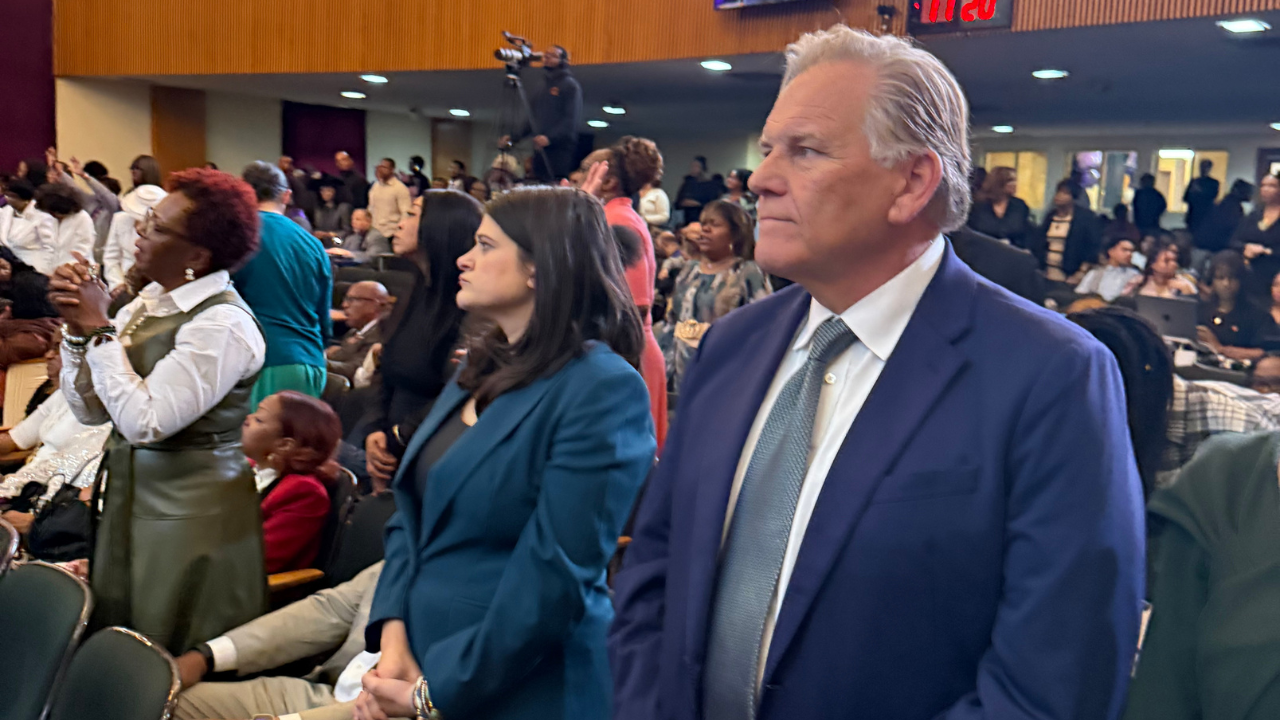
On a Sunday morning inside Detroit’s Perfecting Church, the gospel music rose and fell like a tide, and the congregation stood, clapped, and bowed their heads in prayer. But for those who knew the political undercurrents, the scene was less about spiritual unity than about the strange, uncomfortable geometry of a fractured moment. Rep. Haley Stevens, a Michigan Democrat, stood in that sacred space alongside Mike Rogers, the Republican nominee for U.S. Senate. It was an image that should have been surprising—a Democrat and a Republican sharing a pew in a high-stakes Senate race—but it made a kind of tragic sense when you learned the backstory. Stevens had originally been expected to appear at the church with Abdul El-Sayed, the Democrat who had narrowly defeated her in Michigan’s August Senate primary. That plan had fallen apart. Stevens had been disinvited after a bitter dispute over an outside group’s advertisement linking U.S. support for Israel to higher grocery prices, an ad Stevens branded as antisemitic. El-Sayed, caught in the storm, said the ad was not produced by his campaign and that he disagreed with its contents. But the damage was done. The invitation was pulled, and Stevens ended up at the same church service as Rogers, her former rival’s Republican opponent. For a moment, the church became a quiet theater of estrangement, where the people who were supposed to be standing together were standing apart, separated by more than the distance between two bodies in a sanctuary.
The story behind that Sunday service is really a story about how a single campaign season can unravel relationships and leave raw wounds that no amount of handshakes or photo opportunities can heal. Stevens and El-Sayed had already survived a brutal primary. In the August Democratic primary, El-Sayed defeated Stevens by a narrow margin, and the loss seemed to land on her like a weight she was not ready to carry. Rather than offering a full-throated endorsement of her party’s nominee, Stevens stepped back, pressing El-Sayed to take a stronger stand on issues that mattered deeply to her, especially regarding Israel. When an outside group ran an advertisement tying U.S. support for Israel to rising grocery prices, Stevens saw not just a policy disagreement but something closer to a moral violation. She called it antisemitic and demanded that El-Sayed condemn it. El-Sayed responded by saying the ad had nothing to do with his campaign and that he rejected its narrative. But his words did not satisfy Stevens, and the disagreement festered. Rep. Debbie Dingell, the Michigan Democrat who had helped organize the planned church appearance, found herself in an impossible position. She had tried to create a moment of unity, bringing the two rivals together before voters in a setting that felt above politics. But the dispute had become a distraction, and the church’s bishop was upset by the controversy. Reluctantly, Dingell asked Stevens to skip the service. It was a decision made in the name of decorum, but it only deepened the fracture. In the aftermath, El-Sayed’s campaign went further, asking Stevens to stay away from its remaining events. The two Democrats, who should have been allies against a common Republican opponent, were now behaving like estranged family members who could barely occupy the same room.
What the public saw as a political spat was, for Stevens, something more personal. She had built her career on authenticity and conviction, and she did not believe that winning a primary entitled anyone to a pass on fundamental values. For her, the advertisement was not a clumsy political mistake; it was a line in the sand. To remain silent, she felt, would be to betray a community she had long defended. There was a heaviness in her decision to appear at Perfecting Church even after being disinvited. It was not necessarily an act of defiance, though it may have felt that way to El-Sayed’s supporters. It was more like a statement of belonging: she would not be pushed out of a space that was supposed to be about faith, community, and the common good simply because a political campaign found her inconvenient. At the same time, one could imagine the hurt in El-Sayed’s camp. Here was a candidate who had worked hard, who had articulated a vision for Michigan, who had won a tough primary, only to have a fellow Democrat refuse to fall in line and then show up at an event with his Republican opponent present. It was a humiliating tableau. The church, a place of forgiveness and reconciliation, became a backdrop for the opposite: a quiet demonstration of unresolved anger. The bishop, no doubt, wanted anything but this. The congregation may have sung about peace, but the pews could not hide the tension. That was the human cost of a dispute neither side was willing to forgive.
And then there was the matter of Jason Turkish, Stevens’s fiancé. In a political campaign, family is often the quiet engine that keeps someone going—or the sudden spark that ignites an inferno. Turkish had already crossed the line that many partisans considered sacred. He had endorsed Rogers, the Republican candidate, and had appeared at a Rogers campaign event. His reason was simple, if not deeply divisive: he could not support El-Sayed because of El-Sayed’s positions on Israel. For Stevens, this must have been a painful bind. She was a Democrat, a elected official, and a woman who had spent years fighting alongside her party. But the person she loved most was publicly backing the other side. Within a party that prizes solidarity, this was not just a personal decision; it was a political statement with consequences. Stevens’s critics were already furious, saying she had refused to explicitly back El-Sayed and had stayed on television too long, with one fellow Democrat reportedly saying she needed to “stay the f— off television.” The attack lines were harsh, even cruel. But they also revealed how raw the wounds were. The dispute was never just about policy positions or campaign strategy. It was about loyalty, love, respect, and the feeling of being abandoned by people you expected to fight beside you. In the silence of that church, with Rogers a few feet away, Stevens may have felt the weight of all that lost trust. Did she look over at him? Did she think about what it meant to be on the same ground as the man who wanted to defeat the Democrat she had refused to embrace? It is impossible to know. But the image of her there, in the presence of her fiancé’s chosen candidate, said something about how deeply warped the relationships had become.
The larger picture was not lost on anyone watching. Michigan’s Senate race was emerging as one of the most consequential contests in the nation, with the potential to help determine control of the U.S. Senate. A close race, a divided Democratic coalition, and a Republican opponent who could appeal to swing voters—this was the stuff of a perfect storm. Rogers, a former congressman and FBI agent, had never been the kind of candidate who could easily be dismissed. He was disciplined, visible, and comfortable in settings like the Perfecting Church. By being present on that Sunday, he was not just attending a service; he was occupying the space left by Democratic infighting. He was showing, without saying a word, that the Democrats were so busy tearing each other apart that they could not keep a simple promise to appear together. For voters who were already exhausted by partisan bickering, this scene may have reinforced a discouraging narrative: that the party that should be channeling its energy toward healthcare, jobs, and the future was instead expending its strength on internal warfare. The advertisement dispute, the disinvitation, the fiancé’s endorsement, the angry comments from fellow Democrats—all of this was material for Republican operatives, a gift that kept giving. And in a race as tight as Michigan’s, even a small shift in independent voters could be decisive. The people who had once thought of Stevens and El-Sayed as two sides of a healthy primary rivalry were now watching them drift toward something more destructive. The tension in the church was not just a local drama; it was a window into a national problem.
In the end, the Sunday service at Perfecting Church was not the final word. It was, perhaps, a beginning of a reckoning that Michigan Democrats would have to face in the weeks before the general election. Eventually, someone would have to bridge the gap between Stevens and El-Sayed. Someone would have to remind them that the real opponent was not the person who won a primary, but the person who wanted to replace them in Washington. The church itself offered a lesson if anyone was willing to hear it: that people of faith learn to sit together even when they do not fully agree, that forgiveness is not the same as forgetting, and that the bonds of a community are often stronger than the fractures of a season. Stevens might have felt justified in her stand. El-Sayed might have felt betrayed by her refusal to offer the endorsement he had earned. But the voters who sat in those pews were not thinking about the advertisement or the primary or the fiancé’s endorsement. They were thinking about their own lives, their own bills, their own hopes for a better tomorrow. That is the thing about politics that gets lost in the shouting: the people who must live with the consequences are not the candidates, not the operatives, not the commentators. They are ordinary citizens, looking for leaders who can rise above their own pain long enough to serve. The image of Stevens and Rogers at the same church service—two people on opposite sides of a chasm, separated by a dispute that was not even theirs—should haunt anyone who cares about democracy. Because if we cannot find a way to sit together in a place of peace, how will we ever sit together in the halls of power? The music ended, the service closed, and the congregation filed out into the daylight. Stevens walked out one door, Rogers walked out another, and El-Sayed was not there at all. The story of that day remains unfinished, a reminder that politics is not just about winning. It is about what happens to the people we become when we lose, and whether we can still look across the distance and see, not an enemy, but a fellow traveler, broken and human and searching for a path forward.