


On a quiet stretch of farmland in South Africa’s North West Province, the ordinary became unspeakable. Hannetjie van Zyl, 55, went to open a gate on her farm, a task she had likely performed hundreds of times without a second thought. It was a moment of everyday life, unremarkable and mundane, until an attacker reportedly came up behind her and struck her over the head with an iron bar, again and again. She died there, beside the gate, her vehicle and belongings stolen. About 80 miles from Johannesburg, another farm became a scene of horror. Donovan Marx, 50, was brutally attacked on his property: he was shot, stabbed, and his ears were cut off. Corné Mulder, leader of the opposition Freedom Front Plus, told Fox News Digital that the attackers did not stop at that cruelty. “The perpetrators not only attacked him, they tried to castrate him.” Marx survived, but only barely; he is fighting for his life in a hospital. Both victims were White farmers, Afrikaners—people of European descent whose families have deep roots in South Africa’s often violent history of land and race. For the communities that know them, these are not statistics or political symbols. They are a mother, a father, a neighbor, a life shattered in a country that still cannot escape the weight of its past. “This month’s attacks were appalling,” said Ian Cameron, chair of South Africa’s Portfolio Committee on Police and a member of parliament with the main opposition Democratic Alliance. He described the attack on Marx as involving “extraordinary cruelty.” For critics of the South African government, these attacks are not random crime. They are the dangerous fruit of years of rhetorical violence.
The State Department, rarely so blunt in public, responded with extraordinary force. A spokesperson told Fox News Digital that “the lives and property of Afrikaners have been endangered by politicians who incite race-based violence against them.” That sentence alone would have been striking from any American administration. But the State Department went further, accusing South African politicians of threatening to confiscate farms without compensation and of supporting “a corrupt, race-based scoring system that discriminates against Afrikaners and other minorities in employment.” In both recent attacks, the victims’ vehicles and belongings were reportedly stolen. To Mulder, the alleged torture of Marx goes far beyond ordinary burglary or robbery. “Safety and farm attacks in South Africa remains a huge problem,” he said. He did not see the violence as random criminality; he saw it as the logical consequence of a political climate in which one group of South Africans has been cast as the enemy. The State Department’s message was clear: this violence is not simply the work of criminals. It is happening with the knowledge of political leaders who have allowed racial animosity to fester and who have resisted American demands to address incitement. The administration views the attacks as part of a broader pattern in which Afrikaner lives are treated as expendable in the service of political messaging. And when a superpower openly accuses another government of endangering its own citizens, the diplomatic stakes rise dramatically.
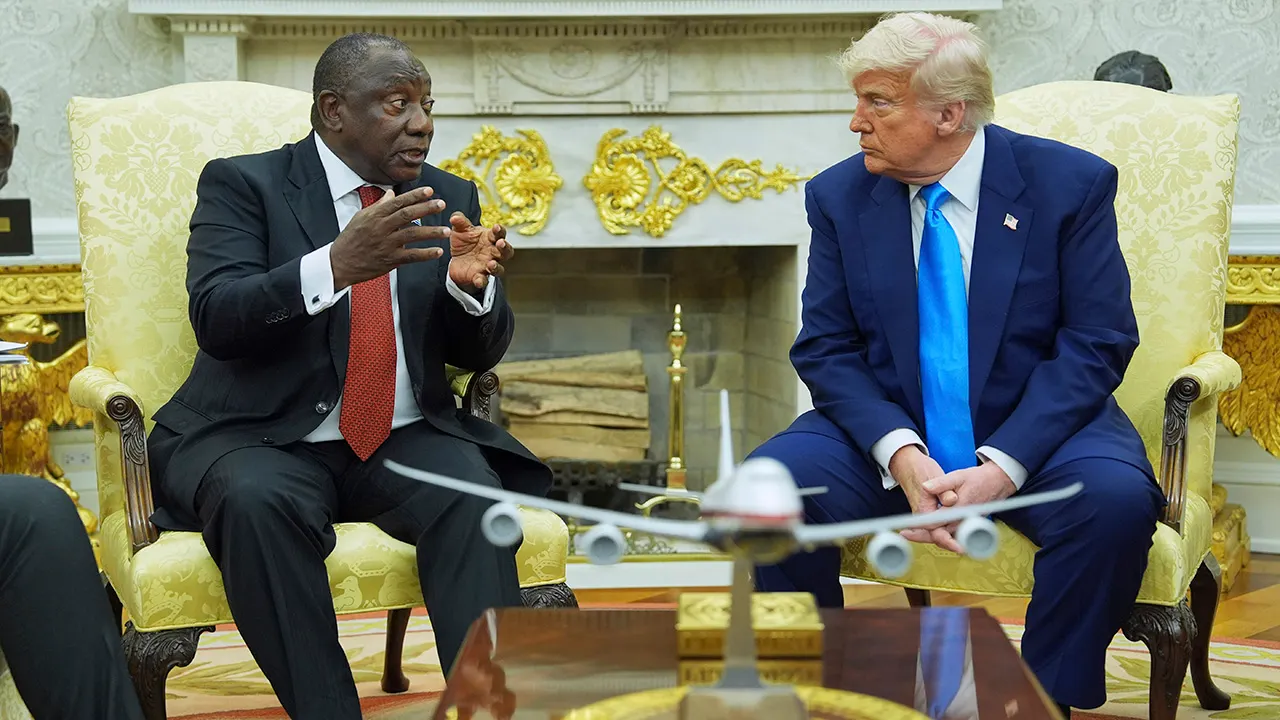
The dispute between Washington and Pretoria has been building for over a year. It first exploded in the Oval Office during a heated exchange between President Donald Trump and South African President Cyril Ramaphosa. The central issue was the repeated performance of the song “Kill the Boer, Kill the Farmer.” The word “Boer” refers to South Africans of Dutch or Huguenot descent, but in the context of the chant, it has become something more ominous. The song is sung in stadiums, at political rallies, in front of crowds that can reach 90,000 people. Ramaphosa has not stopped it. He says he cannot, because South Africa’s highest court ruled that the lyrics do not constitute hate speech. To the Trump administration, that explanation is unacceptable. Last month, U.S. Ambassador to South Africa Brent Bozell III told Fox News Digital that Ramaphosa could ban the song if he truly wanted to, despite the court ruling. “So, to say, ‘Well, you can’t do it because the court said it’s not,’ … you know, that’s poppycock,” Bozell said. “If President Ramaphosa, if he wants to, he can do it. It’s just as simple as that.” For opposition leaders like Mulder, the song is not harmless tradition. It is incitement, and it has consequences. “As long as [President Ramaphosa] does not stop the incitement to attack farmers with the singing of the song ‘Kill the Boer,’ the attacks will continue,” he said. “We see the practical reality when these things play out as happened with the last two farm attacks that we’ve seen.” In other words, to its critics, the song is a promise of violence, and the silence of the presidency is an endorsement.
What has troubled so many observers is the response from South Africa’s leaders—or, more precisely, the lack of one. Mulder called the reported torture of farmers “unthinkable,” and he was deeply shaken that Ramaphosa offered no public sympathy. “Not one word from the President of South Africa to sympathize, not even acknowledging that this has happened, which is absolutely unbelievable,” Mulder said. Fox News Digital reached out to the South African government for comment but was referred to police, who did not immediately respond. That institutional silence is part of the problem, according to Cameron. He insisted that the recent attacks were not isolated incidents. “I have personally attended farm attack scenes in which people were tortured with boiling water, burnt with clothing irons and subjected to other horrific abuse,” he said. He called on the South African Police Service to put its best resources behind the cases: “SAPS must put experienced investigators, forensic support and crime intelligence behind these cases. Nobody should have to accept this level of violence as a normal part of life.” For years, rural communities have pleaded with the government to treat farm attacks as a form of domestic terrorism or at least as a priority crime. “We have been pleading with [the] government to prioritize rural crime and farm attacks as a priority crime, they are not prepared to do so,” Mulder said. While no public figure has yet accused these specific attackers of racial motives, the pattern feels clear to many Afrikaners. They hear politicians speak about land expropriation without compensation. They hear crowds sing about killing farmers. They watch their president refuse to condemn it all. And then they see an attacker walk up behind a 55-year-old woman while she opens a gate and beat her to death.
The Trump administration is not settling for statements. On Friday, the State Department doubled down on its demand that South Africa act. A spokesperson told Fox News Digital that the United States had asked senior South African officials “to condemn incitement to race-based violence, particularly the singing of ‘Kill the Farmer! Kill the Boer!’” The administration also demanded that South Africa formally designate rural crime as a priority crime, and urged the government to “expand alternatives to the Broad-Based Black Economic Empowerment ownership requirements, such as equity equivalent investment programs.” The current system, in Washington’s view, is not just flawed; it is discriminatory. It forces ownership transfers and scoring systems that disadvantage Afrikaners and other minorities in employment. The State Department spokesperson said the lack of a meaningful response to these requests made clear that the South African government “does not want a constructive relationship with the United States and is willing to continue pursuing oppressive policies that disadvantage all South Africans.” The most tangible proof of this policy shift is in the numbers. Nearly 13,000 South African refugees, most of them Afrikaners, have been flown to the United States during fiscal year 2026. That number is expected to increase by another 17,500 refugees in fiscal year 2027. “As directed by President Trump, we are prioritizing the resettlement of Afrikaners in South Africa escaping government-sponsored race-based discrimination,” the State Department spokesperson said. For the administration, this is not merely diplomacy. It is a rescue mission, a way to say to a threatened community that the United States sees them and is willing to open its doors when their own government will not protect them.
Behind the diplomatic language, the court rulings, the songs, and the refugee statistics, there are human beings whose lives will never be the same. A woman went out to open a gate and never came home. A man who worked the land is lying in a hospital bed, his body broken by people who treated him not as a person but as a target. Their families must now live with the haunting knowledge that the violence came not from a war zone but from the place they called home. For Afrikaners in rural South Africa, fear is not an abstraction. It is the feeling that follows them as they drive down dusty roads, as they check locks at night, as they hand the land they love to their children with a warning instead of a blessing. The attacks have reignited a painful conversation about whether South Africa can ever truly heal the wounds of its past, or whether the past has simply changed its face. There are those who argue the attacks are pure crime, driven by greed and desperation, not politics. But the victims’ stolen vehicles and belongings do not erase the extraordinary cruelty of what was done. There are those who argue the song is merely speech. But speech has power, and in South Africa, it has often been the prelude to violence. Ian Cameron’s words remain the clearest summary of the tragedy: “Nobody should have to accept this level of violence as a normal part of life.” That should not be a controversial statement. Yet in South Africa today, for too many farmers, it feels like a plea that no one in power is listening to. Until leaders find the will to act, each morning on every farm will carry the same quiet question: is today the day the ordinary becomes unthinkable again? And how many more gates must be opened before the world finally sees the blood on them?