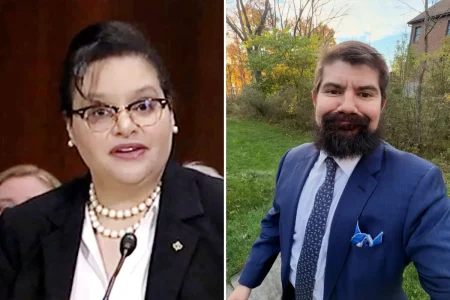



On Saturday, with the Michigan landscape sprawling beneath a fierce summer sun, the Democratic Senate campaign found itself caught in a human moment that no amount of planning could have prepared for. Dr. Abdul El-Sayed, the nominee, stood in front of a small but committed crowd of volunteers, his voice measured, his shoulders squared, and answered a question that had been humming through the political grapevine for days. Yes, there had been tension. Yes, it had flared between him and the person who had challenged him in the primary. No, he was not going to pretend it didn’t happen. But then he did something that political operatives rarely do with such honesty: he lifted his chin, looked directly into the lenses of the cameras, and said, “I don’t want any distractions.” It was a simple sentence, almost quiet, but it carried the weight of a campaign that had already survived so much. In that moment, El-Sayed was not just speaking to the reporters gathered in the sweltering room. He was speaking to every uncertain supporter, every skeptical fence-sitter, every volunteer who had stayed up late making phone calls. He was speaking, perhaps, to himself. That one phrase, so easy to overlook in the white noise of political news, was a promise — a promise to keep his eyes on the horizon when the pull of petty battle tried to drag him downward.
To understand why those words resonated so deeply, you need to understand who Dr. Abdul El-Sayed has become over the course of his public life. He is not the polished, hand-trained product of a political dynasty, nor does he move through the world with the easy smile of someone who has never known the sting of rejection. He is a physician, an epidemiologist, a man who has spent years studying the workings of the human body and the society it lives in. Before he ever stood on a debate stage, he stood in hospital corridors, seeing the way illness can be a symptom of inequality. He has written about how our health is shaped by the conditions of our neighborhoods, our schools, our paychecks. He knows that a kid in Flint who was poisoned by water is not an abstract statistic, and he knows that the father in Detroit who can’t afford his insulin is not a talking point. That grounding, that stubborn devotion to the idea that policy is ultimately about flesh-and-blood life, has made him a different kind of candidate. It has made him a candidate who refuses to apologize for caring deeply. And it has made him a candidate who understands, perhaps more than most, that every day spent relitigating a primary scar is a day taken away from the families who need someone to fight for them. So when he said he didn’t want any distractions, it wasn’t a scripted line from a media trainer. It was the voice of a doctor telling his patient, “We don’t have time to dwell on the diagnosis. We need to start the treatment now.”
But let’s be honest about something: primary rivalries are not easy to walk away from. They are not like the arguments you have about where to go for dinner, where everyone eventually shrugs and moves on. A primary campaign is a raw and intimate kind of combat. You spend months learning your opponent’s every weakness, every mistake, every nuance of their platform that you believe is wrong. You rehearse your best counterarguments late at night in hotel rooms. You feel the sting of every negative story, every dropped poll, every debate exchange that didn’t go exactly the way you hoped. You do this because you genuinely believe that your vision is the right one, and that the stakes are too high to be polite. Then, when the votes are counted, you are suddenly expected to embrace the person you spent months trying to defeat. You are expected to smile at the unity press conference and say all the things about coming together for the greater good. But the human heart is slower than the political calendar, and the tension that flares between former rivals is often just the visible spark of a deeper emotional truth: they both gave everything they had, and only one of them gets to take the field for the final game. That is why lo these many weeks after the primary, El-Sayed’s words felt so real. He did not claim there was no tension. He did not dismiss it as media invention. He acknowledged its existence and then made a choice about what it would not be allowed to do. That choice is not as easy as it sounds. It requires swallowing pride, setting aside hurt feelings, and remembering that losing an election is not the same as losing your purpose in the world.
When El-Sayed said, “I don’t want any distractions,” he was also tapping into something that all of us recognise in our own lives. Distractions are the enemies of progress. They are the little voices that tell you to argue with a stranger on the internet instead of finishing the project that might change your future. They are the unresolved phone calls, the unhealed arguments, the endless reruns of old grievances that keep us from becoming who we want to be. In a campaign, distraction is even more dangerous. A single day of responding to a petty attack can cost you a week of positive coverage. A single moment of losing your temper can be replayed a million times on social media. And so the savvy candidate learns to say no to the distractions, not because they feel nothing, but because they know that attention is the most precious resource in politics. For a man like El-Sayed, who has spent his career focused on the structural causes of suffering, distraction is also a moral failure. It means ignoring the waiting room full of people who cannot afford their medicine so that you can win a debate with someone who was never going to agree with you anyway. It means turning away from the crisis of housing and hunger and pollution to stare into the rearview mirror of campaign history. His statement was therefore a discipline, not just a strategy. It was a reminder to himself that every hour he spends on a grudge is an hour stolen from the promise of a better Michigan. And in a world that seems to endless churn with outrage and sideshows, there is something genuinely refreshing about a leader who finally says, “Let’s focus on what matters.”
There is also a bigger picture here, one that goes beyond the personal dynamics of one campaign. The Democratic coalition, after all, is a raucous and beautiful family of many voices. It includes progressives and moderates, union members and teachers, young activists and suburban grandparents. These groups do not always agree with each other. They have different histories, different priorities, different ways of talking about the world. But when the primary is over, the challenge is to build a bridge broad enough for everyone to cross. That is what El-Sayed’s comment, at its heart, was about. He was not asking his former rival to fade into the background. He was not asking voters who supported someone else to betray their principles. He was asking them to remember the thing they all shared: a desire to make life better, fairer, safer for the people of Michigan. He was asking them to look at the faces of their neighbours and see not a battlefield but a community. In the past, primaries have left such deep wounds that the party could not recover in time for November. But this time, El-Sayed seems determined to write a different story. His refusal to be distracted is, in many ways, an invitation. It says: come heal. Come bring your energy, your ideas, your passion, but leave behind the bitterness. There is too much at stake to spend another day fighting among ourselves. And for anyone who has ever been part of a team, a family, or a movement that almost tore itself apart, that invitation hits home with the force of a shared memory.
And so, as the sun began to set on that Saturday afternoon, El-Sayed’s brief words hung in the air like the promise of a cleaner season. There are people who will remember this moment not for its eloquence but for its timing — the slight pause before he spoke, the way his voice caught when he mentioned the word “distractions.” There will be commentators who will parse every syllable for hidden loyalties, and political operatives who will try to spin the whole episode in their favour. But for the ordinary voter, the takeaway is simpler. Leadership is not about never being tired or never being hurt. It is about carrying the weight anyway. It is about waking up the morning after a hard loss and asking not “what did I lose” but “what can I still do.” It is about looking at the person who beat you in a primary, or who almost did, and remembering that the only way forward is together. Dr. Abdul El-Sayed, in that brief Saturday moment, showed us what that kind of leadership looks like. He did not feed the fire. He did not relish the drama. He simply drew a line in the sand and said that there are more important things, more urgent things, more human things that deserve our attention. It was not a grand speech, and it will probably not make the history books. But it was true, and in this age of noise, truth is the rarest and most refreshing thing of all. The campaign goes on. The tension may still smoulder. But the man at the centre of it has made his choice — and he is choosing to look ahead.