

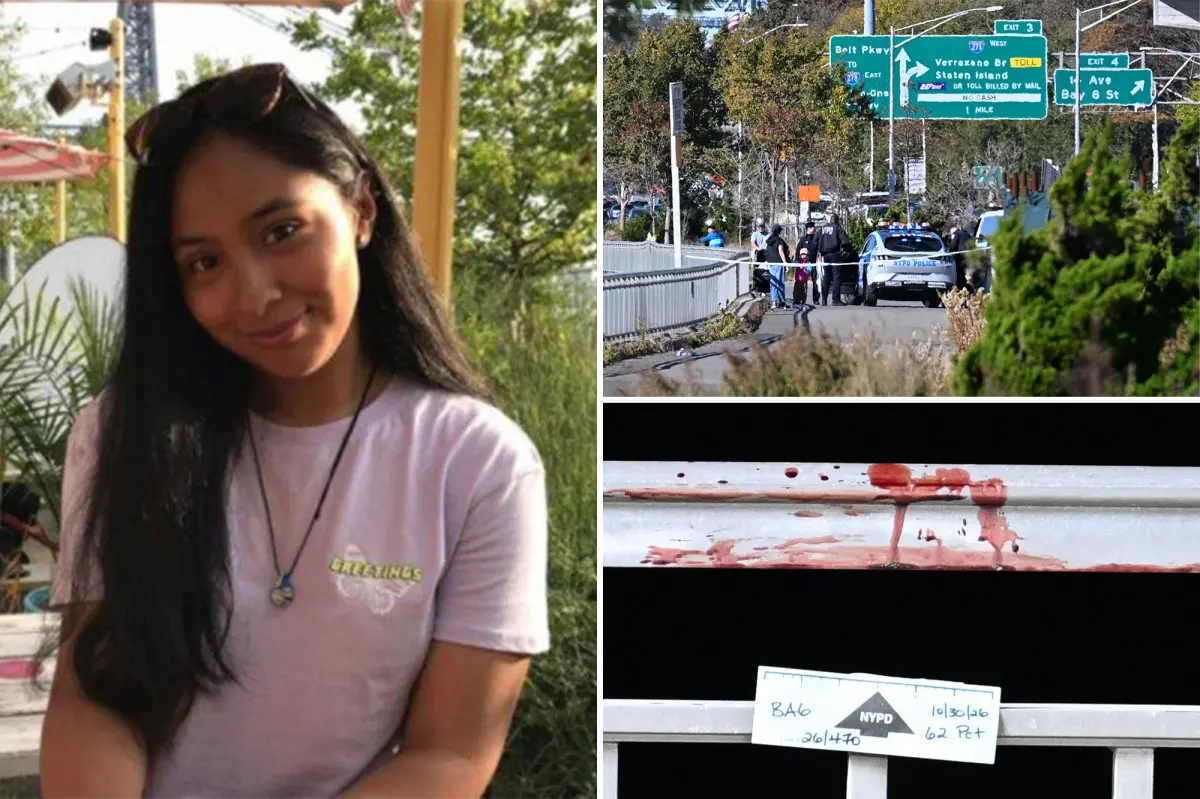
On a quiet Friday evening, the Brooklyn waterfront promenade in Bath Beach was just beginning to settle into the familiar calm of nightfall. The gentle lapping of water against the shore and the distant hum of city traffic should have been the soundtrack to an ordinary run along Shore Parkway. But just after 8 p.m., near Bay 17th Street, that peace was violently shattered. Katie Suarez, a 28-year-old woman known to her neighbors for her warm smile and gentle nature, was stabbed in the neck while jogging on the popular path. She was a local bank teller, a daughter, a partner, a friend—someone whose life was measured not in headlines but in small acts of kindness. When she did not return home, her father went out looking for her along the route she loved. Instead of finding her safe, he found her bleeding on the promenade, a scene so terrible no parent should ever witness. Police and paramedics rushed her to NYU Langone Hospital, where she was listed in critical condition. By Saturday, the devastating news arrived: Katie was declared brain dead. The attack had stolen her future in the cruelest way possible. For those who knew her, the shock was immediate and overwhelming. This was not a faceless statistic; it was Katie, the quiet woman who exchanged greetings on the street, who worked behind the counter at the local bank, who had a family that adored her. The promenade that had been part of her daily routine had become the site of an inexplicable tragedy.
In the aftermath, neighbors gathered with heavy hearts, struggling to reconcile the violence with the woman they had known. They described Katie as “very professional, very kind,” a person of “very good character” who carried herself with quiet dignity. One neighbor, visibly shaken, said, “I mean, nobody is supposed to have their life taken, you know, being bad or good, but she was kind of exceptional to me, the way I interact with her.” Another man, speaking about Katie and her partner, lamented, “It’s sad, man, because they’re good neighbors… constantly walking by, you know, they treat people with respect.” These were not distant acquaintances; they were people who saw Katie nearly every day, who knew her rhythm and her routine. She was a familiar presence at the local bank branch, where she worked as a teller, always professional, always approachable. “A good teller and good character, you understand? Looks like a very family oriented woman,” one neighbor explained. Another local, who had known Katie for several years, remembered her as “a very soft spoken girl, very nice,” and simply said, “It’s very sad for her.” In these remembrances, a portrait emerges of a young woman who did not seek attention, who lived modestly and kindly, who smiled at neighbors and took pride in her work. She was not famous or powerful, but she mattered deeply to the people around her. Her death has left a hole in the community that cannot be measured in statistics.
The grief in Bath Beach is palpable, and it extends far beyond Katie’s immediate family. Local resident Anna Dece spoke for many when she said, “I’m very sad. That’s terrible. I’m sad for everybody.” But she also captured the particular anguish of seeing violence strike so close to home: “But this is close. It’s too much right now. It’s a mad world.” That sense of a mad world is hard to escape when a young woman can be attacked on a popular waterfront promenade, a place where families stroll, where joggers run, where people go to escape the pressures of the city. The path near Bay 17th Street and Shore Parkway is not a dark alley or an abandoned lot; it is a public space, a place of everyday life. Now it is marked by blood and memory. Residents who once walked there without a second thought are suddenly afraid. Parents who let their daughters run in the evening are wondering if it is safe. The senselessness of the attack makes it even more terrifying: Katie was not doing anything risky. She was simply being active, caring for her health, enjoying the evening air. There is no explanation that can make sense of it, and that is part of the horror. The community is left not only with grief but with a shaken sense of security, a reminder that tragedy can strike anywhere, at any time, to anyone.
Katie’s life, now so cruelly cut short, deserves to be remembered in full. She was a young woman with a future ahead of her—perhaps dreams of a family of her own, of a career, of quiet weekends with the people she loved. She had a partner, someone with whom she shared a home and a life, someone who now faces an unimaginable emptiness. She had a father who loved her enough to go searching for her in the dark, only to find the worst possible outcome. The image of a father discovering his daughter on that path is one that will haunt anyone who hears it. It is a reminder that behind every crime report is a family shattered, a network of people whose lives will never be the same. Katie worked at a local bank as a teller, a job that requires patience, trust, and the ability to interact with all kinds of people. Those who knew her say she excelled at it, not because she was ambitious in the usual sense, but because she was genuinely kind. In an era when rudeness and indifference often dominate public life, Katie’s soft-spoken decency stood out. She was the kind of person who made a bank visit feel human, who remembered faces, who treated strangers with respect. That goodness is what her neighbors are holding onto now, even as they mourn.
This tragedy also forces a broader reckoning with the violence that women face in public spaces. Katie was doing something that should be completely safe: going for a run in her own neighborhood. Yet she was attacked in a way that was sudden, brutal, and fatal. The randomness of the assault is terrifying, but it is also familiar to anyone who has ever felt vulnerable while walking alone, running at dusk, or simply existing in public. Women often learn to adjust their behavior—to carry keys between their fingers, to avoid certain streets, to check over their shoulders—and still, it is never enough. Katie’s death is a painful reminder that the burden of safety should not fall only on potential victims. The community is calling for justice, for police to find the person responsible, for the streets to be made safer. But justice alone cannot undo the loss. Even if an arrest is made, even if the legal system does its work, Katie will not come back. Her family will not hear her voice again. Her partner will not hold her hand. Her father will not see her smile. The promise of her life is gone, and no verdict can restore it. In the meantime, the neighborhood is left to grieve, to rage, to wonder how such a thing could happen in a place that felt like home.
As the sun rises over the Brooklyn waterfront in the coming days, the promenade will still be there, but it will feel different. The spot where Katie fell will be marked by flowers and candles, by tears and silent prayers. Neighbors will gather, not to run or walk, but to honor a life that was taken too soon. They will remember Katie Suarez not as a victim, but as a person—a woman who loved her family, who was kind to her neighbors, who worked hard and spoke softly. They will try to hold onto the good moments: the greetings exchanged, the small talk at the bank, the sense of community that she helped create simply by being herself. In the midst of a mad world, her gentleness was a quiet gift, and her loss is a profound one. The best way to honor her is to refuse to let her death be just another statistic in an endless cycle of violence. It is to be kinder to one another, to look out for our neighbors, to fight for a world where no one has to fear the evening run. It is to remember that behind every headline is a human being, and that human beings deserve more than brief moments of sympathy. Katie Suarez was loved. Katie Suarez was good. And her memory will live on in the hearts of those who knew her, and in the determination of a community to seek healing and justice in the face of senseless tragedy.