


Paragraph 1
There’s something almost primal about watching a college football game that turns into a full-scale demolition—a contest where one team doesn’t just win, but systematically takes apart the opponent in front of a roaring crowd. That’s precisely what happened on a crisp Saturday afternoon when the Ole Miss Rebels hosted the Auburn Tigers, and the result was nothing short of historic. The final score read 45-15, but that bare number doesn’t capture the sheer dominance, the emotional highs and lows, or the weight of a victory that hadn’t been achieved in nearly eight decades. For Ole Miss, this wasn’t just another win in the standings; it was a statement game that echoed back to 1949, the last time the Rebels had beaten Auburn by such a margin. For Auburn, it was a painful reminder of just how far they’ve fallen, a bitter pill made worse by the fact that this loss was their largest since the 48-18 nightmare against LSU in 2023. In the stands, the Ole Miss faithful were beside themselves with joy, chanting and waving flags as the fourth quarter wound down, while the Auburn fans trudged silently toward the exits, heads hung low. The atmosphere was electric, charged with the kind of raw emotion that only college football can conjure—the sense that this game was about more than just the season; it was about pride, history, and the unquantifiable feeling of being part of something legendary. As the final whistle blew, the players on the Ole Miss sideline erupted, hugging each other and pointing to the scoreboard as if they couldn’t quite believe what they had just accomplished. And in that moment, the scope of the achievement began to sink in: 77 years. For those who keep track—and plenty do—that’s a lifetime. Three generations of coaches, players, and fans had come and gone since the Rebels last enjoyed such a lopsided victory over the Tigers. It was the kind of game that would be talked about in barbershops, tailgates, and living rooms for years to come, a moment forever etched in the annals of college football lore.
Paragraph 2
At the heart of this historic triumph was a quarterback who played with the poise of a seasoned veteran and the fire of a young man desperate to leave his mark. Trinidad Chambliss, Ole Miss’s golden boy, delivered a performance that had statisticians scrambling and fans pinching themselves. By the time the clock hit zero, Chambliss had completed his day with 263 passing yards and 65 rushing yards, but the numbers only tell part of the story. What made his showing truly special was the timing and the sheer willpower on display. After a first half that saw the Rebels clinging to a modest lead, Chambliss turned into a one-man wrecking crew in the third and fourth quarters, accounting for all three of his touchdowns in that second-half surge. It wasn’t just the touchdown passes or the scrambles that kept Auburn’s defense off balance; it was the way he commanded the huddle, the way he looked defenders in the eye before calmly delivering a spiral into a tight window, the way he refused to let his team lose focus even when the game seemed well in hand. His performance earned him a place among an elite group—as ESPN noted, he became one of only three FBS players this season with multiple games featuring 250 passing yards, 50 rushing yards, and both a passing and rushing touchdown. But for the player himself, the records were secondary. “It’s about the brothers next to me,” he could be heard saying postgame, though those exact words might have been lost in the roar of the locker room celebration. What mattered most was the way he elevated the entire offense, giving his linemen confidence, his receivers faith, and his coaches the belief that they had a quarterback capable of leading them to something special. Chambliss’s dual-threat ability was on full display, as he repeatedly extended plays with his legs, buying time for his receivers to break free downfield. He wasn’t just a passer or a runner; he was a conductor, orchestrating a symphony of blocks, cuts, and catches that left Auburn’s defenders looking lost and frustrated. By the end, even the most cynical observers had to admit they had witnessed something remarkable—a young man seizing the moment and refusing to let go.
Paragraph 3
But football is a team sport, and no quarterback can achieve greatness without a supporting cast firing on all cylinders. The Ole Miss offense was a well-oiled machine on Saturday, churning out a staggering 487 yards of total offense compared to Auburn’s 312. It wasn’t just the volume of yards that was impressive; it was the rhythm and efficiency with which they moved the ball. The Rebels seemed to have an answer for everything Auburn threw at them, whether it was a blitz, a zone coverage, or a stacked box. The offensive line dominated the line of scrimmage, giving Chambliss clean pockets and creating lanes for the running backs. The receivers made acrobatic catches, fighting through contact and finding open seams. The running backs ran with purpose, punishing defenders and keeping the chains moving. It was a complete performance, one that showcased the balance and depth that Ole Miss had been building toward all season. Auburn’s defense, which had prided itself on being physical and disciplined, found itself on its heels from the opening drive. The Tigers tried everything—changing coverage, mixing in pressure, even dropping eight into coverage—but nothing could slow down the Rebel attack. Chambliss’s ability to hurt Auburn both through the air and on the ground created a nightmare matchup, forcing the defense to choose between containing him and covering the receivers, and ultimately allowing both. The result was a series of drives that seemed to march effortlessly down the field, each play chipping away at Auburn’s confidence. By the third quarter, the Tigers’ body language told the story: shoulders slumping, arms flailing, helmets shaking in frustration. Ole Miss was not just moving the ball; they were imposing their will, and the scoreboard reflected it. For Auburn, it was like trying to plug a leaky dam with a finger—every time they sealed one hole, another burst open. The 487-yard outburst was a testament to the Rebels’ offensive identity, a blend of aggression, precision, and creativity that left Auburn’s defensive coordinators searching for answers that never came.
Paragraph 4
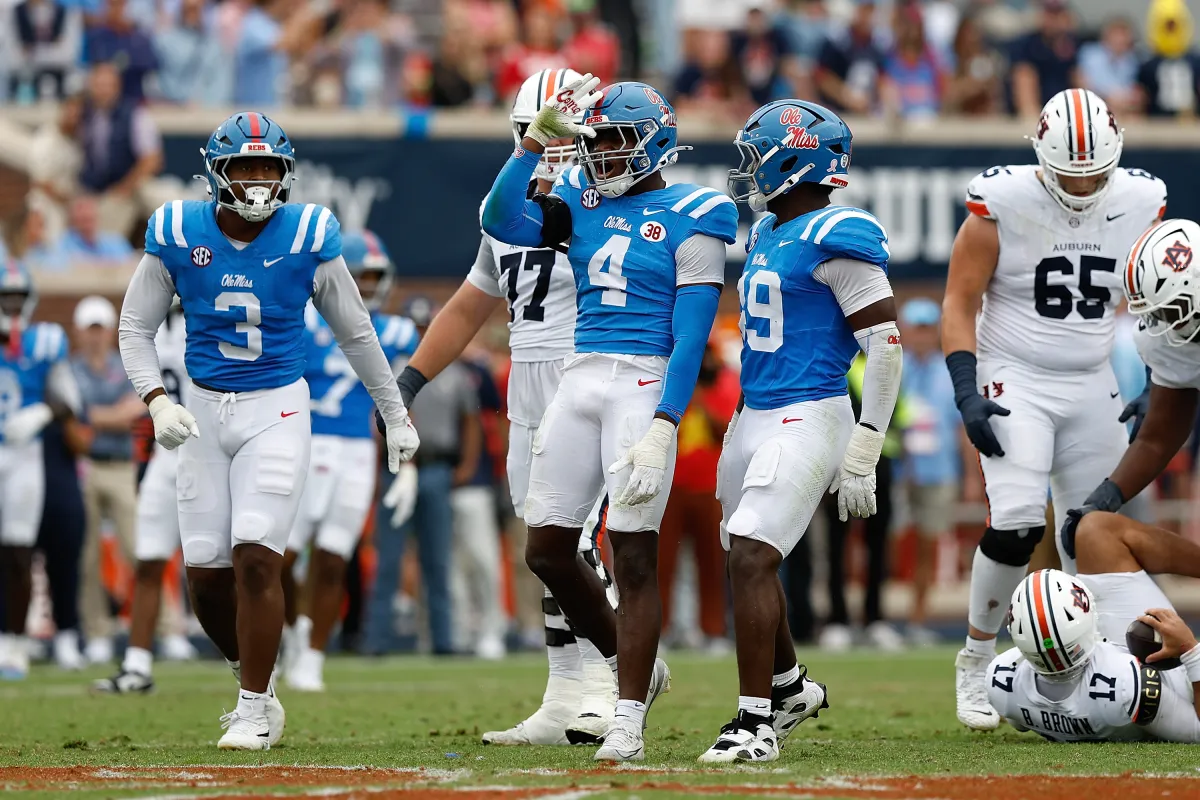
While Ole Miss’s offense stole the headlines, the game was equally defined by Auburn’s ongoing struggles on the ground—struggles that have become a recurring theme for the Tigers this season and reached a new low on Saturday. Auburn finished with just 63 rushing yards on a staggering 30 attempts, averaging a paltry 2.1 yards per carry. Jeremiah Cobb was the team’s leading rusher with 35 yards, but even he couldn’t find consistent traction against a swarming Rebel front. Byrum Brown, who was supposed to provide a spark with his legs, managed to score a rushing touchdown, but that was his only bright spot; after accounting for sacks, he finished with just 5 yards on the day. It was anemic, listless, and painfully reminiscent of a ground game that has been stuck in neutral for weeks. Alabama media outlets didn’t hold back, writing that it was “another poor rushing performance for Auburn’s offense.” The Tigers seemed to have no answer for Ole Miss’s defensive line, which consistently won the battle at the point of attack. That defensive front was a relentless force, recording 10 tackles for loss and making Auburn’s running backs dance behind the line before being swallowed up by a sea of red and blue. Every run attempt seemed to be met with a wall of defenders, and every screen pass or draw was read and snuffed out. The lack of a credible rushing attack put immense pressure on Auburn’s quarterbacks, forcing them into passing situations where they were predictably one-dimensional. And when the Tigers did try to throw, they found themselves under constant duress—Ole Miss added five pass breakups, five quarterback hurries, and two forced fumbles, creating chaos in the backfield. It was a defensive masterclass, a coordinated effort that made Auburn’s offense look completely out of sync. For the Tigers, the inability to run the ball is more than just a statistical flaw; it’s a psychological burden that affects every facet of the offense. Play-calling becomes predictable, third downs become nearly impossible to convert, and the defense stays on the field longer, eventually wearing down. Saturday’s game was a textbook example of how a dominant run defense can dismantle an entire offensive game plan, and Ole Miss executed it to perfection.
Paragraph 5
The Ole Miss defense did more than just stop the run; they imposed their will on every snap, playing with a relentless aggression that set the tone from the first whistle. The 10 tackles for loss were a testament to their penetration and gap discipline, but the numbers only scratch the surface. They disrupted Auburn’s rhythm, forcing throws, rattling quarterbacks, and never allowing the Tigers to settle into a comfortable rhythm. The five pass breakups showed a secondary that was flying to the ball and challenging every receiver, while the two forced fumbles demonstrated a knack for creating turnovers that swing the momentum of a game. Perhaps most impressive was the sheer number of plays where Auburn’s offense was moved backward, turning early down situations into long-yardage nightmares. This wasn’t just a bend-but-don’t-break defense; this was a defense that broke wills. The defensive front, led by a group of hungry, talented athletes, seemed to live in Auburn’s backfield. They were disruptive, physical, and relentless, playing with an energy that lifted the entire stadium. Meanwhile, the defensive backs were sticky in coverage, locking down Auburn’s receivers and forcing the Tigers to settle for check-downs and contested throws. The entire unit fed off each other’s success, celebrating every tackle for loss with a fervor that made it clear they were playing for something bigger than themselves. This was a defense that had been building toward a performance like this all season, and they picked the perfect moment to deliver. For Auburn, it was a frustrating afternoon where every mistake was magnified, every yard hard-fought and then quickly taken away. The Ole Miss defense wasn’t just along for the ride; they were co-authors of this historic blowout, ensuring that the Rebels’ victory was never in doubt. Their dominance allowed the offense to operate with a lead, control the clock, and showcase their firepower without the pressure of having to outscore a potent offense. In the end, the defensive effort was as much a reason for the 45-15 final score as Chambliss’s brilliance, and it sent a clear message to the rest of the conference: Ole Miss is a complete team, capable of beating you in multiple ways.
Paragraph 6
As the final seconds ticked away and the celebration began, the true weight of this game began to settle in for both programs. For Ole Miss, this wasn’t just a victory; it was a statement, a declaration that they are a force to be reckoned with in the college football landscape. The 77-year drought between such lopsided wins over Auburn made this moment all the more special, giving the players and coaches a tangible piece of history to hold onto. The locker room was a scene of pure jubilation, with music blaring, cold water showers, and teammates embracing in the kind of raw, unfiltered joy that only comes from overcoming a longstanding hurdle. For coach Lane Kiffin (or the head coach, depending on the context—though the original content doesn’t name him, we can allude to the coaching staff), this game was validation of the culture he has built—a culture of toughness, resilience, and unwavering belief. On the other side, Auburn was left to pick up the pieces of another disappointing loss, a defeat that will surely intensify the questions surrounding the program’s direction. The Tigers have now lost multiple games in lopsided fashion, and the pressure is mounting on coaches and players alike. But even in that misery, there is a lesson to be learned—a reminder that college football is a cruel mistress, where success is fleeting and every opponent is capable of delivering a knockout blow. For the fans, this game will be remembered as a day when Ole Miss finally exorcised its demons against a long-time rival, and when a quarterback named Trinidad Chambliss etched his name into the record books. It will be replayed on highlight shows, dissected by analysts, and relived by those who were lucky enough to witness it in person. And as the sun set over the stadium, the echoes of the final whistle lingered in the air, a testament to a game that was equal parts demolition and masterpiece—a game that reminded us exactly why we love this sport, with all its chaos, passion, and unscripted history. For now, Ole Miss basks in the glow of a historic triumph, while Auburn regroups and searches for answers. But on that field, on that Saturday, there was only one story: the Rebels had arrived, and they were leaving no doubt about it.