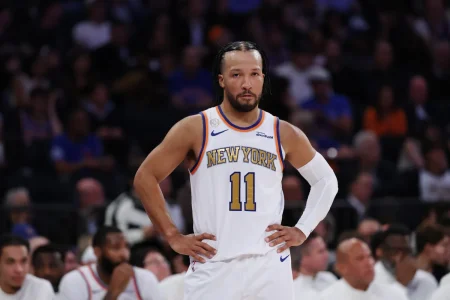




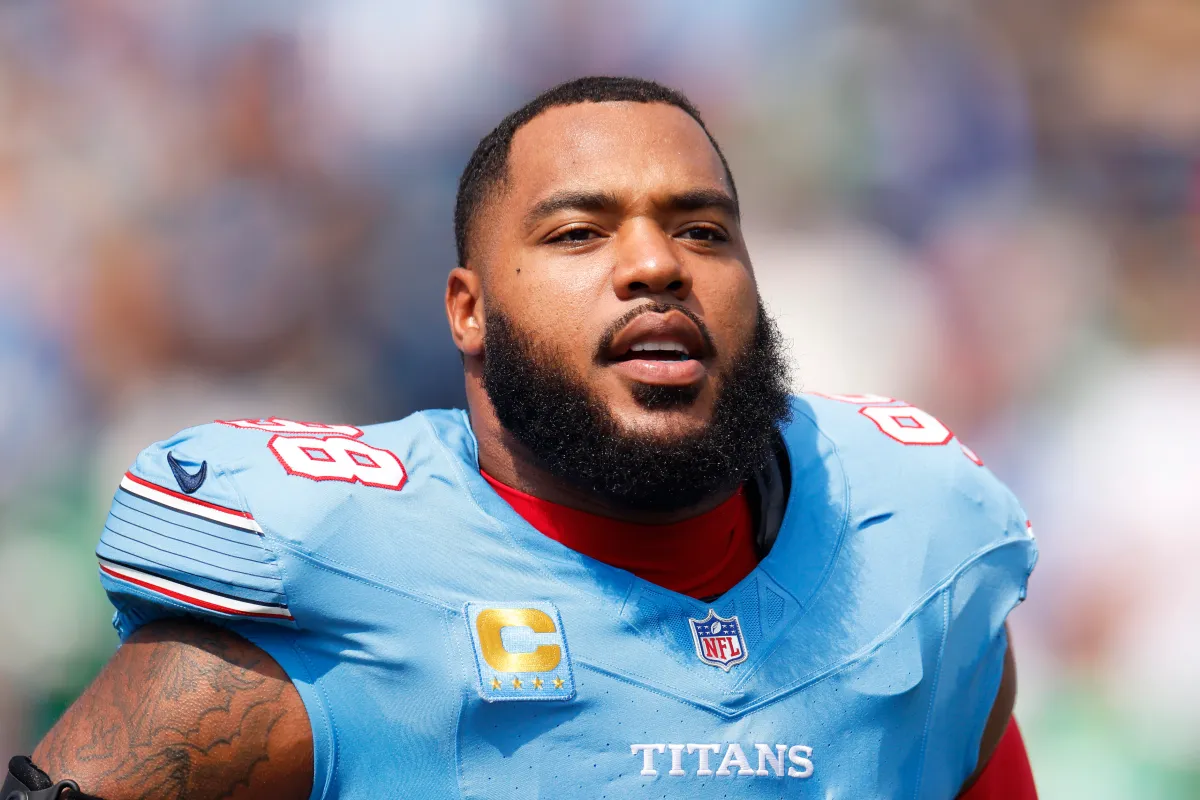
The Chicago Bears didn’t just make a trade on Thursday; they made a declaration. Acquiring All-Pro defensive tackle Jeffery Simmons from the Tennessee Titans was a powerful, public statement that the franchise intends to be taken seriously as a contender. Simmons arrives in his eighth NFL season with four Pro Bowl appearances to his name, a player who has spent years wrecking game plans, punishing offensive lines, and forcing opposing quarterbacks to feel pressure they didn’t know existed. For a Bears team that has been searching for an identity on defense, this move feels less like a simple roster addition and more like a jolt of electricity. Chicago has always been a city that loves its defense—a place where football is more than just entertainment, it’s a civic duty. The arrival of a player like Simmons is a message that the organization is ready to match that intensity. But the trade has brought with it an unexpected human layer. Simmons once made a joke about Bears quarterback Caleb Williams, mocking Williams’ painted nails before Williams ever played a down in the NFL. It was exactly the kind of playful trash talk that makes football fun, but it also created a strange thread connecting two men who will now share a locker room. That thread was pulled into the light on Friday when Simmons stepped to the podium for his introductory press conference. His social media was blowing up, and Bears fans were letting him know exactly where they stood. For a moment, it could have been awkward. Instead, Simmons smiled, remembered the jokes, and recognized that the same passion that had once crashed his Instagram was the same passion that made Chicago the perfect home for his personality. In many ways, the bond between a player and a fanbase is born in moments like this—messy, loud, and wonderfully honest.
During that press conference, Simmons was asked directly about the wave of online responses from Bears fans, and he didn’t shy away from the sudden flood of attention. He started by pointing out that his social media had been absolutely blowing up, which told him everything he needed to know about the enthusiasm of the city. Then he laughed as he recalled making a joking comment about Caleb Williams a couple years ago, a moment that came back to haunt him in the best way possible. “I mean, I thought they were going to crash my Instagram with the comments that I got,” he admitted. It would have been easy to feel defensive or annoyed, but Simmons turned it into a testament to the people. “That’s just the passion. When you have your fans really into it. When you have your fans supporting you even through the ups and downs. I mean, and this is the reason why we play the game,” he told reporters. He was determined to make it clear that this was the reason he enjoys what he does. It wasn’t just media training; it was a veteran player understanding that football is empty without emotion. The angry comments, the nostalgic arguments, the passionate defenses of a young quarterback—all of it was proof that the sport matters. Simmons has played in front of plenty of crowds, but Chicago’s reputation is different. The fans don’t just watch; they invest. They remember. They hold grudges, and they celebrate heroes. So for a man who had once been the target of that passion, standing on the other side of the divide felt almost like a homecoming. He could have apologized or pretended the jokes never happened. Instead, he embraced the history, turned it into something positive, and made it clear that he wants to be part of the city’s football story.
To truly understand the moment, you have to go back to the summer of 2024, when Williams was still a hyped rookie and Simmons was still a Titan. In a memorable appearance on “The Rich Eisen Show,” Simmons was asked about facing the Bears and the young quarterback everyone was talking about. The veteran defensive tackle leaned into the villain role. He brought up Williams’ painted nails, a lighthearted but pointed jab that got the internet’s attention. “I can’t wait to say that to him,” Simmons said at the time. He even insisted that a game in Chicago would light a fire under him, suggesting that the Bears probably thought they were going to beat the Titans badly—and that thought made him want to talk even more smack. “I get into a different mode, as well. I’ll be in a different mode that game,” he promised. When the two teams finally met in Williams’ debut, the atmosphere was electric. In the end, the Bears won 24-17, giving Williams a triumphant first start, but victory didn’t come without flashes of danger. Williams finished with only 93 passing yards, and while Simmons recorded just two tackles that day, his teammates Harold Landry III and Sebastian Joseph-Day each sacked the rookie quarterback. The Bears took home the win, but Simmons made sure the young signal-caller knew he had been in a game. It was playoff-like intensity, the kind of matchup that sticks in a player’s memory. Yet sports have a strange way of turning former enemies into brothers. The internet has a long memory, and Bears fans had not forgotten Simmons’ comments. That memory could have followed him to Chicago like a bad omen. Instead, Simmons used that history as a bridge, showing that he can laugh at himself and respect the passion that once fueled his own competitive fire. The painted nails joke is now just a relic of a time when the two men played opposite sides of the ball. The real story is what comes next.
When Simmons finally had a chance to meet Caleb Williams as a teammate, the old comments didn’t create an uncomfortable barrier. In fact, according to Simmons, they didn’t come up at all. He simply walked over, shook Williams’ hand after practice, and got on with the business of becoming teammates. “I’ve been a fan of Caleb. Of course, being on the other side, having to play against him, I’m not gonna tell him that; I’m gonna talk as much smack as I can, but now he’s on my team, and we’re teammates now,” Simmons said. That statement says everything about the psychological split between a competitor and a friend. On the field, Simmons is the kind of player who will feed on any perceived disrespect, using it to unlock a more ferocious level of play. Off the field, he is aware enough to appreciate talent and character. “Any teammate you ask about me, man, I have my teammate’s back,” he added. He wanted to make it clear that his loyalty is not a casual cliché. “When we on the same team on Sundays, I go to war for any of my guys in locker room,” Simmons said. “I hope Caleb would know that. Them comments a couple years ago … It’s all part of my game with the smack talk.” There is a certain maturity in drawing that line. In a league where players often become defined by their rivalries, the ability to let go can be hard. But Simmons understands that the game is played in the heat of the moment, and the moments change. One Sunday you’re hunting a quarterback; the next Sunday you’re protecting him. For Williams, having a man like Simmons on his side is a significant development. A defensive tackle of that caliber can change the entire structure of a defense. He can shorten the time a defense has to react, create chaos for opposing quarterbacks, and give his own offense more opportunities to shine. More importantly, Williams now knows that a former critic has become a passionate advocate. That kind of mutual respect can be the foundation for a special season.
All of this speaks to a bigger truth about why football fans care so deeply. The trade, the press conference, and the old trash talk are all part of the rich pageantry of a sport that thrives on emotion. In an era where athletes are often polished and media-trained, Simmons stands out because he lets his heart lead. He doesn’t hide the fact that he loves the noise, the criticism, and the celebration. When he talks about fans supporting the team through ups and downs, he is speaking to something fundamental about the relationship between a city and its team. Chicago has endured plenty of disappointment over the years, yet the city keeps showing up, keeps believing, and keeps caring. That is no small thing. Simmons’ social media feed is a reflection of that energy. The same fans who once criticized him are now tagging him in photos, welcoming him with open arms, and dreaming about what the defense could become. To him, that is not a contradiction; it is the beautiful chaos of modern fandom. It is the same reason he says he plays the game. He doesn’t play for the money or the fame. He plays because football brings people together, creates shared memories, and gives people something to scream about on Sundays. In Chicago, that shout is louder than almost anywhere else. Simmons seems to understand that he is not just joining a team; he is joining a culture. There is something humbling about being wanted in a place that treats football with religious devotion. It makes the job feel larger than the individual. It makes every tackle, every sack, every fourth-quarter stop carry the weight of generations. As he settles into his new locker, Simmons is carrying that weight willingly, happy to be part of a city that cares so deeply.
The next test comes soon enough. The Bears will visit the Seattle Seahawks on Monday, Nov. 2, under the bright lights of “Monday Night Football.” It is a significant moment for a team hoping to prove that its playoff ambitions are real. Simmons won’t have much time to ease into things, but that’s exactly how he likes it. The hype around the trade has already sparked bold predictions; Stephen A. Smith publicly made his own eyebrow-raising forecast about the Bears after the acquisition. All of that chatter is part of what makes this moment so compelling. But for Simmons, the ultimate satisfaction will come on the field, when he can translate passion into production. The city of Chicago is not looking for promises. It is looking for proof. A man like Simmons understands that better than most. He has been in football long enough to know that narratives fade and highlight reels shrink, but a defense that imposes its will can change everything. Playing alongside Caleb Williams represents a chance to rewrite an old story. The former rival is now the man he protects. The old jokes are now just cracks in the foundation of a friendship built on respect. As the Seahawks loom on the horizon, the Bears can dream about the possibilities. For Simmons, this is not about revenge or settling scores. It is about being part of something bigger, a team with the potential to do something special. With a Hall of Fame-caliber motor and a heart that beats for the game, he seems ready to give Chicago everything he has. The journey from trash talk to trust has made this trade more than just a transaction; it has made it a human story of redemption, passion, and the strange, wonderful ways football brings people together.