


Imagine standing at the edge of the known solar system, where sunlight is little more than a distant memory and the vast darkness is punctuated by frozen worlds and ancient ice. For generations, this cold, far-flung region felt almost unknowable, a place where our maps simply faded into blank space. But that is changing, and with astonishing speed. The Vera C. Rubin Observatory, perched high on a mountain in Chile, has been scanning the southern sky with a relentless, watchful eye. Its mission is to photograph the entire sky every couple of nights, searching for faint, fleeting objects that move against the stars. The observatory captured its first images in June 2025 and officially began its planned ten-year survey in June 2026. Already, less than five months into that grand project, scientists have found something remarkable: a possible new dwarf planet lurking billions of kilometers beyond Pluto. When astronomers announced the discovery this week at a meeting of the American Astronomical Society’s Division of Planetary Sciences in Spokane, Washington, the room seemed to hum with a sense of wonder. As amateur astronomer Sam Deen put it, the moment feels a little like replicating the 1800s and early 1900s, when explorers were still figuring out what the solar system even looked like. We are not just refining a map; we are filling in blank spaces that no one even knew existed.
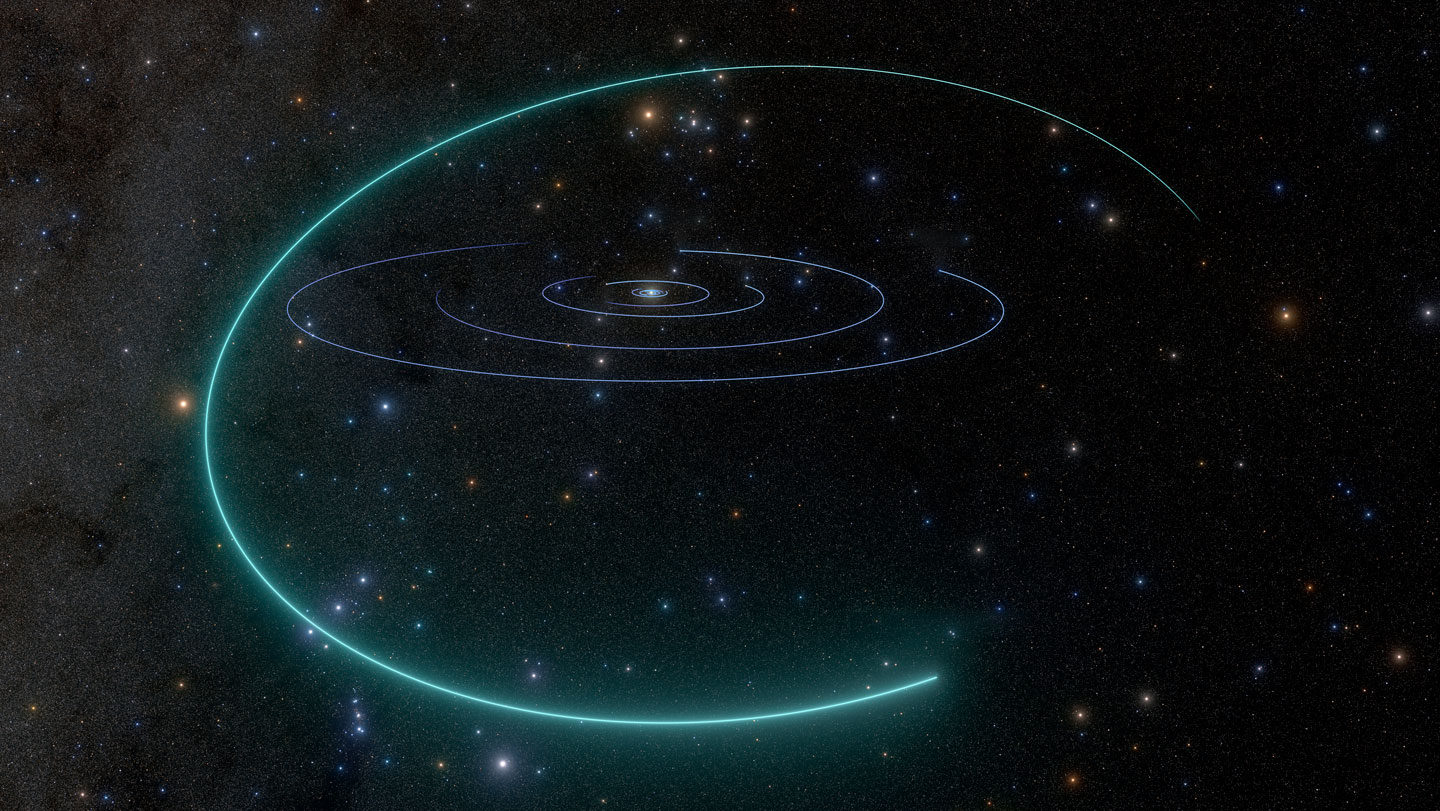
The object at the center of this excitement is officially known as 2026 ED138, and its story is the kind that makes astronomy feel like a treasure hunt. Between March and July, Rubin’s telescope had quietly recorded the object’s motion thirty times over twenty nights, but no one noticed it until mid-October, when Smithsonian astrophysicist Matt Holman deliberately searched the data for moving dots of light. What he found stopped him in his tracks. The object is roughly forty-seven times farther from Earth than we are from the sun, and its brightness suggests it is somewhere between 600 and 1,500 kilometers wide. That could make it as large as Ceres or Makemake, both known dwarf planets, and probably large enough for gravity to have pulled it into a round shape. “It’s really big. It’s damn huge,” Deen said, with the unfiltered awe of someone who spends nights staring at the sky. “No matter what you call it, it’s still the biggest thing we’ve found in the entire solar system in 19 years.” Even Holman, a seasoned scientist, felt a wave of excitement mixed with doubt. Big claims need careful verification, and the team worked quickly to make sure ED138 was real. They found the same object in archived images from the Dark Energy Camera on a neighboring Chilean peak, dating back to 2016. Then Deen pushed the story even further, discovering the object in photographic plates taken at Palomar Observatory in California in 1954. The fact that decades-old images contained this hidden world felt almost impossible, and yet there it was, a faint dot in the middle of a crowded starfield, moving ever so slightly between two exposures taken half an hour apart.
So why had no one seen it before? It turns out that ED138 practically crawls across the sky, taking about 280 years to complete a single orbit around the sun. From our vantage point, its motion is almost imperceptible from night to night, and it happened to be drifting against a dense, glittering backdrop of Milky Way stars where it blended in beautifully. It was like a quiet whisper lost in a stadium full of noise. Once astronomers knew exactly where to look, however, the object became obvious, and combining observations from 1954, 2016, and the new Rubin data gave them a much more precise picture of its orbit. This newly sharpened path means something remarkable: they may be able to watch ED138 pass in front of a distant star on Halloween. Such an event, called an occultation, is a rare and precious opportunity. It can reveal the object’s size and shape with surprising detail, and even show whether it has moons or rings. Usually, predicting an occultation takes years of painstaking observation. To have a chance at doing it almost immediately leaves astronomers feeling like kids in a candy shop, as Deen said, and the idea of catching a glimpse of this far-off world in silhouette is the kind of moment that makes a career in science feel magical.
While ED138 was stealing much of the spotlight, another team was quietly rewriting a different chapter of the outer solar system’s story. Their focus was on Neptune Trojans, icy bodies that travel in the same orbit as Neptune but remain safely parked at points sixty degrees ahead of and behind the planet. These objects are not just cosmic curiosities; they are believed to be some of the original building blocks of the solar system, frozen leftovers that contain an ancient record of how planets formed and migrated billions of years ago. Jupiter has thousands of these Trojans, and astronomers expect Neptune to have many more as well, but until now the numbers have been lopsided. We had spotted about thirty Neptune Trojans in the group that moves ahead of Neptune, but only two in the group that trails behind it. That seemed strangely asymmetric, as planetary scientist Meg Schwamb pointed out. The trailing group had simply been unlucky: for the last fifteen years, from Earth’s perspective, it had been drifting in front of the crowded Milky Way, making individual Trojans almost impossible to distinguish. Schwamb described the search as trying to find a needle in a sequined dress, and the metaphor captures the challenge beautifully. But Vera Rubin’s commissioning data, collected while engineers were still testing the telescope, turned out to be exactly the tool needed. Schwamb’s team found two new trailing Trojans and a third candidate, and their composition appears remarkably similar to the leading group. That matches long-standing theories about how the solar system took shape, suggesting these icy wanderers share a common origin and have remained largely unchanged for eons. As Schwamb noted with a grin, these objects basically photobombed the commissioning survey, and she was grateful for the accidental treasure.
These early discoveries are really just an appetizer, Schwamb said, for what the Vera Rubin Observatory will deliver over the next decade. There are likely hundreds more of these objects hiding in the darkness, waiting to be found, and each one has the potential to reshape our understanding of the Kuiper Belt and the early solar system. The community’s excitement, however, is not entirely unguarded. Astronomer Sam Lawler of the University of Regina in Canada sounded a gentle but urgent warning: the increasing number of bright satellites crisscrossing the telescope’s field of view could make these observations significantly harder. About one hundred new satellites are launched every week, and they keep getting bigger and brighter, leaving bright streaks across otherwise pristine images. Lawler does not want to be a constant downer, but she feels obligated to say it plainly: these discoveries will be hindered by satellite constellations unless we are careful about how we fill Earth’s orbit. Even so, she remains deeply optimistic about what Rubin will find. Just the fact that a dwarf planet turned up so quickly is astonishing, and it makes her wonder what else might be out there. “Maybe we’ll find something even bigger,” she said, allowing herself to dream. “There could be something the size of Mars out there. And then we’d have the whole planet debate all over again. It would be fun.”
More than anything, this is a story about how much remains to be discovered in our own cosmic backyard. The outer solar system, once imagined as a sparse and silent place, is proving to be richer and stranger than we ever knew. Every new object, whether it is a potential dwarf planet like ED138 or a handful of Neptune Trojans, helps astronomers fill in the picture of the Kuiper Belt at the solar system’s frigid fringes. And the discoveries are not coming from a single team or institution; they are the result of a wonderfully human collaboration. Professional astronomers work side by side with dedicated amateurs, scanning old photographic plates and typing out emails with tips that trace back to the 1950s. Holman and his colleagues verified a modern find with archival data; Deen and other backyard stargazers turned history into a detective story. This sense of shared adventure is exactly what the Rubin Observatory was built to inspire. Its ten-year survey will scan the sky again and again, catching transient events, mapping moving objects, and essentially creating a time-lapse movie of the universe. If this is what the first few months have already produced, the next decade is almost impossible to imagine. There are likely worlds waiting in the shadows, objects more massive than Pluto, perhaps even something that reignites the old debate over what counts as a planet. For now, the findings feel like the opening pages of a new chapter. We are learning, in real time, what the solar system really looks like, and the view is far more crowded, beautiful, and mysterious than we ever expected.