


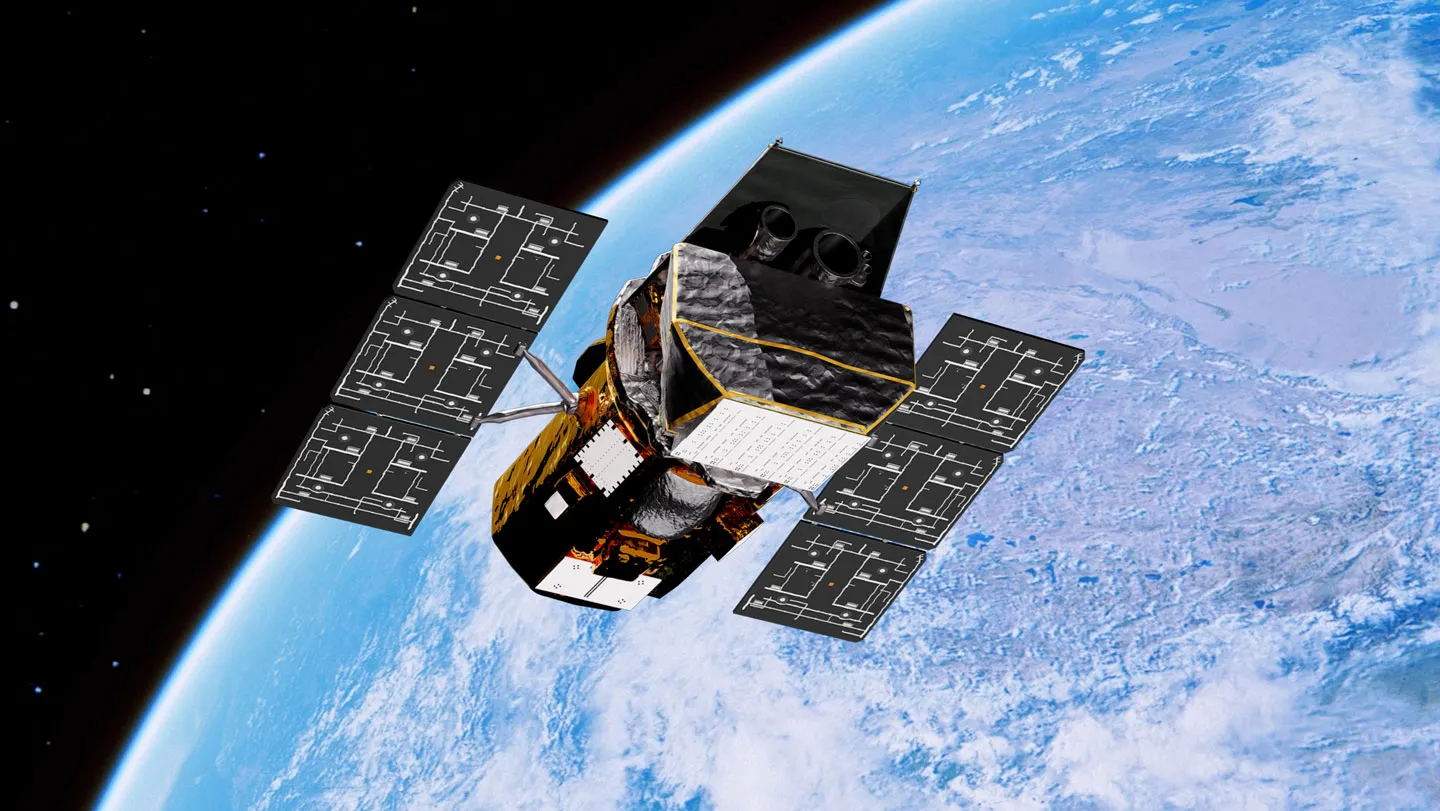
For more than two decades, whenever the universe erupted in a sudden, violent flash of high-energy light, NASA’s Neil Gehrels Swift Observatory was usually the first to look. It had become an almost automatic reflex: a cosmic alarm would sound, and within minutes Swift would turn its instruments toward the source, capturing the explosion in X-rays, visible light, and ultraviolet rays before the signal faded. Now, though, that long and extraordinary run is ending. Swift is falling. The spacecraft has lost so much altitude that it can no longer hold its orbit, and within days it will drop into Earth’s atmosphere and burn up. The ending is not dramatic; it is the result of quiet, relentless physics. For years, Swift has been smacking into stray molecules at the edge of the atmosphere, and those tiny impacts have gradually slowed it down, pulling it ever closer to the planet. The sun has made things worse by being unusually active of late, heating and expanding the atmosphere, creating more drag. Engineers had hoped Swift might keep working into the 2030s, but a rescue mission launched in early July to nudge the spacecraft back to a safer altitude failed by late August. There will be no second chance. What makes the loss especially painful is that Swift’s unique combination of speed, agility, and broad wavelength coverage is still needed. No telescope currently in orbit—or waiting in development—can do exactly what Swift could do. The spacecraft was designed to last just two years. Instead, it delivered twenty-two years of astonishing science. As Brad Cenko, an astrophysicist at NASA’s Goddard Space Flight Center, put it: “This was designed to be a two-year mission. We’re coming up on year 22. We are so fortunate to have had the opportunity to do all the things that we have.” That gratitude, though, does not soften the goodbye.
Swift was born to unravel one of the most tantalizing mysteries in astrophysics: gamma-ray bursts. These explosions are the most powerful events ever seen in the universe, releasing more energy in seconds than the sun will emit in billions of years. But they are also famously fleeting, and before Swift, telescopes were often too slow to observe them properly. By the time astronomers could aim an instrument at the sky, the burst had dimmed beyond usefulness. Swift solved that problem with a radical design. It carried three instruments: a Burst Alert Telescope that scanned roughly half the sky for gamma-ray emissions and could locate them with remarkable precision; plus X-ray and ultraviolet-optical telescopes mounted on a spacecraft that could swing into position within minutes. This meant Swift could watch the same event in many different kinds of light, almost in real time. No observatory before or since has combined those capabilities in quite the same way. As Wen-fai Fong, an astrophysicist at Northwestern University who is not part of the mission team, said: “It has all these views of the universe, all in one observatory, which by itself is rare, but it can also rapidly point any of these instruments.” Swift immediately proved the value of that approach. Just one month after launch, it spotted a gamma-ray burst that turned out to be the signature of a magnetar—a dead star with a ferociously powerful magnetic field. That discovery challenged existing categories. Before Swift, gamma-ray bursts were neatly divided into two groups: long ones, lasting more than two seconds, thought to come from the collapse of massive stars; and short ones, lasting less than two seconds, suspected to come from the merger of two neutron stars. Swift confirmed much of that basic picture, but it also found events that blurred the line. As Lynn Cominsky of Sonoma State University said, “The more data you get, the more confused you get.” That confusion proved productive. Over the years, Swift caught the brightest gamma-ray burst ever seen, nicknamed BOAT; recorded some of the highest-energy photons ever associated with such bursts; and found several of the most distant bursts on record. Equally important, Swift made all of its data public immediately, even before the mission team fully understood its own observations. That was a radical move at the time, and it helped change the culture of astronomy.
As exciting as gamma-ray bursts were, they were only the beginning of Swift’s greatest achievements. The observatory’s speed and flexibility made it a natural tool for all kinds of transient astronomy. Whenever something appeared in the sky that had not been there before—a new supernova, a weird flare, a passing comet—astronomers knew they could ask Swift to turn and look quickly. In its later years, Swift was observing as many as five to ten “targets of opportunity” on a typical day, accumulating hundreds or even thousands of additional observations every year. Phil Evans, an astrophysicist at the University of Leicester in England, described the dynamic nicely: “With scientists, if you give them a tool to do something, they will find other things that you can do with that tool.” Some of Swift’s most exciting work came when it joined forces with observatories that listened to the universe in entirely different ways. Neutrinos, for example, are ghostly particles that can travel across the universe almost undisturbed, and they can bring messages from places where light is blocked. Gravitational waves are ripples in spacetime itself, created when massive objects collide. Both are notoriously difficult to detect and trace back to a visible source. Swift became a key partner in the new field of multimessenger astronomy. In 2017, the mission was involved in back-to-back breakthroughs: first, observing the aftermath of a collision between two neutron stars, an event that was also detected through gravitational waves; and second, helping to trace the first neutrino to its cosmic source. Those discoveries were the culmination of years of careful coordination. Since then, astronomers have made countless searches for light tied to neutrinos or gravitational waves, but none has succeeded. “We had these two really close together and then nothing since,” Evans said. “Which is frustrating, but also kind of fun.” The empty searches do not diminish what Swift accomplished; they only show how rare and precious such alignments are.
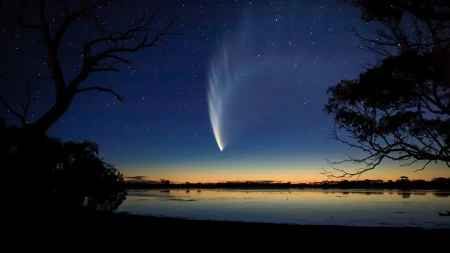
Now, with the end approaching, scientists are feeling the loss even before the spacecraft meets its fiery fate. No future observatory can replace Swift entirely. Some missions are better at certain wavelengths; others have larger mirrors or sharper vision; still others can cover huge swaths of sky. But no other spacecraft combines Swift’s rapid response time, broad wavelength coverage, and long record of reliability. Even during the six-month pause earlier this year, while Swift was being prepared for the possible boost attempt, scientists noticed how much they missed it. Judith Racusin, an astrophysicist at NASA Goddard who worked on Swift in its early years, said that the absence was real. “We’re going to miss out,” she said. “Not just on the common events we have thousands of, but the really rare, unusual ones, which are often the ones we learn the most from.” After the rescue attempt failed, the Swift team decided to wring every last drop of science out of the ailing spacecraft. They turned its instruments back on for a final coda: a short but productive swan song. The team used Swift to make careful technical observations that would help future scientists calibrate and understand all the data it had collected over the years. They used it to study Earth’s atmosphere at unusually low orbital altitudes, a place where most spacecraft cannot operate. They even caught a glimpse of a comet. And, fittingly, Swift was still watching for gamma-ray bursts. In late September, it spotted one that was both distant and incredibly energetic—exactly the kind of event that astronomers will be analyzing for years. Racusin called it “a last hurrah of Swift.” She added, “It’s a burst that we’ll be studying for some time, so I’m really glad we got Swift data on it while we could.” The burst was a final gift, a reminder of the mission’s original reason for existing.
The human story behind Swift is as meaningful as the data it collected. The mission created a community of scientists, engineers, and students who learned how to respond quickly to the changing sky. It trained a generation in the art of rapid astronomy, teaching them to value flexibility and teamwork. It also set a standard for openness. At a time when many missions kept their observations private for months, Swift made its data public right away. That decision, praised by Fong and many others, allowed the entire astronomical community to benefit from Swift’s discoveries and helped inspire other missions to follow suit. Swift’s legacy is visible in the way modern observatories coordinate their efforts: when LIGO or Virgo detects gravitational waves, they do not wait to alert everyone; they immediately send out alerts so telescopes around the world can point at the same patch of sky. Swift helped make that kind of teamwork routine. It showed that the most interesting cosmic discoveries often happen when multiple eyes are looking at the same event from different angles. The mission also proved that a relatively small spacecraft, with a focused scientific goal, can remain relevant for more than two decades if it is well designed and well operated. It survived longer than anyone expected, suffered degradation, lost altitude, and still kept delivering groundbreaking observations. Its resilience is a testament to the engineers who built it and the scientists who guided it through crisis after crisis. Even the final failing—the slow decay of its orbit—became a source of new insight, as the spacecraft was able to sample regions of the atmosphere that were normally out of reach. Swift did not simply rest on its early successes; it kept adapting, kept finding new ways to contribute, and kept making itself useful. That is not a bad definition of a great scientific mission.
When Swift finally burns up, it will leave behind no physical monument. But its legacy will remain in the archives of data it sent back to Earth, in the papers that will continue to be written for years to come, and in the scientists whose careers it helped shape. Every future gamma-ray burst caught by another telescope will be studied, in part, with the knowledge and techniques Swift taught us. Every gravitational-wave event that is traced to a visible source will owe a debt to Swift’s pioneering example. The observatory may have been named after Neil Gehrels, but its true names are countless: the graduate students who turned Swift’s alerts into theses, the engineers who nursed it through every malfunction, the astronomers who stayed up late to watch a new burst unfold, and the casual public readers who followed these discoveries with wonder. Swift was a machine, but it was also a symbol of humanity’s stubborn curiosity. It represented our determination to look at the darkest, most violent corners of the universe and try to understand them. Now it is time to say goodbye. The spacecraft will descend, heat to a blaze of light, and scatter into the upper atmosphere. But the work it did will not disappear. The universe will keep flashing, exploding, colliding, and whispering its secrets, and scientists will keep listening. When the next incomparable burst arrives, they will wish Swift were there. But they will also be ready, because Swift taught them how to catch such moments before they slip away. It was, in every sense, a mission of a lifetime.