


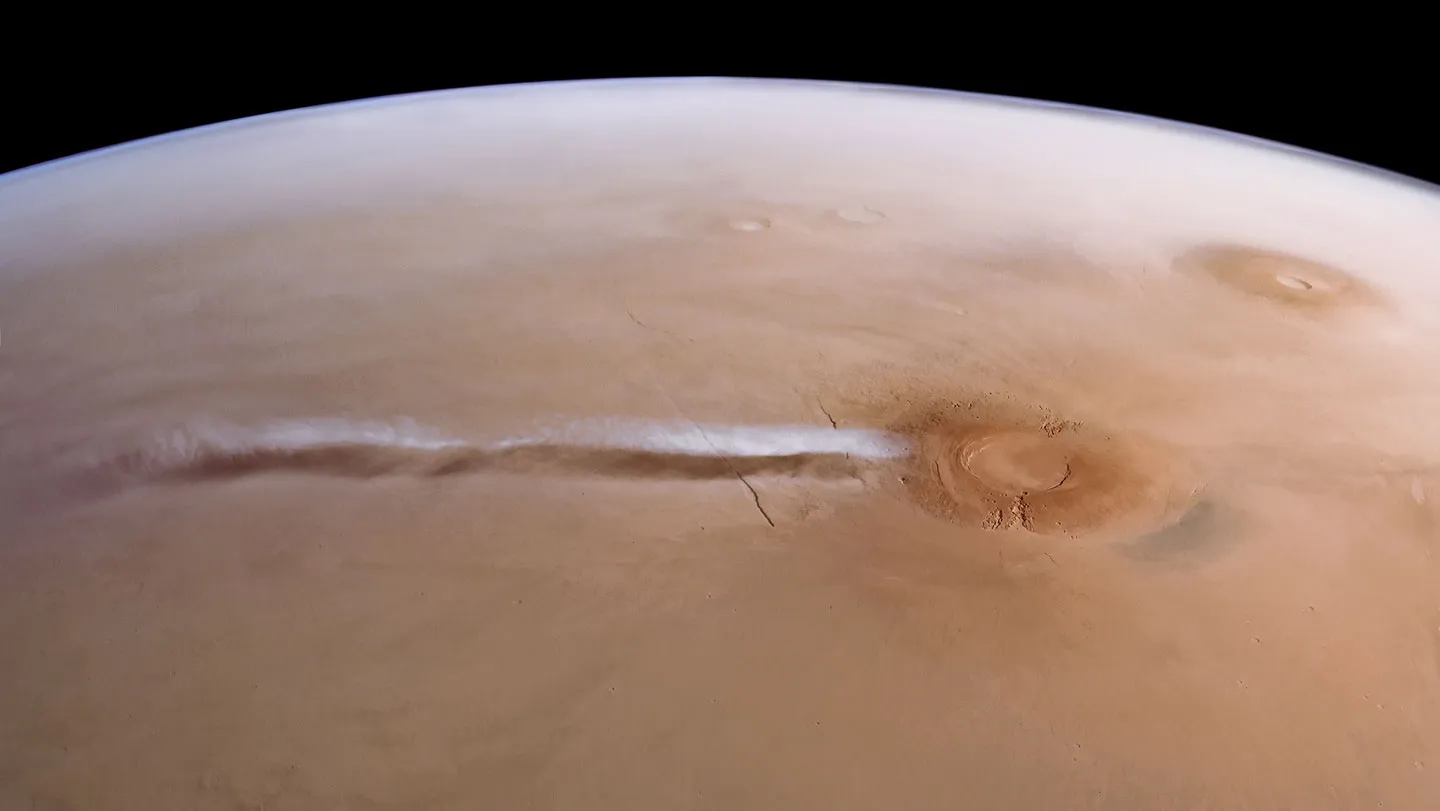
1. Imagine a cloud so enormous that it could swallow four Grand Canyons, laid end to end, and still have room to spare. That is the Arsia Mons Elongated Cloud, a ghostly ribbon of water ice that appears each morning on Mars, clinging to the slopes of a giant volcano. It is not a random occurrence or a fleeting weather event. For several months every Martian year, this wispy plume emerges in the same place, at roughly the same time, and takes on the same striking, stretched-out shape. It hangs about 45 kilometers above the surface, in the thin, frigid upper reaches of the planet’s atmosphere, where clouds have no business being so persistent. For years, scientists have been puzzled by it. How could such a consistent, structured cloud form in a place where the air is so dry and sparse? And how could it form without the usual ingredients? On Earth, clouds are built from tiny floating particles—dust, sea salt, ash, even bits of pollen—that act as seeds. Water vapor condenses onto these particles, forming droplets or ice crystals that grow into visible clouds. Without seeds, most clouds simply cannot form. But on Mars, high above the dusty surface, those seeds are missing. The dust that does exist tends to clump together and fall, leaving the air nearly empty of the particles that cloud formation usually requires. This paradox set the stage for a surprising new explanation, one that overturns assumptions about how clouds can form in nature.
2. The strange case of the Martian cloud has now been studied in detail, and the results were published in Nature Geoscience. A team of researchers, led by planetary physicist Jorge Hernández-Bernal, tried everything they could to explain the cloud using the standard rules of cloud physics. They ran computer models over and over again, incorporating the usual assumptions about dust and water vapor and temperature. The cloud refused to appear. No matter how they adjusted the inputs, they could not reproduce its long, narrow tail or its uncanny daily rhythm. François Forget, an astrophysicist at the Laboratoire de Météorologie Dynamique, or LMD, in Paris, was part of the effort. He and his colleagues were stuck. The cloud was real—satellites had captured it again and again—but the equations that describe cloud formation on Earth simply could not account for it. The obstacle was not a lack of dust across Mars as a whole. The Red Planet is famously dusty, with global storms that sometimes swallow the entire globe. The problem was location. The cloud forms high in the atmosphere, where the air is thin and the gravity easily pulls larger particles down. Any dust that does get lofted up there does not stay long. It sinks, clumps, or gets swept away. Without a steady supply of tiny particles floating in the air, there should be nothing for water vapor to glom onto. At least, that is what old models said. The team had reached an impasse: either the cloud was breaking the rules, or the rules themselves were incomplete.
3. The solution, when it came, was as elegant as it was radical: the cloud may form without any seeds at all. This process, called homogeneous nucleation, is something atmospheric scientists had long considered possible on paper but never expected to find naturally occurring anywhere in the solar system. In ordinary cloud formation, water vapor needs a tiny particle, called a nucleation site, to act as a platform for ice or liquid droplets to grow on. Homogeneous nucleation is different. In extreme conditions, water vapor can condense directly into liquid or ice all by itself, using nothing more than its own molecules. The water molecules cluster together spontaneously, forming stable structures without any foreign material to help. It requires a very special environment—usually an astonishing degree of supersaturation, meaning the air holds far more water vapor than it should be able to at a given temperature. On Mars, that environment may exist right next to Arsia Mons. The model suggests that air flowing over the volcano’s flanks gets pushed upward suddenly, into lower pressure. As the air rises, it expands and cools very quickly. That cooling is so dramatic that the amount of moisture in the air suddenly becomes absurdly excessive—hundreds of thousands of times more than the air can normally hold. At that point, the excess water vapor has nowhere to go but into ice. It spontaneously forms tiny crystals, almost as if the water molecules have decided to organize themselves into a cloud, with no outside help. It is a little like a room so overcrowded that people start stacking themselves into orderly lines just to make room, even without anyone directing them.
4. When the researchers included this unconventional physics in their computer simulations, the mysterious cloud finally appeared. The model was not perfect—it did not match every detail captured by satellites—but it accurately reproduced the cloud’s overall shape, its location, and, crucially, its daily rhythm. In the real observations, the cloud forms every day for months during certain Martian seasons, emerging around the same time and lasting for hours before dissipating. In the simulation, the same thing happened. The key was a patch of cold air that forms repeatedly near the volcano’s slope. Once that cold pocket exists, the process becomes almost self-sustaining. The wind pushes air upward, the air cools, the excess moisture condenses without seeds, and ice crystals form. Then the winds sweep those crystals horizontally, stretching the cloud into a long streamer that spreads across hundreds of kilometers. The study also helps explain why Mars has so few clouds in this region despite having water vapor in the air. Without dust particles to act as seeds, most of the Martian atmosphere remains cloud-free. But in this one special place, the intense cooling created by the volcano is enough to bypass the usual requirements. The volcano acts as a kind of ice-making machine, forcing the air to grow clouds the hard way. For the first time, the formation of the Arsia Mons Elongated Cloud made sense. The research not only solves a Martian mystery but also demonstrates a mechanism that could be at work in other extreme environments throughout the solar system.
5. Scientists not involved in the study were cautious but intrigued. Samuel Atwood, an atmospheric and planetary scientist at the University of Maryland, Baltimore County and NASA Goddard Space Flight Center, noted that homogeneous nucleation is usually treated almost as a theoretical curiosity rather than a real phenomenon. To see it proposed as the driving force behind an actual planetary cloud was surprising. Atwood called the new model “a pretty compelling story,” but he also warned that it is still just one perspective. The cloud can be observed from orbit, but no probe has been able to sample the air directly in the exact place and time where the cloud forms. That means the precise conditions inside the cloud remain inferred rather than measured. The model could be right, but it could also be missing another explanation. Hernández-Bernal himself is not resting on the result. He has said he plans to test alternative explanations, digging deeper into the data and trying to rule out other ways the cloud might form. This is how science works, especially when dealing with a place as distant and hard to visit as Mars. Every model is a hypothesis, a story told with equations. The best stories are the ones that can be tested, refined, and challenged. There are already plans to compare the model’s predictions with more detailed observations from orbiters, and future missions might one day be able to measure the cloud from the inside, if not by landing then by flying through its icy wisps with an atmospheric probe.
6. The implications reach far beyond Mars. Earth has clouds at staggering heights in a layer called the mesosphere, near the edge of space. These noctilucent, or “night-shining,” clouds shimmer after sunset and were long thought to form around tiny particles of meteor smoke—debris from meteors burning up in the atmosphere. But the new Martian study may prompt scientists to reconsider some of those assumptions. A few studies had already suggested that homogeneous nucleation might be able to create these exotic clouds in Earth’s upper atmosphere, but the idea never gained much traction. Now that researchers have proposed homogeneous nucleation as the best explanation for a naturally occurring cloud on another planet, that idea becomes harder to ignore. Hernández-Bernal himself suggested that interest in investigating homogeneous nucleation on Earth might grow in the wake of this discovery. The universe, after all, likes to repeat its tricks. If the same physics that makes clouds on Mars can work in Earth’s mesosphere, then the shared principles of nature become clearer. It is a reminder that even the most familiar features of the sky—clouds—are still full of secrets. What looks like a simple wisp of ice on a distant volcano turns out to challenge ideas that scientists thought were settled. And it shows that sometimes the most extraordinary explanations are the ones hiding in plain sight, waiting for someone to take them seriously. The next time you look up at a cloud drifting across the sky, it might be worth remembering that the same kind of cloud, born in a completely different way, could be forming right now on the slopes of a Martian volcano.